Controversy over new UGC regulations intensifies nationwide protests as the Supreme Court stays their implementation, raising questions over accountability, governance and political motives.
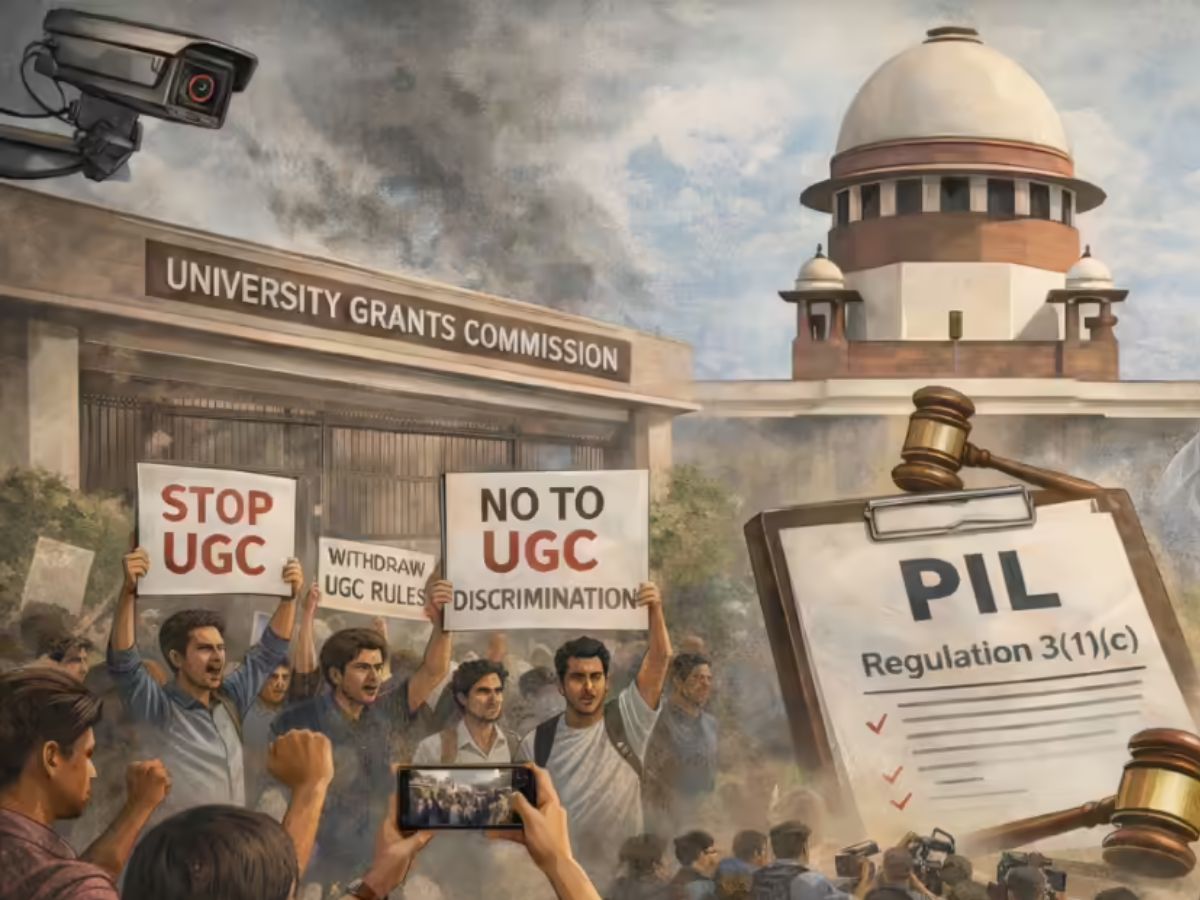
Controversy over new UGC regulations intensifies nationwide protests [Photo: X]
New Delhi: To this author, the new UGC regulations carry the unmistakable smell of a deeprooted domestic and foreign conspiracy—and what appears to be either a mistake or a deliberate error is being exploited for political gain.
First of all, the committee constituted by Parliament under the orders of the Supreme Court—headed by Congress MP Digvijaya Singh—is primarily responsible for this uproar. It seems that the committee, perhaps in a state of utter irresponsibility, signed off without serious deliberation on a report prepared by lawyer Indira Jaising and forwarded it to the Ministry of Education.
It is worth noting that this committee included MPs from all political parties. Today, however, these very parties are continuously fanning protests against the UGC rules for political advantage. Not a single member of the committee recorded any objection to the proposed rules at the time, yet now their parties are fuelling agitation against them.
Even more than the committee’s report, the bigger mistake is of the UGC chairman, Vineet Joshi, and an even greater failure rests with the Human Resource Development Minister, Dharmendra Pradhan. Their negligence gave the UGC— and the government—an opportunity to allow protests against the rules to erupt across the country.
The committee, the UGC, and the Ministry of Human Resource Development have committed an unforgivable mistake, leading to castebased tensions nationwide. Strikes are taking place, shutdowns are being enforced, students are on the streets, caste-based organizations are protesting, and political parties are busy exploiting the situation.
While the government is certainly at fault, its inaction and stunned silence are further intensifying the agitation.
On Thursday, the Supreme Court delivered a very commendable judgement by staying the implementation of the new UGC rules, stating that the old rules would remain in force.
The Court also sought clarifications from the UGC and the government and fixed the next hearing for March 19.
Initially, both sides welcomed this decision wholeheartedly—sweets were even distributed. However, it seems that some political parties quickly realized that they were losing a major opportunity to corner the Narendra Modi government. Despite the Supreme Court’s balanced ruling, they decided to continue the agitation for various reasons.
This author is coming round to believe that foreign “toolkits” have entered this movement. Indian political parties have repeatedly claimed that, as in Bangladesh, Nepal, and Sri Lanka, a Gen-Z-driven movement could also be used to change governments in India. The ill-conceived UGC rules have provided the opposition with an opportunity to launch a nationwide agitation.
At a time when global instability is widespread and India’s influence is rising, any such movement can only obstruct the country’s progress and development.
The government must intervene immediately and bring this agitation to an end. Otherwise, those who have ignited the fire will not allow it to die down. They will continue baking their political bread by destabilizing the government and will see it in their interest to keep the agitation alive. They have nothing to do with the nation; they want power by any means necessary.
The government must demonstrate seriousness and reassure the public that no innocent person from any caste will be falsely implicated, and no guilty person will be spared. First and foremost, Prime Minister Narendra Modi should immediately dismiss UGC chairman Vineet Joshi and Human Resource Development Minister Dharmendra Pradhan, whose negligence has dragged the government into an unnecessary crisis.
Thereafter, a committee comprising representatives of all castes should be formed to suggest mechanisms, ensuring that no innocent person from any caste is victimized and no guilty individual escapes punishment.
The committee’s recommendations must not only appear impartial and selfless but must truly be so.
Protesters should also reflect that once the Supreme Court has stayed the controversial UGC rules, continuing any agitation on this issue until its final resolution is politically motivated and reeks of domestic and foreign conspiracies. National interest must be paramount.
