A short video of a projectile leaving the deck of PNS Tippu Sultan was promoted as visual proof of a new naval deterrent capable of holding Indian aircraft carriers like INS Vikrant at risk far into the Arabian Sea.
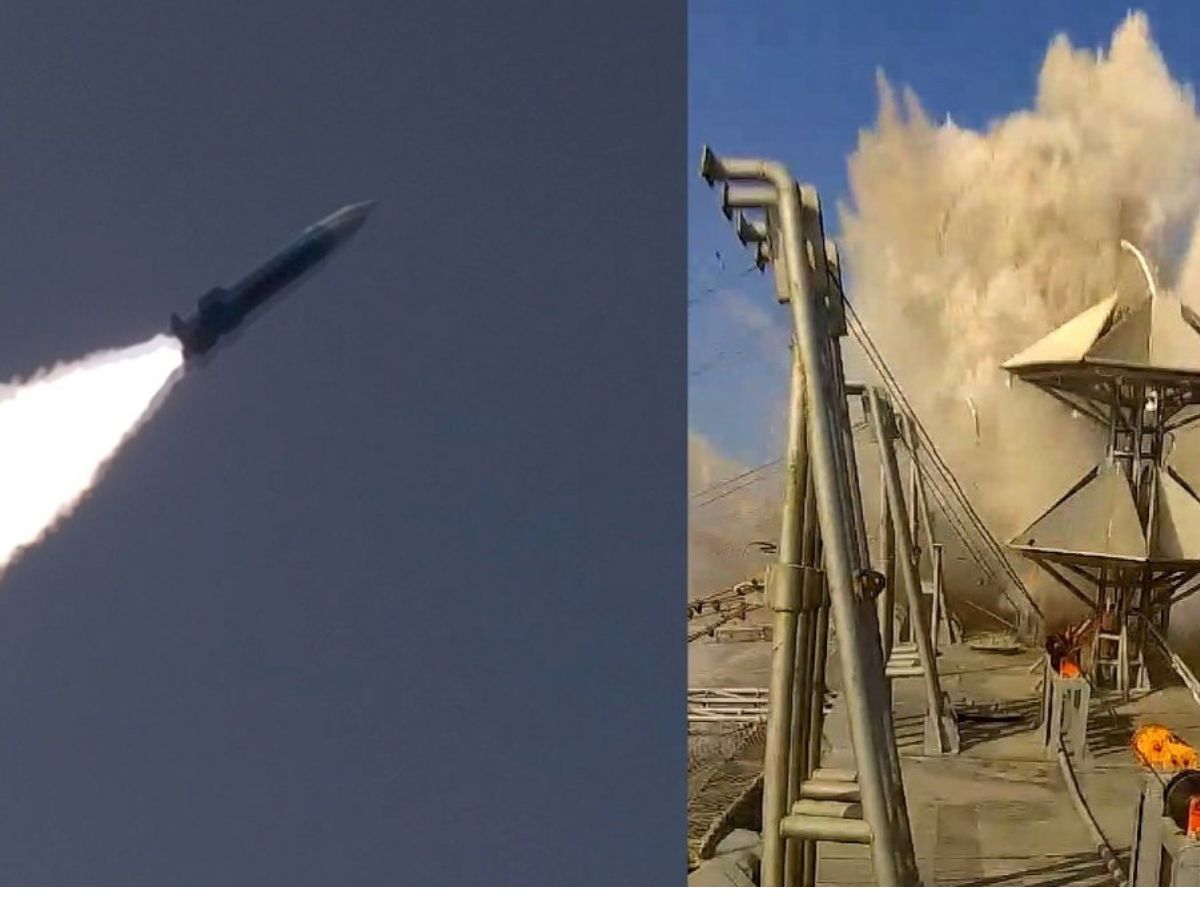
A short video of a projectile leaving the deck of PNS Tippu Sultan was promoted as visual proof of a new naval deterrent capable of holding Indian aircraft carriers like INS Vikrant at risk far into the Arabian Sea. (Image Source: File)
Pakistani social media circles have been celebrating what has been described as a historic naval breakthrough: the maiden launch of a hypersonic, ship-launched anti-ship ballistic missile (ASBM) said to strike targets up to 850 km away. According to these claims, the missile, dubbed “SMASH”, is claimed to have vaulted Pakistan into an elite club of maritime powers alongside China and the United States.
A short video of a projectile leaving the deck of PNS Tippu Sultan was promoted as visual proof of a new naval deterrent capable of holding Indian aircraft carriers like INS Vikrant at risk far into the Arabian Sea.
But a closer examination of Pakistan’s industrial capabilities, the design of the ship used for the firing, the visible characteristics of the launch itself, and the strategic architecture needed to operate a true ASBM paints a very different picture.
Instead of being a hypersonic leap forward, the test appears to be a familiar anti-ship cruise missile firing dressed in exaggerated language for domestic and political effect.
The most tangible evidence, Pakistan Navy’s own footage, is the clearest starting point. Rather than emerging from a vertical launch cell, the missile is seen taking off from an angled deck launcher tilted at roughly 35 to 45 degrees. This is the standard configuration for cruise-missile systems such as Pakistan’s Harbah, and is also consistent with the CM-302 supersonic anti-ship missile.
ASBMs, by contrast, launch vertically. Whether China’s DF-21D or the US Navy’s developmental systems, the ballistic flight profile demands a vertical cannister capable of channelling immense thrust, heat and pressure upwards before the booster ignites fully. No such structure is visible on PNS Tippu Sultan because no such structure exists on that class of ship.
The Type 054A/P frigate class, of which Tippu Sultan is a part, is built around a modest 32-cell HQ-16 vertical launch system intended strictly for cold-launched surface-to-air missiles. Nothing about those cells, or the ship’s internal layout, allows for the extreme temperatures, blast forces or gas-management requirements of a ballistic-missile launch.
To fire even a short-range ballistic projectile from a surface ship, extensive redesign is needed: reinforced hot-launch silos, isolated blast compartments, new ducting, and internal rebalancing of weight. These are structural alterations that cannot be concealed, would necessarily appear in tenders or dockyard imagery, and would have been obvious long before any test.
Pakistan’s defence industry, though often modest in scale, is far from opaque. Large programmes leave a predictable set of footprints. Usually, there are incremental reveal events by ISPR, and long development arcs across missile families like Ababeel or Fatah-II.
“SMASH”, however, emerges from silence. Before reports in late 2024, there were no advertisements seeking guidance specialists, propulsion engineers or systems integrators. No industrial MoUs surfaced. No prototypes were exhibited. No programme lineage can be traced to any known Pakistani missile ecosystem.
A ship-launched ASBM, which is a system infinitely more complex than any missile Pakistan has previously fielded, cannot appear suddenly and without the years of industrial maturation such a project requires.
Even in the extremely unlikely scenario where Pakistan has somehow developed a ballistic missile in total silence, and even if Tippu Sultan were structurally capable of firing it, the system would still be operationally useless without a functional kill chain.
Long-range anti-ship ballistic missiles require a tightly woven surveillance-and-targeting network to detect, track and continuously update the position of a moving vessel. China’s system depends on over-the-horizon radars, Yaogan maritime-surveillance satellites, long-endurance UAVs, electronic-intelligence relays and sophisticated data-fusion nodes.
Pakistan has none of these. It does not operate OTH radars, has no maritime ISR satellite constellation, fields no long-range UAVs capable of persistent oceanic surveillance, and lacks the real-time data links needed to provide mid-course corrections. Without these elements, an ASBM cannot hit anything but the empty sea — a fact the viral celebrations conspicuously fail to mention.
Ballistic missile tests are not private affairs. Their heat signature, trajectory and boost phase are routinely detected by American, Indian, Japanese and European sensors. A genuine hypersonic ballistic launch from the northern Arabian Sea would have generated infrared alerts, OSINT tracking threads, and radar analyses within minutes.
No such signature was reported. No independent assessment confirmed a ballistic trajectory. No external monitoring system picked up a parabolic arc. The silence is consistent with what the video already suggests: a conventional or near-conventional cruise-missile flight, not a ballistic one.
To sum up, there is no credible missile programme behind SMASH, no ship physically capable of launching an ASBM, no kill chain to guide it, no ballistic trajectory observed, and a video that contradicts every central claim. Pakistan did conduct a test — but it was a routine anti-ship cruise-missile launch recast as a revolutionary capability.
Far from altering the strategic balance of the Indian Ocean, the episode illustrates something far more familiar: the gap between Pakistan’s defence messaging and the realities of what its platforms are capable of doing.
(Aritra Banerjee is a defence and security analyst)
