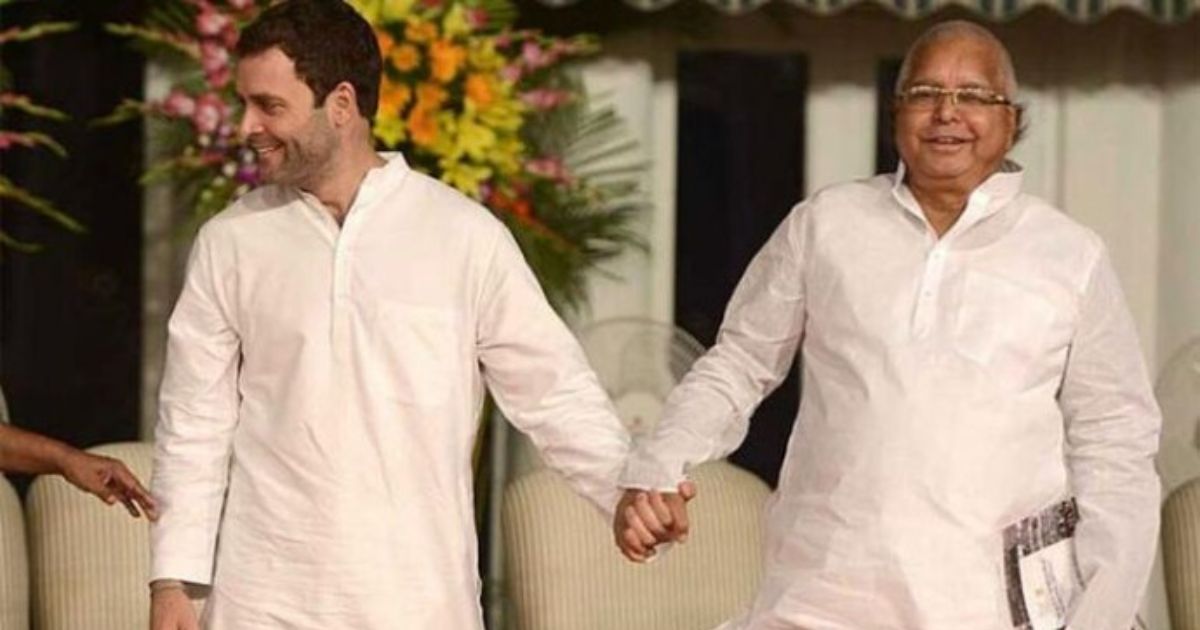
Lalu and Rahul’s ambitions are focused on Raisina Hill’s throne.
New Delhi: Lalu Yadav and Rahul Gandhi share the same goal – to capture the throne of India on Raisina Hill. Lalu Yadav’s autobiography, “From Gopalganj to Raisina”, published in 2019, hinted at this very ambition. The foreword to this book had been sent as early as September 13, 2018, by Sonia Gandhi, chairperson of the Congress Parliamentary Party. At that time, both seemed under the illusion that in the 2019 Lok Sabha elections, Prime Minister Narendra Modi and the BJP would fail to secure a clear majority, and that a Congress-led coalition supported by Lalu would form a government under Rahul Gandhi’s leadership. But like Mungerilal’s rosy dreams, neither 2019 nor 2024 brought this fantasy to life.
In that autobiography, Lalu Prasad Yadav also devoted an entire chapter to his son Tejashwi Yadav, projecting him as his political successor. Now, ahead of the Bihar Assembly elections, Tejashwi Yadav has flown the kite of making Rahul Gandhi the Prime Minister while himself becoming the Chief Minister, using Lalu’s old formula.
On that same formula, Tejashwi Yadav and Rahul Gandhi, along with their parties, are attacking central agencies such as the CBI, ED, and the Election Commission, in order to confuse the public. Their aim is to destroy trust in the electoral system so that, after facing defeat, they can incite dissatisfaction and unrest by other means.
In reality, during the 1990 and 1995 Bihar Assembly elections, the Congress party’s collapse had given Lalu Yadav’s Janata Dal (later renamed Rashtriya Janata Dal after the split) a massive majority, pushing his ambitions to their peak. Lalu began projecting himself as the Prime Minister of a coalition government at the Centre. At his rallies, displaying the strength of his caste and Muslim vote base, Lalu would loudly declare in public gatherings – “No one born of a mother’s womb can stop us from seizing Delhi!”
On the other side, the honest administrator and former cabinet secretary under Rajiv Gandhi, T N Seshan, had been appointed Chief Election Commissioner by P V Narasimha Rao’s Congress government. Seshan was taking all possible strict steps to curb electoral malpractice, as he had done before. Frustrated, Chief Minister Lalu Yadav said before his supporters during his morning durbar – “Seshan is like a mad bull. He doesn’t know that we can tie him with a rope and lock him up in the cattle shed.”
Later, even when Deve Gowda and the Congress ran the central government, the CBI intensified its probe into the fodder scam, and Lalu resorted to outright threats.
Lalu himself admitted this in a 2008 television interview. Recalling a meeting with then Prime Minister H D Deve Gowda at 7 Race Course (the PM’s residence), Lalu said – “I asked him why he was delaying my cases. How can I function in Bihar like this? Then we had a heated exchange, I became very aggressive, and scolded him badly. He started crying and nearly fainted.”
Eventually, due to pressure from Lalu and the Congress, Deve Gowda was removed and Inder Kumar Gujral became Prime Minister. At that time, the CBI was intensifying its investigations. The CBI Director, Joginder Singh, even told journalists like me that due to Lalu’s pressure, Gujral too instructed the CBI to slow down the probe into the Rs 900 crore fodder scam.
This background is a reminder that Rahul Gandhi and Tejashwi Yadav are now running campaigns using the same formula—mounting pressure on investigating agencies and coalition governments. To demonstrate their supposed strength in toppling and creating governments at the Centre, Tamil Nadu Chief Minister M K Stalin was paraded on the streets of Bihar. But the people of Bihar mocked this, asking what votes in their state Stalin could possibly influence.
Not only this, but senior Congress leaders—both in Bihar and nationally—are troubled by the fact that Rahul Gandhi has handed over decision-making to his most trusted southern ally, K C Venugopal. In Tamil Nadu and Karnataka, leaders of the DMK and Congress frequently make anti-Hindi and anti-North Indian statements. Moreover, Rahul’s reliance on Venugopal, Mallikarjun Kharge, and Jairam Ramesh has disturbed Congress veterans of the Indira-Rajiv era, who are now searching for new paths.
To counter Tejashwi and Rahul Gandhi’s campaign, Nitish Kumar’s Janata Dal (United), the Bharatiya Janata Party, and Prashant Kishor’s Jan Suraaj Party are reminding voters of the reign of terror from criminals and mafia during Lalu Yadav’s rule. Concerns are also rising that, spurred by Rahul and Tejashwi’s claims of electoral victory, criminals have already begun acts of murder, theft, and kidnapping in an attempt to discredit the Nitish government.
Abuse hurled at Prime Minister Narendra Modi’s mother, as well as the emotional pitch of the Yadav-Muslim-Christian equation promoted by Lalu and Tejashwi, are stirring sentiments beneath the surface. Attention is also being drawn to Tejashwi’s wife, Stalin, and Sonia Gandhi’s Christian connections.
Meanwhile, Prime Minister Narendra Modi and Home Minister Amit Shah are focusing the BJP-JD(U) alliance’s campaign on the welfare and development schemes of the Nitish government, highlighting efforts to empower women and make them self-reliant.
