
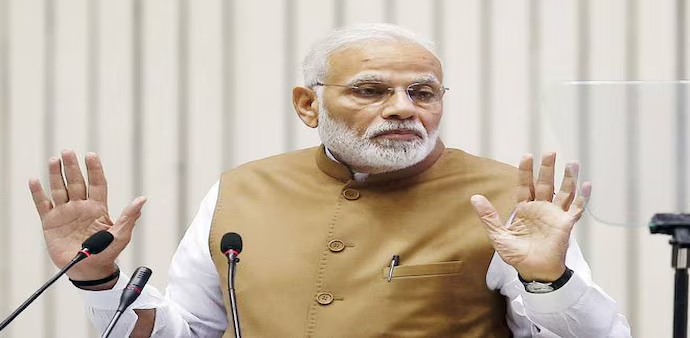
New Delhi: The possibility of a reshuffle in the Union Council of Ministers and changes in the leadership of several BJP-ruled states has been discussed for months.
However, people familiar with discussions within the BJP and official circles say the case for a comprehensive reset is increasingly being driven by concerns that a negative perception of the central government has accumulated over the past six to eight months.
A succession of controversies, governance-related concerns and complaints about the functioning of ministers has created political baggage for the government, according to people familiar with these discussions.
Some of the Prime Minister’s well-wishers believe a limited reshuffle would not be sufficient to address the problem and that a comprehensive exercise involving both the Union Cabinet and chief ministers in some states may be necessary.
The assessment among those advocating a reset is that economic and political concerns have added to the negative perception surrounding the government. Corruption allegations involving chief ministers in BJP-ruled states, media reports about alleged corruption and complaints from party workers about governance in some states have contributed to these concerns. The perceived arrogance of Union ministers has also emerged as a recurring complaint among voters, media representatives and party workers, according to people familiar with the discussions.
The concern is that the problem extends beyond individual controversies. The negative perception surrounding some ministers, their perceived ineptness and complaints about their failure to deliver are no longer confined to the ministries or departments they head.
There is an apprehension that the accumulated negativity could damage the broader public image of Prime Minister Narendra Modi, even when the controversies or governance failures in question are not directly attributable to him.
People advocating a comprehensive reshuffle argue that the Prime Minister’s personal standing has remained a major source of political strength for the BJP through its three consecutive terms in power at the Centre. They fear that the continued association of the government with underperforming ministers, controversies and allegations of corruption could gradually erode that advantage. From this perspective, the proposed exercise is being viewed not merely as an administrative reshuffle but as an attempt to prevent the political liabilities of individual ministers from spilling over into the Prime Minister’s own standing.
The concern is not confined to the ruling party. Opposition leaders have also indicated that they see the BJP and the central government as passing through one of their weakest phases in the past 12 years. According to these leaders, the perception that several ministers are failing to deliver, while responsibility for executing the government’s agenda remains concentrated in the Prime Minister and his immediate team, has encouraged the opposition to intensify its political offensive in recent days.
Opposition leaders have also pointed to what they describe as inadequate engagement by some MPs with their constituents. They argue that elected representatives are not maintaining sufficient contact with voters or responding adequately to local grievances, leaving the Prime Minister and his immediate team to shoulder much of the responsibility for delivering on the government’s commitments.
The opposition’s assessment, according to people familiar with its thinking, is that the gap between the Prime Minister’s public standing and the functioning of parts of his government has become more visible, creating an opportunity to challenge the BJP on multiple fronts.
Those advocating a more extensive exercise are pointing to the BJP’s own experience in Gujarat as an example of a radical response to anti-incumbency. In September 2021, the party replaced the entire state Cabinet following the resignation of then chief minister Vijay Rupani, with Bhupendra Patel taking over and a new ministerial team being sworn in. The party undertook another major Cabinet overhaul in October 2025, when all ministers, except Chief Minister Bhupendra Patel, resigned and a new team was inducted. The two exercises demonstrate the BJP’s willingness to replace a substantial part of its state leadership when it considers a change necessary.
Supporters of a similar approach at the Centre argue that substantial changes in leadership can signal a break from accumulated baggage instead of allowing existing faces to remain associated with controversies and governance concerns.
The same reasoning is being extended to chief ministers in some BJP-ruled states. The question, according to people familiar with the discussions, is not limited to whether an individual chief minister has personally faced allegations of corruption. It also concerns whether the state leadership has been able to address allegations and complaints about corruption within the administration under its watch.
L. Murugan’s move to step down as Minister of State and relinquish his Rajya Sabha membership has added to the speculation. On 13 October, Murugan said he wanted to return to grassroots politics and devote himself to strengthening the BJP in Tamil Nadu ahead of the 2029 Lok Sabha elections.
The scale of the churn is already larger than the Murugan exit suggests. Four members of the Union Council of Ministers have left since June: Ministers of State George Kurian and Ravneet Singh Bittu, who quit after the BJP did not renominate them to the Rajya Sabha, and Education Minister Dharmendra Pradhan, who resigned on 25 July amid the NEET protests.
Four more positions could open up in the coming weeks. Petroleum Minister Hardeep Singh Puri and Minister of State BL Verma were both left out of the BJP’s Rajya Sabha list for Uttar Pradesh, and their current terms end on 25 November. They can legally remain ministers for up to six months without a seat in Parliament, but their continuation is now in question.
Two other Ministers of State, Pankaj Chaudhary and Harsh Malhotra, have also taken charge of the BJP’s Uttar Pradesh and Delhi units, respectively, while continuing to hold ministerial positions. If the party applies a one-person, one-post approach, they too could be relieved of their ministerial responsibilities.
Taken together, as many as eight berths could be vacant or in play, strengthening the case for a wider reshuffle rather than a few stop-gap arrangements.
The period from 21 October to the last week of November could provide a window for a Cabinet expansion or reshuffle. December appears more constrained because the Prime Minister is expected to undertake a multi-country foreign tour, including the G20 summit in Miami on 14-15 December, though that does not rule out an exercise.
The political warning being raised by some observers is that the government risks repeating the experience of the United Progressive Alliance’s second term between 2009 and 2014 if it fails to respond to mounting negative perceptions.
During UPA-II, allegations of corruption, criticism of ministers and complaints about the government’s functioning became central to the political debate.
Those advocating a comprehensive reset for the BJP believe that a similar failure to make substantive changes could leave the government carrying the same political liabilities into the remainder of its term. They argue that the response needs to involve accountability, leadership renewal and a change in the public face of the government, rather than routine portfolio reallocations.
The comparison with UPA-II is therefore being made as a warning that negative perceptions, if left unaddressed, can extend beyond individual ministers and affect the wider leadership.
The immediate question is whether the government will opt for limited adjustments or a more sweeping reset in response to concerns being raised within the party and among its supporters.


