While political controversy and opposition criticism continue to raise questions about electoral process, a majority of respondents still expresses confidence in EVMs.
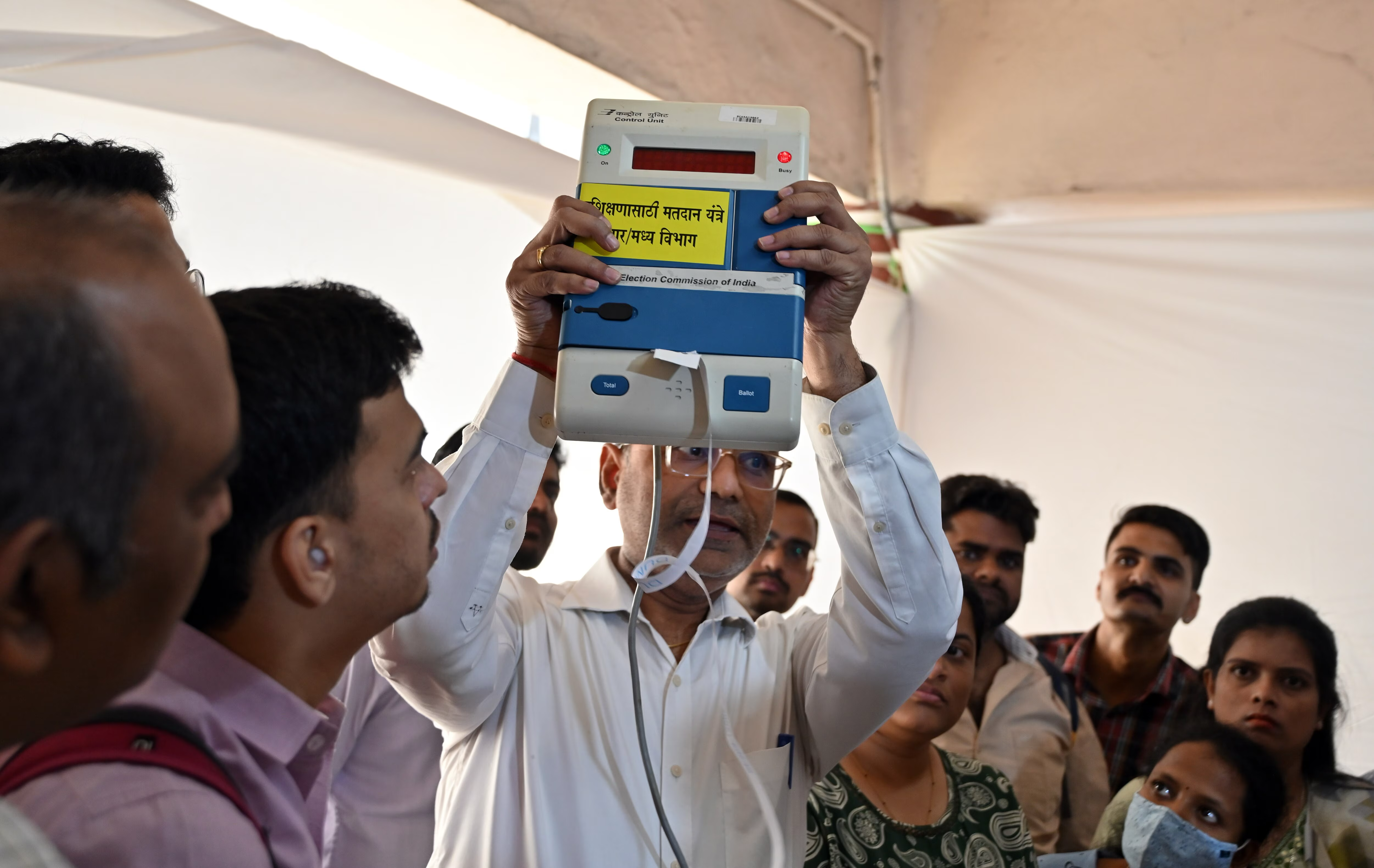
Public opinion survey reveals most voters trust EVMs amid political debates, though a notable minority calls for greater transparency (Photo: File)
NEW DELHI: The Sunday Guardian conducted a detailed public opinion survey between January 7 and January 10, 2026, to assess public confidence in Electronic Voting Machines (EVMs) amid the ongoing political debate surrounding their credibility.
On being asked whether the public trust in EVMs has increased or declined following recent political controversies and surveys, including claims made in Karnataka, 51% of respondents felt that public trust in EVMs is increasing. In contrast, 25% believed that trust is declining. Another 16% said there has been no significant change in trust levels, while 8% said there is no trust in EVMs at all.
The survey, titled "Public Confidence in EVMs," was carried out on a total sample size of 1,014 respondents. Of these, 946 respondents were male, accounting for 93% of the sample, while 68 respondents were female, making up the remaining 7%.
On the question of perception of Congress' repeated allegations regarding EVM manipulation, including in states where the party is either in power or actively contesting elections, 38% of respondents said there is "some truth" in what Congress is alleging. Another 26% felt that Congress is politically losing on the EVM issue and that the narrative is not resonating with voters. Meanwhile, 22% said Congress routinely makes such accusations after electoral defeats, and 14% said they were unable to form an opinion on the matter.
The second question in the survey focused on the Karnataka government's claim that 83% of people trust EVMs, asking respondents whether they agreed with this assertion. A majority endorsed the government's position, with 54% saying they strongly agree with the claim and another 10% saying they somewhat agree. However, 32% of respondents said they disagree with the statement, while 4% said they had no information or awareness to comment on it.
In the third question, respondents were asked whether they believe elections in India are being influenced through EVMs in a manner that benefits the ruling party or the opposition. The responses showed a clear rejection of the idea that EVMs help the ruling dispensation. As many as 57% of respondents said EVMs actually benefit the opposition, while only 5% believed that EVMs favour the ruling party. A significant 36% dismissed such allegations outright, calling them baseless, and 2% said they were unsure or did not know.
The survey then assessed public reaction to Rahul Gandhi and other opposition leaders raising questions over the integrity of EVMs. Half of the respondents, or 50%, said that these allegations are political in nature and that the EVM system itself is functioning properly. Another 25% said the questions raised by opposition leaders are valid and deserve consideration. Meanwhile, 19% felt that while EVMs may not be fundamentally flawed, the system still requires improvements or reforms. The remaining 6% said they had no opinion on the issue.
The fifth question addressed the long-standing debate on whether India should return to ballot paper voting or continue with EVMs. A majority of respondents, 51%, said that EVMs are fine and should continue to be used. At the same time, 34% supported a complete return to ballot paper voting. Another 13% suggested a hybrid approach, advocating the use of both ballot papers and EVMs together, while 2% said it does not matter to them which system is used.
The sixth question examined whether public trust in EVMs has increased or declined following recent political controversies and surveys, including claims made in Karnataka. According to the findings, 51% of respondents felt that public trust in EVMs is increasing. In contrast, 25% believed that trust is declining. Another 16% said there has been no significant change in trust levels, while 8% said there is no trust in EVMs at all.
Finally, the seventh question explored concerns about the technical security of EVMs, specifically whether hacking or tampering is possible. Nearly half of the respondents, 48%, said that EVMs are secure and cannot be easily tampered with. Another 35% felt that hacking is possible but extremely difficult. Meanwhile, 11% admitted to having some apprehension about the system, and 6% said they did not have enough information to comment on the issue.
Taken together, the findings of the Sunday Guardian survey indicate that while political controversy and opposition criticism continue to raise questions about the electoral process, a majority of respondents still express confidence in EVMs and support their continued use. At the same time, a sizable minority remains sceptical or seeks greater transparency and reform, underlining that public trust, though strong, is not unanimous.
