PM Modi's two-day visit to West Bengal showcases development-focused agenda in sharp contrast to Mamata's aggressive temple-building campaign in recent days
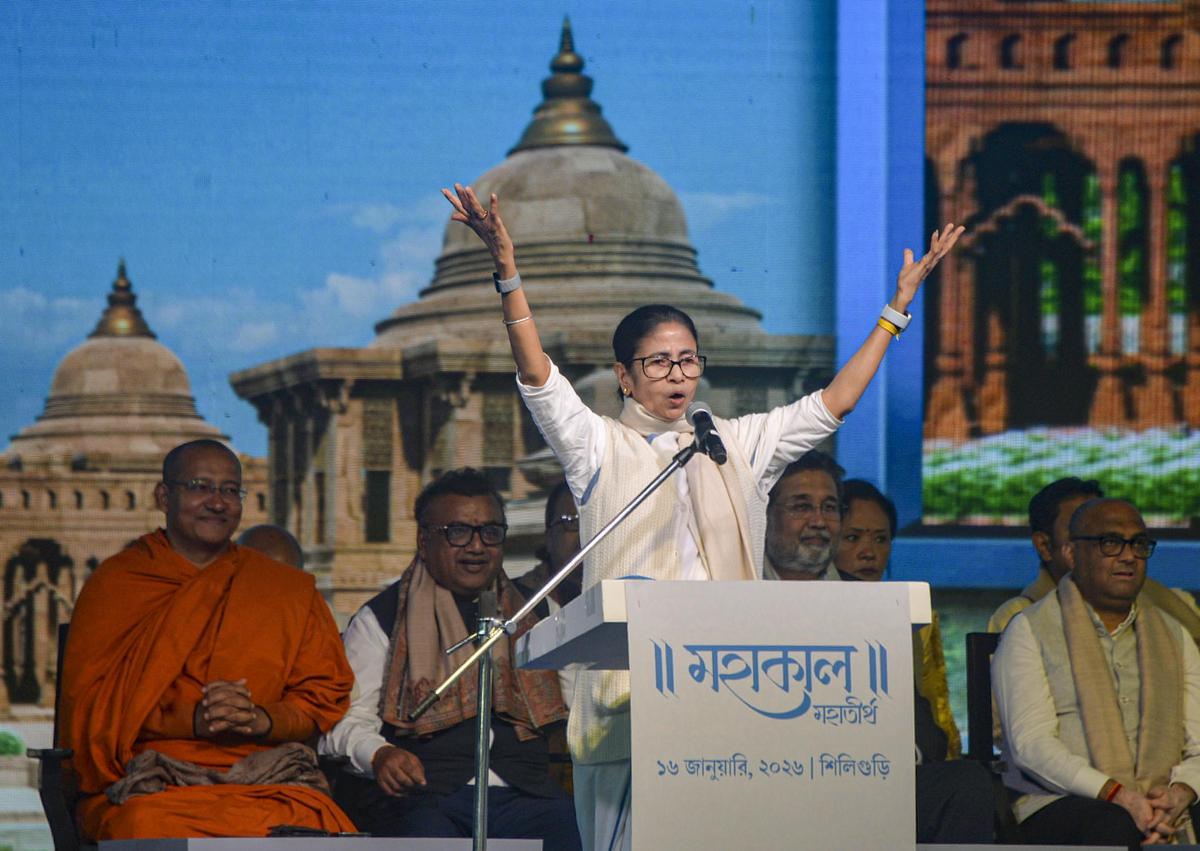
PM Modi inaugurates infrastructure projects in West Bengal, while Mamata Banerjee lays foundation for Mahakal Mandir amid pre-election campaigning (Photo: X)
KOLKATA: As West Bengal braces for crucial Assembly elections in April-May next year, two contrasting political narratives are emerging: Prime Minister Narendra Modi's infrastructure-focussed visit to the state on January 17-18 and Chief Minister Mamata Banerjee's aggressive temple-building campaign, including the recent foundation-laying of the Mahakal Mandir in Siliguri.
On Friday, Banerjee laid the foundation stone for what she announced would be the world's tallest Mahakal idol in North Bengal's Siliguri, a 216-feet high structure including a 108-feet bronze sculpture. Speaking at the ceremony attended by leaders from various religious communities, she positioned the project as a boost to cultural tourism.
The Mahakal Mahatirtha project, to be built on 17 acres of land along National Highway 10, follows Banerjee's earlier temple initiatives: the Rs 250-crore Jagannath Temple at Digha in Purba Medinipur inaugurated in April 2025, and the Durga Angan in New Town, Kolkata, for which she laid the foundation in December. The Durga Angan, spread across 17.28 acres with a project cost of Rs 262 crore, is designed to accommodate one lakh devotees daily.
During her December address at the Durga Angan ceremony, Banerjee framed the project as cultural preservation. "Durga Puja was recognised by UNESCO as an intangible cultural heritage. At the Durga Angan, the culture and spirituality of Bengal will come together," she said, adding, "Thousands of people will come here every day".
The Chief Minister also took a direct swipe at critics. "Many people have said that I am engaging in appeasement, but I am secular and believe in all religions," she had declared, announcing she would build the Gangasagar bridge herself after waiting "in vain" for Central assistance, and would lay the foundation stone for the Mahakal Temple in mid-January.
In stark contrast, Prime Minister Narendra Modi's two-day visit to West Bengal showcased a development-focused agenda. On Saturday, January 17, Modi flagged off India's first Vande Bharat Sleeper Train between Howrah and Guwahati from Malda Town Railway Station, promising to cut travel time by 2.5 hours with airline-like amenities at economical fares.
At a public rally in Malda around 6:45 PM, the Prime Minister dedicated rail and road infrastructure projects worth over Rs 3,250 crore aimed at strengthening connectivity in West Bengal and the Northeast. The projects include the new Balurghat-Hili rail line, freight maintenance facilities at New Jalpaiguri, upgradation of Siliguri Loco Shed, and modernization of Vande Bharat maintenance facilities in Jalpaiguri.
"Today, the campaign to accelerate West Bengal's progress from Malda has gained even more momentum," Modi said. "These projects will make travel easier, simplify trade and business".
The Prime Minister also virtually flagged off four new Amrit Bharat Express trains connecting North Bengal to southern cities: New Jalpaiguri to Nagercoil, New Jalpaiguri to Tiruchirappalli, Alipurduar to Bengaluru, and Alipurduar to Mumbai (Panvel), enhancing affordable long-distance connectivity.
Modi cited recent electoral victories, including the BJP's record win in Mumbai's Brihanmumbai Municipal Corporation. "In every corner of India, there is a Government of good governance under the BJP. Now it's Bengal's turn for good governance," he told the gathering, adding that "India's Gen Z believes in BJP".
On Sunday, January 18, Modi is scheduled to visit Singur in Hooghly district at 3 PM to inaugurate and lay foundation stones for development projects worth around Rs 830 crore. These include the Extended Port Gate System at Balagarh with an Inland Water Transport terminal, a road overbridge, and the Jayrambati-Baropopinathpur-Maynapur new rail line.
Singur holds particular political symbolism as the former site of Tata Motors' Nano plant, which was abandoned following TMC-led protests over land acquisition and the company was forced to shift its plant to Sanand in Gujarat following the direct intervention of the then Gujarat Chief Minister Narendra Modi.
The BJP has been quick to characterize Banerjee's temple initiatives as electoral opportunism. Party leader Dilip Ghosh launched a sharp attack, saying: "Mamata Banerjee is getting a Durga temple built here to woo Hindus and has sent one of her minions to build a Babri Masjid so that she can get Muslim votes. This happens before elections".
BJP's West Bengal in-charge Amit Malviya claimed: "After making a spectacle of the Messieveni, Mamata Banerjee has now turned her gaze to defiling the sanctity of Maa Durga". Opposition leader Suvendu Adhikari argued that Government funds should not be used to construct places of worship, calling it a violation of constitutional principles. "Chief Minister Mamata Banerjee is misusing taxpayer money and disregarding the secular framework outlined in the Constitution," he said.
However, political analysts offer more nuanced interpretations. Political observer Sabyasachi Basu Ray Chaudhury noted that the TMC may be walking a tightrope with its soft Hindutva approach. "Its principal opponent, the BJP, can go all out, whereas the TMC will still have to balance this strategy with the need to maintain its secular image," he said.
Other observers view Banerjee's temple projects as part of an attempt to change the "minority appeasement" tag that the BJP has successfully attached to her government. With Muslims comprising more than 30 percent of West Bengal's electorate, the TMC's traditional strategy has relied heavily on minority consolidation while the BJP has aggressively pursued Hindu vote consolidation. The temple initiatives are seen as a dual approach—consolidating minority votes through welfare schemes while countering the BJP's Hindutva narrative by appropriating Hindu symbols.
Earlier in 2025, Banerjee increased Government grants for Durga Puja committees from Rs 85,000 to Rs 1.10 lakh per organizer, covering 40,000 organizers, while also waiving their taxes and service charges. Political commentator Nirmalya Mukherjee observed: "Mamata still manages to maintain a 10 per cent lead in vote share over the BJP, and this is not a cakewalk for the latter to close".
The Mahakal temple in Siliguri is particularly significant as North Bengal has been a challenging region for the TMC, with the BJP making substantial inroads in recent elections. The symbolic value of religious infrastructure in this region cannot be understated in the electoral calculus.
The contrasting approaches of the two leaders are unmistakable. Modi's focus remains squarely on infrastructure, connectivity, and economic development—laying foundation stones, flagging off trains, and promising logistics efficiency and employment generation. Banerjee's strategy combines religious infrastructure with cultural preservation narratives, attempting to shed the minority appeasement image while maintaining her secular credentials. Her physical presence at religious foundation-laying ceremonies, complete with priests and elaborate rituals, marks a distinct shift from her earlier political positioning.
With Assembly elections just months away, both narratives will be tested at the ballot box. The question remains whether West Bengal's electorate will be swayed more by the promise of development or the pull of religious identity politics—or whether voters will demand both from their leaders. As the campaign intensifies, one thing is clear: the 2026 West Bengal Assembly elections will be fought not just over governance records and development promises, but over competing visions of identity, culture, and the State's political future.
