
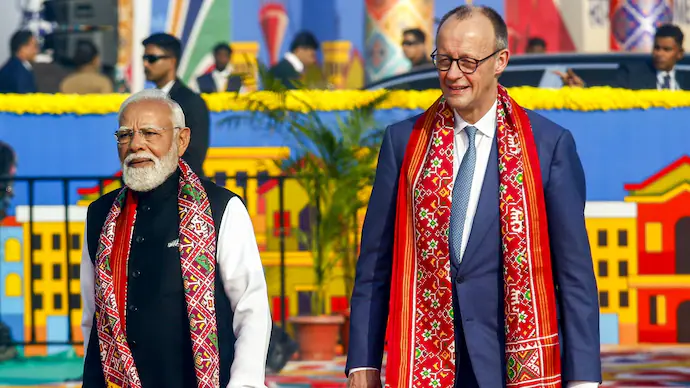
New Delhi: Prime Minister Narendra Modi and German Chancellor Friedrich Merz agreed to significantly deepen cooperation across defence, critical technologies, clean energy and global security during Merz’s first official visit to India on 12–13 January 2026, signalling a sharper strategic alignment between India and Germany.
Merz’s visit, his first to Asia since taking office, came amid expanding India–Germany engagement and ahead of the 25th anniversary of the bilateral Strategic Partnership in 2025 and 75 years of diplomatic relations in 2026. He was accompanied by a high-level delegation of 23 German CEOs and industry leaders, underlining Berlin’s commercial and strategic focus on India.
The two leaders met in Ahmedabad, where they held restricted and delegation-level talks, paid tribute to Mahatma Gandhi at Sabarmati Ashram, participated in the Kite Festival and addressed the India–Germany CEO Forum. Merz also visited Bengaluru, with engagements centred on business and technology collaboration.
Both sides committed to elevating defence and security cooperation, welcoming the outcomes of the High Defence Committee meeting held in November 2025. The leaders endorsed closer military-to-military engagement through joint exercises, training, senior-level exchanges and reciprocal naval port calls. India welcomed Germany’s decision to participate in key Indian military engagements, including Naval Exercise MILAN, the Indian Ocean Naval Symposium conclave in February 2026 and Air Combat Exercise Tarang Shakti later this year. Berlin also announced it would deploy a liaison officer to India’s Information Fusion Centre–Indian Ocean Region.
The two countries signed a Joint Declaration of Intent to develop a Defence Industrial Cooperation Roadmap, aimed at long-term industry partnerships, co-development and co-production of defence platforms. India also welcomed Germany’s efforts to expedite export clearances for defence equipment.
Modi and Merz strongly condemned terrorism and violent extremism in all forms, including cross-border terrorism. They condemned the April 2025 terror attack in Pahalgam, Jammu and Kashmir, and the November 2025 attack in Delhi, and pledged closer cooperation against terrorist entities, including those listed under the UN 1267 sanctions regime.
Bilateral trade in goods and services crossed USD 50 billion in 2024, accounting for over a quarter of India’s trade with the European Union, a trend both leaders said continued through 2025. Modi invited German companies to expand investment in India, while Merz pitched Germany as an attractive destination for Indian firms. Both leaders reiterated support for concluding the India–EU Free Trade Agreement and welcomed the signing of a Joint Declaration of Intent under the German-Indian CEO Forum to boost industry collaboration.
On technology, the two sides agreed to strengthen cooperation in semiconductors, critical minerals, digitalisation, artificial intelligence and Industry 4.0. A new Joint Declaration of Intent on Semiconductor Ecosystem Partnership was signed, and progress was noted on cooperation in critical minerals, telecommunications and digital governance.
The leaders reviewed progress under the India–Germany Green and Sustainable Development Partnership, noting that around 5 billion euros of Germany’s 10 billion euro commitment till 2030 has already been used or earmarked for projects spanning renewable energy, green mobility, urban infrastructure and climate adaptation. They reaffirmed support for a free and open Indo-Pacific, backed United Nations Security Council reforms, reiterated concern over the war in Ukraine, welcomed steps towards ending the Gaza conflict, and called for accelerated global climate action and climate finance.
Modi welcomed Germany’s decision to introduce visa-free transit for Indian passport holders, calling it a step that would further strengthen people-to-people ties. Both sides agreed to expand cooperation in education, skilling, legal mobility and higher education partnerships.




