
Drass: It has been 26 years since the Kargil War was fought between two nuclear-armed neighbours, India and Pakistan. Yet, the memories of the fierce battles and the heroic sacrifices made by Indian soldiers during Operation Vijay remain deeply etched in the nation’s heart.
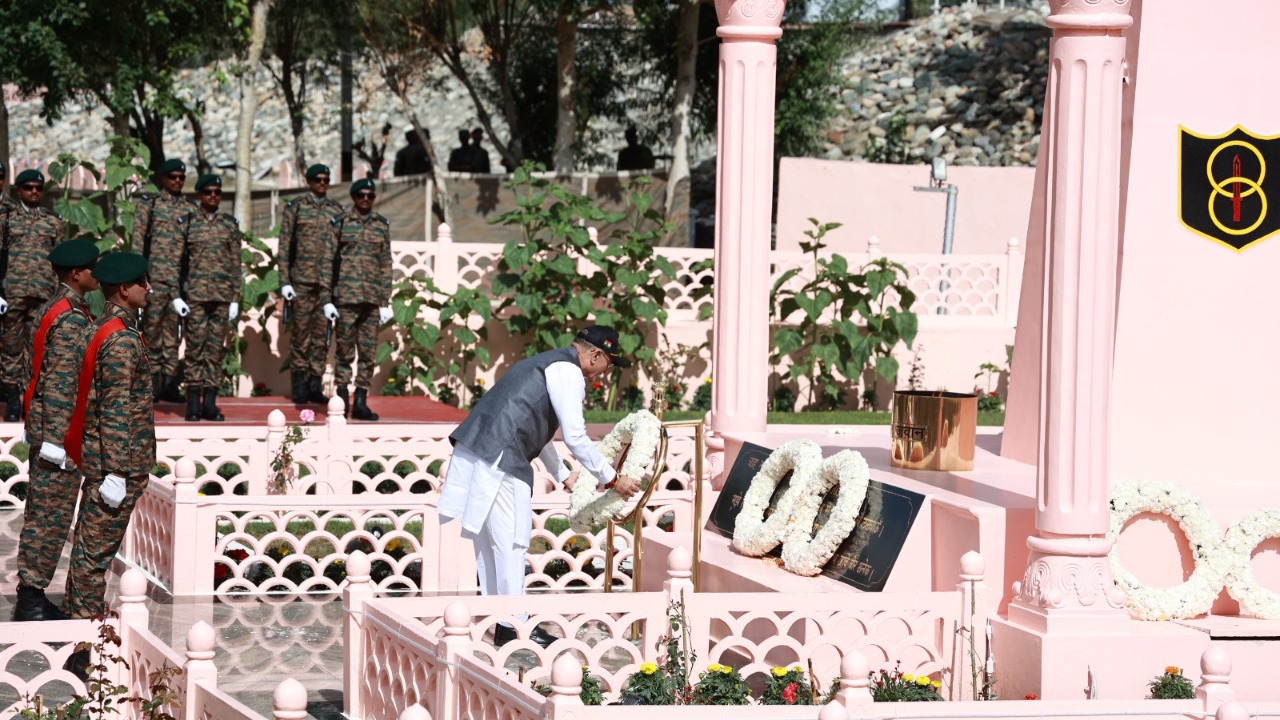
On the occasion of Kargil Vijay Diwas, a solemn yet powerful ceremony was held at Drass in Kargil, where the Indian Army paid rich tributes to the fallen heroes. Families of the martyrs were present, honouring the legacy of their loved ones who laid down their lives for the nation.
We also spoke exclusively to the families of brave soldiers who laid down their lives during the war. Their voices reflect pain, pride, and an unbreakable spirit of patriotism that continues to inspire the nation.
To showcase the evolving strength and preparedness of the Indian Armed Forces, the Army exhibited advanced defence capabilities, including highly sophisticated weaponry, artillery systems, and cutting-edge drone technology.
The ceremony not only paid homage to the courage and sacrifice of the soldiers but also sent a strong message of India’s unwavering commitment to national security and its ever-growing defence capabilities.
Indian Army also put up a spectacular drone display, highlighting the technological advancement and growing strength of India’s defence systems.
The showcased drones were part of Operation Sindoor, during which several terror camps across the border were successfully targeted and destroyed. These unmanned aerial systems demonstrated India’s evolving military capabilities in precision strikes and surveillance.
During the 1999 Kargil War, the Indian Army faced immense challenges while battling Pakistani intrusions and militants in the rugged terrain of Kargil. Despite the odds, Indian soldiers emerged victorious after fierce combat and strategic brilliance.
Over the years, India has focused on strengthening its defence sector with indigenous technologies, modern equipment, and a robust surveillance network. The drone show serves as a testament to India’s preparedness and its ability to meet future threats with confidence and precision.
The event was marked by the presence of senior Army officers, adding to the pride and emotion of the occasion as the nation remembered its heroes who ensured India’s victory in Kargil.
Army showcased two significant wartime captures a Pakistani Army igloo shelter from Tiger Hill and a sentry post from Batra Top, both seized during intense battles in July 1999.
These structures, built to withstand extreme high-altitude conditions, were designed to be portable carried in parts across treacherous terrain, and quickly assembled at remote military posts. The igloo shelter was captured on 8 July 1999 atop Tiger Hill, a strategic position that played a pivotal role in India’s victory. Similarly, the sentry post was recovered from Batra Top on 7 July 1999, where some of the fiercest fighting took place.
Both shelters, now preserved by the Indian Army, serve as tangible evidence of Pakistan’s deep involvement in the Kargil War, contradicting initial denials of military participation.
These captured structures not only highlight the tactical preparedness of the intruders but also underscore the bravery and resolve of Indian soldiers who reclaimed every inch of the nation’s territory under extreme conditions.
We spoke with a former Indian Army Major Tashi Chepal who shared his firsthand account of the Kargil War. He said, “If the ceasefire hadn’t been announced, we were in a position to capture more areas of Pakistan-occupied Kashmir (PoK) and push the enemy further back.
Speaking at the Kargil War Memorial during the 26th Kargil Vijay Diwas, Chief of Army Staff General Upendra Dwivedi paid rich tribute to the brave soldiers who sacrificed their lives in the 1999 war. “This is my fourth visit here, and every time I stand on this ground, it reminds us of the bravery and sacrifice of our soldiers,” he said. He also recalled that Prime Minister Narendra Modi was present at the same site last year.
The COAS noted that India is no longer the same nation it was in 1999. “We are now stronger, faster, and more capable. Our infantry is well-equipped with drones and artillery. We have new commando battalions, and the Indian Army is fully prepared to respond to any threat.”
Referring to recent cross-border action, he confirmed the launch of Operation Sindoor a targeted response after innocent civilians were killed by terrorists in Pahalgam. “We took swift action and destroyed 9 terror camps in Pakistan and PoK. This was not just a message, but a warning.”
General Dwivedi emphasized that the Indian Army has the strength and strategy to counter any enemy, adding, “We are proud of our brave jawans. We have done it before, and we will do it again if needed.




