Mirroring Soren’s strategy in Jharkhand, NDA in Bihar transfers Rs 10,000 to one woman per household under Mukhyamantri Mahila Rojgar Yojana.
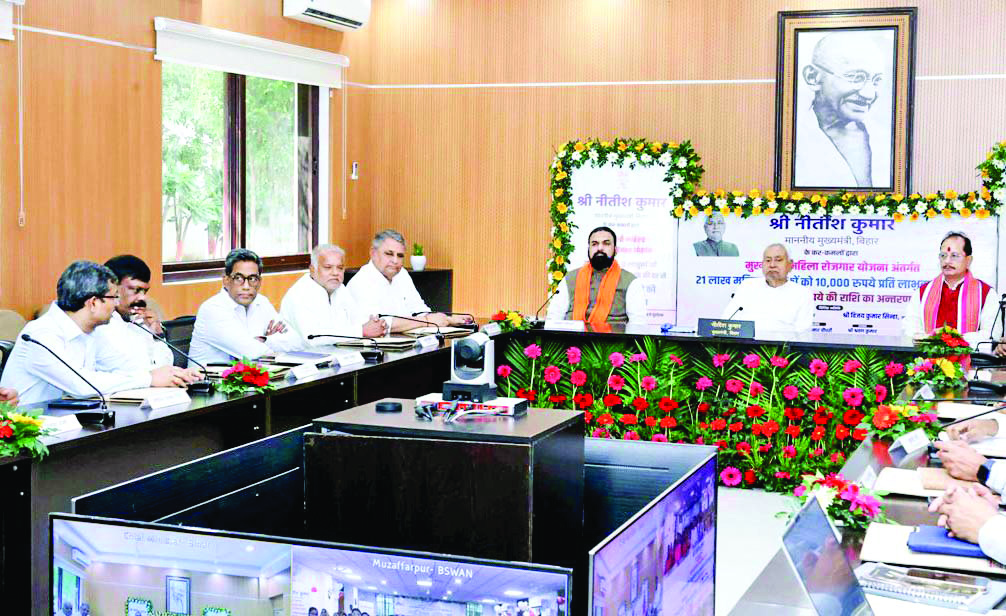
Bihar CM Nitish Kumar transferred an assistance amount of Rs 10,000 to 21 lakh women under the Chief Minister’s Women Employment Scheme, in Patna on October 6 (Photo: ANI)
NEW DELHI: Almost a year ago, the Jharkhand Mukti Morcha led INDIA bloc won the Jharkhand elections by rolling out ex panded welfare programunes and direct cash transfers to poor households. The gamble paid off: the JMM-led alliance secured 56 of 81 seats, with Soren's party alone win ning 34 a decisive victory powered largely by women voters, who turned out at 70.46 percent compared to 65 percent of men.
Now, the opposition bloc is condemn ing the very same strategy this time deployed by Bihar's ruling BJP-backed National Democratic Alliance (NDA). The parallel is striking.
In Jharkhand, Chief Min ister Hemant Soren's gov ernment faced mounting anti-incumbency pressures heading into the November 2024 assembly elections. In the run-up to the election, the government also announced free electricity for upto 125 units monthly and a nearly three-fold increase in pensions from Rs 400 to Rs 1100 for the elderly, widows, and persons with disabilities. The issues included high youth unemployment, crumbling infrastructure, discontent among tribal and rural voters, and gov ernance concerns that had accumulated over years in power. His response was aggressive welfare expan sion, particularly through the Maiya Samman Yojana, which provided cash trans fers to women.
Now, Bihar Chief Minister Nitish Kumar, in power for over two decades, is reading from the same play book. His NDA government launched the Mukhyamantri Mahila Rojgar Yojana in Sep tember, transferring Rs 10,000 to one woman per household. Prime Minister Narendra Modi inaugurated the first tranche on 26 Sep tember, with subsequent transfers continuing through October.
The timing of these mea sures appears aimed at countering voter fatigue after Kumar's two-decade tenure, reinforcing his image as the state's chief provider. The strategy seems to be yielding results the first phase of poll ing on 6 November recorded 64.66 percent turnout, the highest in Bihar's electoral history, driven largely by women voters.
Sources in the Election Commission of India told The Sunday Guardian that trans fers under this scheme do not violate the Model Code of Conduct, as the programme was announced and imple mented well before the poll schedule was declared.
The INDIA bloc led by the Rashtriya Janata Dal (RJD) and Congress has denounced the NDA's wel fare moves as "pre-poll brib ery". RJD MP Manoj Kumar Jha even wrote to the Election Commission on 31 October, protesting the cash transfers. The criticism, however, overlooks an inconvenient fact the same coalition governed Jharkhand using nearly identical tactics less than a year ago. Accord ing to post-poll surveys, the INDIA alliance's Mahila Samman Scheme proved particularly effective there: women showed stronger support for the alliance (45 percent) compared to the BJP (38 percent), and tribal women backed INDIA at 60 percent.
The contradiction under scores how welfare politics has become ideologically flexible in India con demned as corruption when practiced by opponents, but defended as social justice when implemented by allies. Ironically, the INDIA bloc's Bihar manifesto promises its own cash transfer scheme the Mahila Bahumana Yojna offering Rs 2,500 per month (Rs 30,000 annually) to women.
Both cases point to a broader convergence in In dian state politics. Twelve states are set to collectively spend Rs 1.68 lakh crore on unconditional cash transfers to women in 2025-26 up from just two states imple menting such programmes three years ago, according to PRS Legislative Research. Confronted with entrenched or looming anti-incumbency, parties across the ideologi cal spectrum are translating governance into direct eco nomic relief through subsi dies, scholarships, and cash transfers a strategy that transcends party lines even as partisan attacks over it intensify
