Combined strike rate of Narendra Modi, Amit Shah and Nitish Kumar averaged well above 80%, while top MGB campaigners delivered a 15% strike rate.
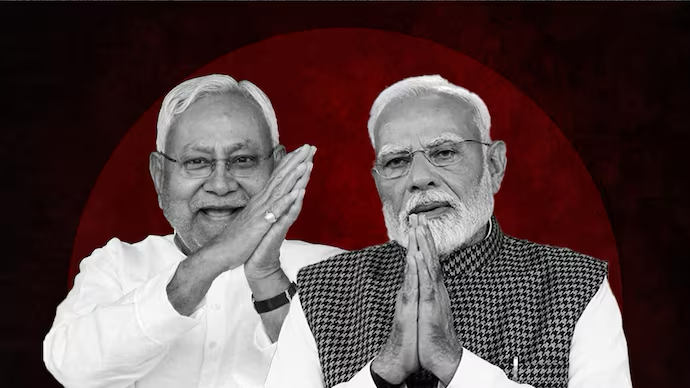
Prime Minister Narendra Modi and Chief Minister Nitish Kumar (Photo: File)
NEW DELHI: The Bihar Assembly Election 2025 has delivered one of the starkest contrasts in campaign effectiveness in recent Indian electoral history, with the NDA's top leadership converting rallies into sweeping victories while the Mahagathbandhan's star campaigners struggled to translate their extensive outreach into seats. The numbers tell a story of clinical execution on one side and a catastrophic collapse on the other.
Prime Minister Narendra Modi's campaign proved to be the most decisive force for the alliance, with the NDA securing 97 of the 122 seats covered by his 16 rallies, delivering a striking 80 percent success rate. Modi campaigned across 16 districts including Purnia, Muzaffarpur, Patna, Begusarai, West Champaran and Sitamarhi, and the alliance bagged 44 new seats compared to 2020 while retaining 49 and losing only seven. District-wise performance showed near total sweeps in several regions, with the NDA winning all seats in Bhojpur, Bhagalpur and Sitamarhi while Muzaffarpur delivered a 90 percent strike rate. West Champaran registered 88 percent, Katihar 85 percent and Nawada 80 percent. Even in politically complex districts like Patna, the alliance secured 11 of 14 seats. In 2020, Modi had addressed 12 rallies covering 110 seats and delivered 67 victories with a 61 percent strike rate, making the leap to 80 percent one of the strongest rally-to-seat conversion ratios ever recorded by the NDA in Bihar.
Union Home Minister Amit Shah emerged as one of the prolific campaigner, delivering 125 victories out of the 141 seats covered by his 28 rallies across 20 districts, registering the highest strike rate among all leaders at 88.6 percent. Shah held rallies in Purnia, Katihar, Supaul, Jamui, Bhagalpur, East and West Champaran, Darbhanga, Sitamarhi, Madhubani, Gopalganj, Vaishali, Samastipur, Nalanda, Lakhisarai, Munger, Patna, Begusarai and Khagaria, with the NDA sweeping entire districts including Supaul, Bhagalpur, Khagaria, Gopalganj and Sitamarhi. The NDA posted exceptionally high strike rates in Katihar at 85 percent, East Champaran at 91 percent, Darbhanga at 100 percent, Madhubani at 90 percent and West Champaran at 88 percent. Compared to 2020 when the NDA had won 93 of these 141 seats, the tally jumped to 125, representing a net gain of 32 seats in areas where Shah campaigned. Shah also held targeted rallies in Alauli, Tarsipur and Lakhisarai for specific candidates, all of whom won their seats. In the 2020 election cycle, the Home Minister did not campaign in Bihar due to testing positive for COVID-19, making his return to full-scale public outreach in 2025 a critical factor in the alliance's sweeping mandate.
Chief Minister Nitish Kumar proved to be the single biggest contributor to the NDA victory, addressing 84 rallies across the state and covering all 243 seats. The NDA won 202 of these constituencies, delivering an 83 percent strike rate that made Nitish's extensive statewide campaign the backbone of the alliance's massive victory. His micro-managed outreach reinforced the narrative of stability and governance, turning several close contests into comfortable wins and providing the organizational muscle that complemented the star power of Modi and Shah.
In stark contrast, the Mahagathbandhan's two tallest faces registered some of their weakest performances in recent years. Congress leader Rahul Gandhi's campaign delivered only 13 wins out of 86 seats covered by his 15 rallies, producing a dismal strike rate of just 15 percent. Rahul campaigned in districts including Kishanganj, Purnia, Banka, Bhagalpur, Araria, Aurangabad, Gaya, Begusarai, Khagaria, Nalanda, Shekhpura, Muzaffarpur and Darbhanga, but in six of these districts the Mahagathbandhan drew a complete blank despite his presence, including Banka, Bhagalpur, Khagaria, Nalanda, Shekhpura and Darbhanga. The numbers represent a steep decline from 2020, when Rahul's smaller campaign of eight rallies had delivered a 30 percent strike rate, suggesting that his appeal has diminished significantly in the state.
RJD leader and Grand Alliance CM candidate Tejashwi Yadav's performance marked perhaps the biggest personal setback of the election. Despite addressing the largest number of rallies among all leaders at 183 and covering the entire state, Tejashwi could deliver only 35 seats for the Mahagathbandhan out of 243 constituencies, producing a strike rate of merely 14 percent. This represents a dramatic fall from 2020, when Tejashwi held 247 rallies and secured 110 seats for the alliance with a 44 percent strike rate, making him the face of the opposition's spirited challenge. The collapse from 44 percent to 14 percent in just five years marks one of the steepest declines for any major regional leader in recent Indian elections, raising serious questions about his ability to convert personal popularity into electoral victories.
The combined strike rate of Modi, Shah and Nitish averaged well above 80 percent, while Rahul and Tejashwi together could barely manage 15 percent, creating a performance gap that proved impossible to bridge. The 44 new seats attributed to Modi's rallies alone played a decisive role in helping the NDA cross the 200-seat mark and secure a commanding mandate. The Mahagathbandhan, meanwhile, must confront the uncomfortable truth that their top campaigners delivered strike rates under 15 percent, among the lowest for any major leaders in Bihar in recent elections, suggesting that their message, strategy and perhaps even their leadership may need a fundamental re-assessment before the next electoral battle.
