
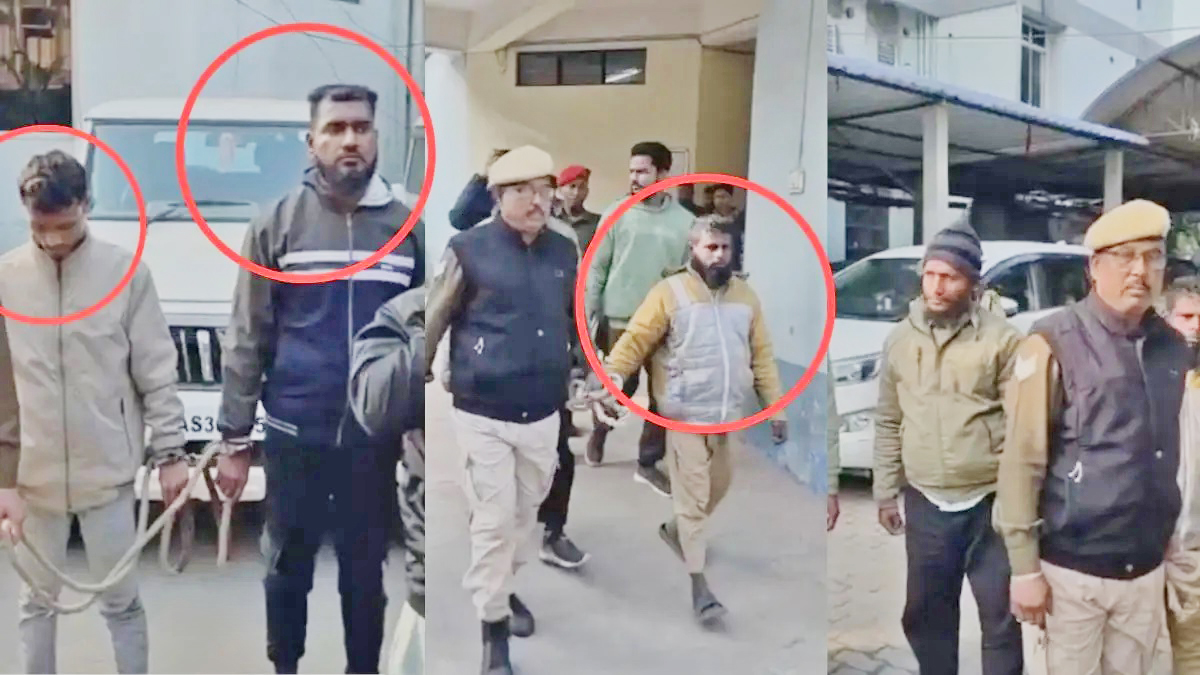
Guwahati: The Indian security and intelligence apparatus has keeping a eye on jihadi activities in Northeast India, with a particular focus on Assam. Based on the analysis of central intelligence agencies, a new module the Imam Mahmuder Kafila (IMK) has been busted by the Assam Police. The Imam Mahmuder Kafila (IMK) is a Bangladesh-based offshoot of Jamaat-ul-Mujahideen Bangladesh (JMB), which is banned in India. IMK was founded in 2018 by Jewel Mahmud, also known as Imam Mahmud Habibullah, and Sohail, an ex-JMB member who claims to be the Amir of IMK and propagates the ideology of ‘Ghazwatul Hind’.
Police sources revealed that following the regime change in Bangladesh in August 2024, senior leaders of JMB, Ansarullah Bangla Team (ABT) and Al-Qaeda in the Indian Subcontinent (AQIS) issued directions to the IMK leadership to activate and expand its Indian modules. Consequently, Bangladeshi nationals Umar and Khalid were assigned to coordinate Assam-based activities. The head of the Assam cell is Nasim Uddin, alias Tamim, of Barpeta Road in Assam.
These activities were coordinated through secure social media platforms. One such group, titled ‘Purva Akash’, functioned as a principal communication and recruitment platform. Individuals based in Assam, West Bengal and Tripura were radicalised, recruited, financially mobilised and connected with the outfit, including persons holding Indian passports, those with prior visits to Bangladesh, and known former members of proscribed terrorist organisations.
Following the change of government in Bangladesh, cadres of JMB, ABT and AQIS were released or emboldened, leading to the revival of their ideological influence and Indian networks, including through IMK-linked platforms. IMK disseminates extremist propaganda advocating violent jihad and the armed conquest of India through digital platforms, including dedicated websites and social media accounts operating under the Ghazwatul Hind banner. It was further disclosed that radical literature authored by IMK leadership, including ‘Sarbobhoumo Khamatar Malik Allah’ and ‘Ghazwatul Hind er Sonkhipto Alochona’, was systematically circulated to indoctrinate cadres and sympathisers through online platforms. In Assam, such extremist content was circulated through an encrypted social media platform titled ‘Purva Akash’.
WHAT IS THE IMK MODULE?
The IMK module employs a systematic process to radicalise and recruit followers. Indian members are first identified through online jihadist channels, fed IMK propaganda in the form of books and lectures, and monitored within secure social media groups. To formally join IMK, recruits are required to take a ‘bayat’ (pledge of allegiance) to Amir Mahmud Habibullah. The procedure requires each recruit to submit personal details and identity proof on a prescribed form, followed by recording and sending a video of their oath to an Indian Zimmedar (responsible cadre). The Indian Zimmedar then forwards the oath video to the Amir in Bangladesh for verification and acceptance. Only after this authenticated ceremony are recruits admitted into the organisation.
This process reportedly led to the radicalisation of several youths in Assam, mainly in Barpeta and Chirang districts, and in West Bengal. IMK also exploits social and religious gatherings. Several clandestine meetings have been held at local mosques since December 2024. At a meeting held on December 28, 2024, in Barpeta, IMK ideologues, including Nasim Uddin and Manirul Islam, allegedly made statements advocating violent armed struggle in India. One such statement reportedly said that “atrocities against Muslims in India must be stopped through armed struggle”. Each meeting typically involved 6-8 local youths, who were indoctrinated and urged to prepare for jihad.
Additionally, some IMK cadres and recruits have already visited Bangladesh on valid passports and visas to meet IMK leadership, while many others were encouraged to travel to Bangladesh, even with their families, for arms training. Notably, at least two Assam operatives Nasim Uddin of Barpeta and Siddik Ali of Barpeta crossed into Meghalaya in April 2025 to rendezvous with Bangladeshi handlers.
IMK operations are funded through a combination of hawala networks and small bank account transactions. Recruits and local supporters contributed cash donations, which were pooled by cadre Nasim Uddin alias Tamim in Assam. Funds collected, both in cash and through his bank accounts, were routinely transferred to Bangladesh via hawala channels. Multiple bank accounts were used for funding; several Indian operatives also used UPI platforms to transfer money. In total, lakhs of rupees were systematically remitted from Assam and Tripura to Bangladesh to support extremist training and logistics. Those involved in collecting and transferring funds, including Mustafizur Rahman, Siddik Ali, Abdur Rahman and others, are considered complicit in terrorism financing.
According to security officials, the IMK module maintains active links with handlers in Bangladesh. Following political developments in Bangladesh in 2024 and the release of IMK’s Amir from custody, recruitment and mobilisation activities intensified. Investigations revealed that IMK propagated extremist ideology, including calls for migration (Hijrat) to Bangladesh and armed struggle against India. Security agencies also found that several Assam based IMK associates travelled to Bangladesh in 2025 using valid Indian passports and visas to undergo training and attend meetings with the outfit’s leadership. Video oaths of allegiance by Indian recruits were allegedly sent to handlers in Bangladesh. Investigators further noted that extremist literature and materials related to weapons and bomb making circulated in Assam matched content previously recovered in IMK-linked cases in Bangladesh.
Based on these inputs, STF teams conducted raids on the intervening night of December 29-30, 2025, across Barpeta, Chirang, Baksa and Darrang districts of Assam, as well as Agartala in Tripura, leading to the arrest of 11 individuals.
THOSE ARRESTED INCLUDE:
- Nasim Uddin Najimuddin Tamim (24), Barpeta
- Junab Ali (38), Chirang
- Afrahim Hussain (24), Darrang
- Mizanur Rahman (46), Barpeta
- Sultan Mehmud (40), Barpeta
- Md Siddique Ali (46), Barpeta
- Rasidul Aalam (28), Baksa
- Mahibul Khan (25), Baksa
- Sharuk Hussain (22), Barpeta
- Md Dilbar Razak (26), Barpeta
- Jagir Miah (33), West Tripura
What is ‘chicken Neck’?
Increasing comments about taking over the Seven Sisters have been made by political leaders in Bangladesh. Further, these comments have intensified following the anti-India protests in the country.
Speaking to TSG, Rajiv Bhattacharya, noted insurgency expert and author, said the current political churn in Bangladesh has serious implications for India’s Northeast, particularly in terms of infiltration and long-term security risks. He pointed out that anti-India and fundamentalist elements have always existed in Bangladesh but remained subdued earlier due to political constraints. With regime change and the rise of hardline forces, these elements have re-emerged, creating uncertainty along India’s eastern borders. Bhattacharya warned that while large-scale permanent settlement of illegal immigrants in Assam has reduced in recent years, the Northeast is being used as a transit corridor for undocumented migrants moving to other parts of India.
He stressed that Assam’s real challenge is no longer sudden infiltration alone but a gradual, organised process of demographic and social pressure, which he termed a “Rohingya-model threat” which could destabilise the region without conventional violence. According to him, instability in Bangladesh, especially if hardline Islamist forces gain power, could trigger minority persecution, leading to fresh migration pressures that would directly affect border states. Bhattacharya cautioned that unless eviction drives, border management, and internal enforcement are pursued consistently and over the long term, the Northeast could face a far deeper crisis by mid-century, one that would be far more difficult to manage than traditional insurgency.




