
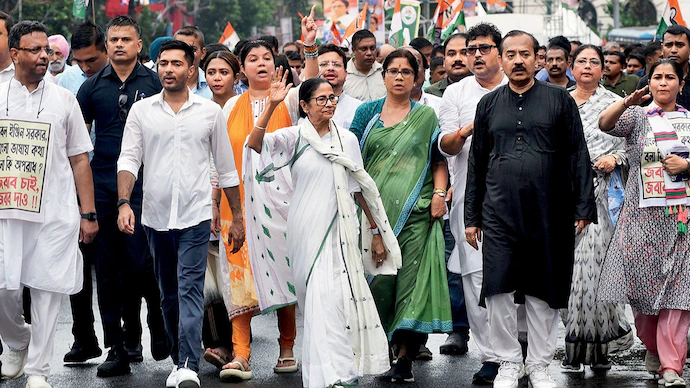
NEW DELHI: West Bengal appears set for an unusual multi-corner Assembly election, a development that could significantly disrupt the state’s long-standing electoral pattern, which for the most part has been defined by bipolar contests.
For decades, the state’s political arena was dominated by a Congress–Left confrontation. With the rise of the Trinamool Congress (TMC), the contest gradually shifted to one between the TMC and the Left. In more recent years, however, West Bengal politics has largely settled into a direct face-off between the TMC and the Bharatiya Janata Party (BJP). The current electoral scenario, however, suggests a clear departure from this familiar pattern.
The emergence of Humayun Kabir’s Janata Unnayan Party (JNP) has injected a fresh variable into the electoral equation. Kabir has announced plans for the JNP to contest close to 180 Assembly seats, a move that has the potential to influence results across large parts of the state. Simultaneously, the Congress–Left alliance is seeking to regain lost ground, even as the two principal adversaries—the TMC and the BJP—gear up for yet another high-stakes showdown.
Among all the players, the BJP is perceived to be the most keen on leveraging a fragmented electoral contest. Having secured a vote share in the range of 32–34 per cent in recent elections, BJP strategists believe that a multi-corner battle could tilt the balance in their favour if the opposition vote, particularly that of the TMC, is divided. Party leaders are optimistic that the entry of the JNP and the renewed Congress–Left alliance will erode the TMC’s traditional voter base.
Kabir has made it clear that the JNP intends to concentrate largely on Muslim-dominated constituencies. He is reportedly in talks to explore possible alignments with the Indian Secular Front (ISF) led by Abbas Siddiqui and the All India Majlis-e-Ittehadul Muslimeen (AIMIM) headed by Asaduddin Owaisi, although neither the AIMIM nor the ISF has formally declared its position so far.
If such an alignment take shape, it could present a formidable challenge to Chief Minister Mamata Banerjee and her party, the TMC. Owaisi is believed to command influence in districts such as Malda, North Dinajpur and South Dinajpur, which border the Seemanchalregion, while Siddiqui’s ISF enjoys considerable support in parts of South Bengal—areas traditionally regarded as TMC strongholds. In the previous panchayat elections, the ISF won nearly 400 seats in these regions. Kabir, meanwhile, hails from Murshidabad, a district where recent political and social mobilisation, including developments linked to the Babri Masjid foundation ceremony, has had a discernible impact.
A political analyst closely monitoring political developments in West Bengal told The Sunday Guardian that if Kabir manages to split the Muslim vote, the consequences could be “disastrous” for the TMC. The party derives a substantial share of its support from the Muslim community, which constitutes roughly 27–30 per cent of the state’s population. The analyst further noted that several anti-Trinamool parties seem to be quietly extending support to Kabir’s initiative.
Significantly, both the Congress and the Left have adopted a relatively flexible and accommodating stance in the evolving situation. There are indications that Kabir could be open to seat-sharing arrangements, including with parties such as the CPI(M), adding further complexity to an already intricate electoral calculus.
Muslims account for nearly 30 per cent of West Bengal’s population and play a decisive role in close to 100 Assembly constituencies. For decades, this community has been central to shaping the political direction of the state. With multiple political players now competing for influence over this crucial vote bank, the forthcoming Assembly elections are shaping up to be among the most unpredictable and closely watched contests in West Bengal’s recent political history.




