Parties are divided, some support social justice measures, while others fear alienating upper-caste communities.
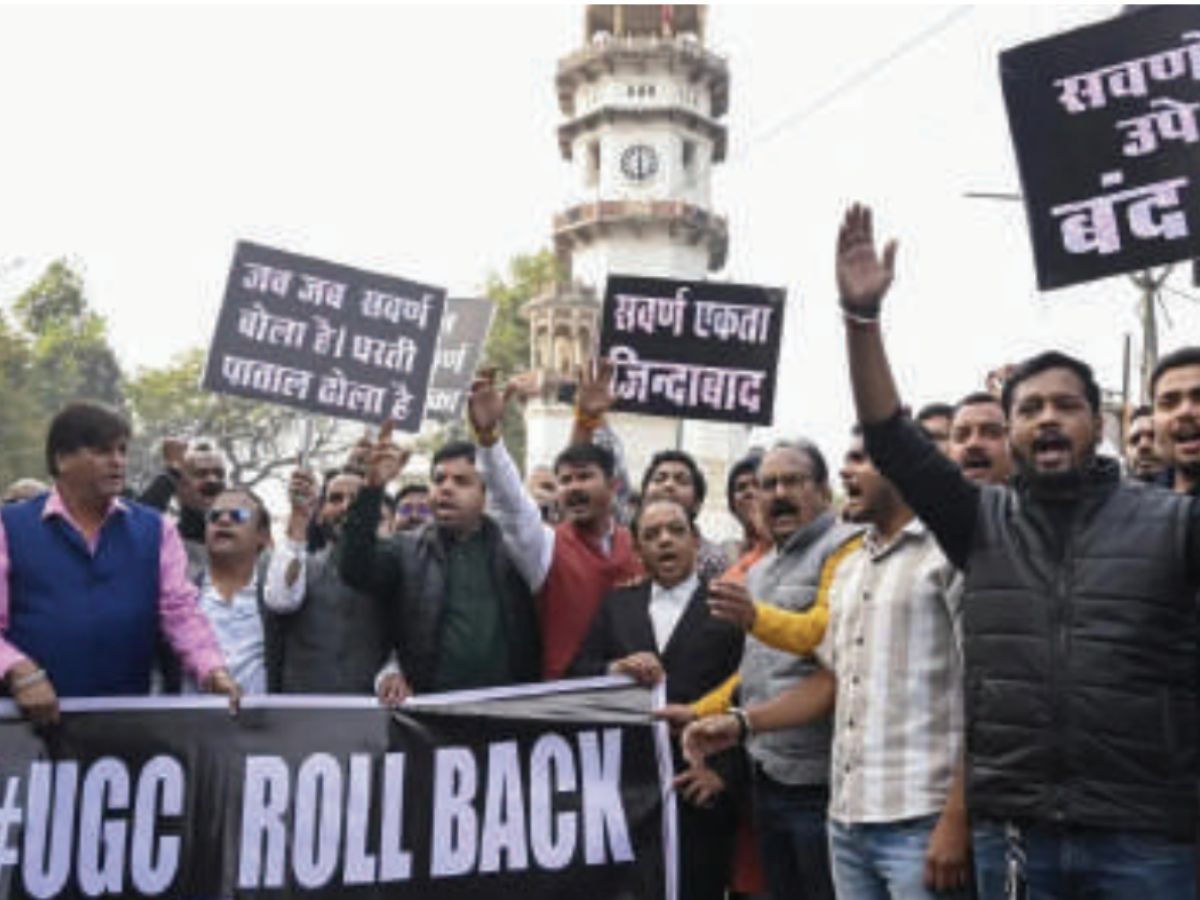
People hold placards during a protest against the University Grants Commission’s recently notified “Promotion of Equity in Higher Education Institutions Regulations, 2026.
New Delhi: The Supreme Court has stayed the University Grants Commission’s (UGC) guidelines on maintaining equality in higher education institutions and has sought a response from the government. These guidelines, however, have stirred debate in political circles. Leaders from various parties, when approached, appeared hesitant to comment, likely to avoid displeasing their top leadership. What emerged from these conversations is a shared concern: no party wants to alienate the country’s approximately 30% upper-caste population and risk losing a crucial segment of its political base.
Samajwadi Party MP Rajiv Rai from Uttar Pradesh stated that, according to their national president Akhilesh Yadav, no guilty person should go unpunished, and no one should face injustice. SP members emphasise their commitment to social justice and establishing a fair society. He added that the government should ensure that no section of society feels insecure or misled, and that the Supreme Court and government must act responsibly. “Their intentions are flawed. Caste is a reality in this country,” he said.
Reports suggest that the Parliamentary Standing Committee on Education, chaired by Congress leader Digvijay Singh, has given approval to these guidelines. However, senior Congress leader Pramod Tiwari told us that the government’s job is to extinguish fires wherever they erupt. “The BJP government is one that incites conflict in the name of class, caste, and religion.
The Supreme Court recognised this and issued a stay order to extinguish the fire. But this government does not function according to the Constitution. To divert attention from inflation and unemployment, it is thirsty for the blood of the youth,” he said.
Meanwhile, Hanuman Beniwal, Rashtriya Loktantrik Party MP from Rajasthan, spoke on the UGC guidelines and the Supreme Court stay. “I haven’t heard who approached the Supreme Court or the full debate, but I have demanded a government response to prevent campus conflict. Reservation for SC/STs has existed since the Mandal Commission in 1990, and many castes have been included in the state lists over time. For example, in Rajasthan and Delhi, the Jat community is categorized as OBC, while in other states it is not. The UGC has not implemented this to favour any caste. Complaints within colleges are increasing, and the UGC’s measure is appropriate.
The average first-year student does not come here for caste politics. If they face atrocities, abuse, or ragging, it is the government’s responsibility to protect them. We are not against anyone, but there should be no irritation caused in the name of OBCs,” Beniwal said. He added that the government must clarify whether it was aware of the UGC guidelines, whether officials were asleep on the matter, or whether IAS officers were making these decisions.
Beniwal further noted that India is a democratic country where all castes live freely. “I demanded reservation for the upper castes in Rajasthan in 2016, 2017, and 2018. Brahmins, Baniyas, Rajputs, and Kayasthas should receive reservations based on economic conditions. Furthermore, no one has the right to engage in hooliganism within campuses. SCs, STs, and OBCs should receive rights as granted by the Constitution.”
Regarding the UGC guideline, BSP supremo Mayawati tweeted on X: “The new rules implemented by the University Grants Commission (UGC) to prevent caste-based incidents in government and private universities across the country have created an atmosphere of social tension. In light of the current situation, the Supreme Court’s decision to ban the new UGC rule is appropriate. This situation would not have created such social tension if the UGC had consulted all stakeholders before implementing the rule and ensured proper representation for upper-caste communities in the investigation committee, in line with natural justice.”
SP MP Ziaur Rahman Barq said that he is a member of the Parliamentary Education Standing Committee but has yet to receive a copy of the guidelines or attend any meeting regarding them.
On the other hand, senior BJP leader Laxmikant Vajpayee stated that, while the matter is sub judice, there is no need for comment. “The Supreme Court will consider any comments during the hearing and decide accordingly,” he said.
Meanwhile, Upendra Kushwaha, head of the Rashtriya Lok Morcha, an NDA constituent and Rajya Sabha MP, justified the UGC guidelines, advising the central government to explain them properly to the public, assuring that people will understand.
Azad Samaj Party MP Chandra Shekhar Azad said there is no need for protests, as incidents of atrocities are increasing in colleges.
He pointed out that the guidelines cover all students, including SC, ST, OBC, and EBC communities. “Regarding representation, there is currently only one SC, one ST, and five OBC vice chancellors across the country, so you can imagine the situation,” he added.
