
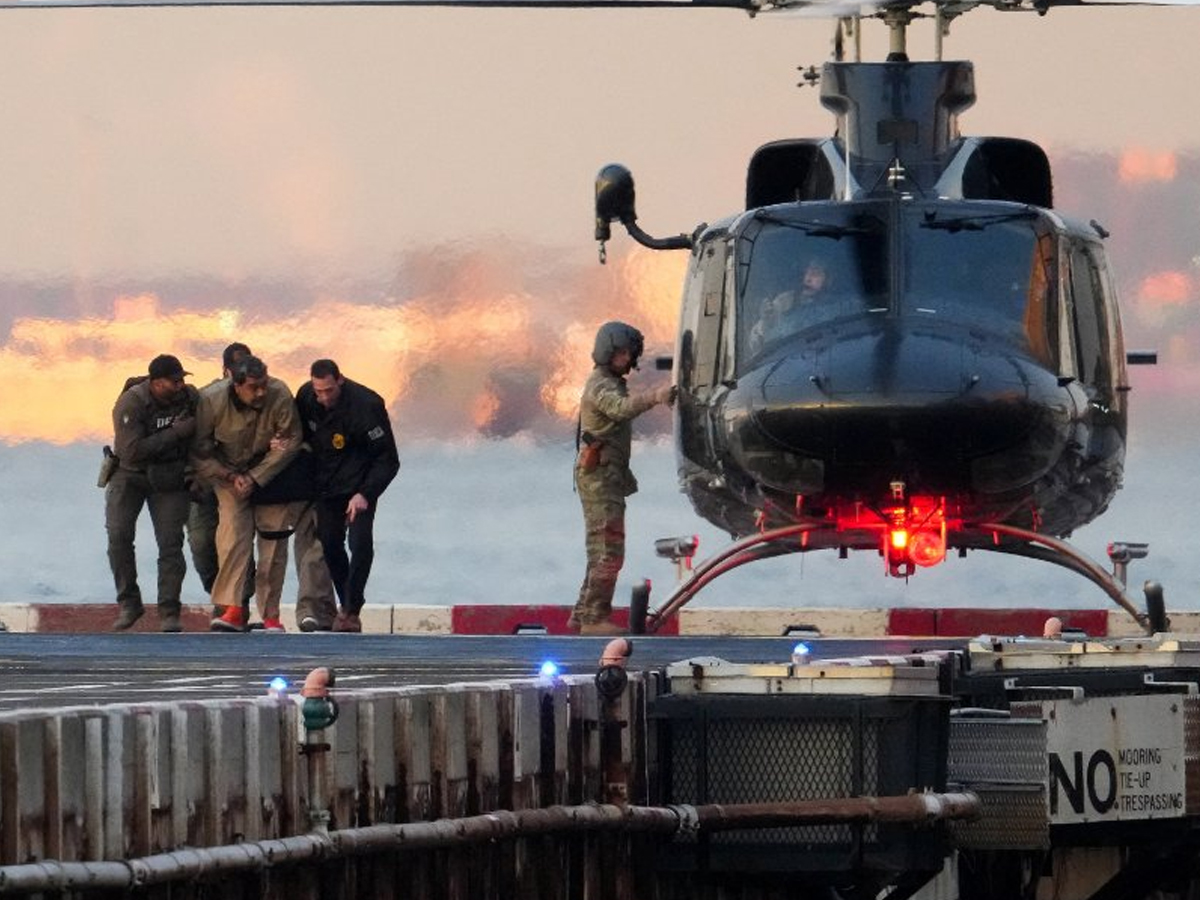
A dramatic new chapter began for Venezuela on Monday as ousted president Nicolás Maduro arrived at a federal courthouse in New York. His court appearance followed a high-risk U.S. military operation that removed him from power and triggered sharp global reactions.
As Maduro faces legal proceedings in the United States, Venezuela moves forward under interim leadership amid warnings of further conflict.
Maduro Brought to New York for High-Security Court Appearance
Nicolás Maduro reached a federal courthouse in Manhattan under heavy security. Authorities sealed off several blocks around the building. Police placed metal barricades along Worth Street. Officers patrolled the area in marked vehicles.
The security buildup reflected concerns over protests and unrest. Maduro’s appearance marks the first time a sitting Venezuelan president has faced U.S. criminal charges on American soil. The case has drawn global attention and raised questions about sovereignty and international law.
BREAKING: Nicolás Maduro surrounded by heavy security as he is transported to New York City court ahead of his arraignment. pic.twitter.com/2EqrMrNKxe
— Fox News (@FoxNews) January 5, 2026
Maduro remains in U.S. custody. Legal experts expect the case to move quickly due to its political sensitivity.
Who Is Running Venezuela Now? Delcy Rodríguez Takes Charge
Venezuela’s Supreme Court named Delcy Rodríguez as interim president over the weekend. She is expected to be officially sworn in shortly.
Rodríguez had earlier pledged loyalty to Maduro. She condemned his capture as an “atrocity.” However, her tone shifted on Sunday. She called for a “balanced and respectful” relationship with the United States.
The U.S. warned it may consider fresh military action if the new government fails to meet its demands. Rodríguez now faces pressure at home and abroad as she tries to stabilize the country.
Why the US Operation Sparked Global Outrage
Several major countries strongly criticized the U.S. military action in Venezuela. China issued a sharp response. China said it is “deeply shocked and strongly condemns the use of force by the US against a sovereign country and the use of force against the president of a country”.
Russia also reacted strongly. Its foreign ministry described the operation as “an act of armed aggression against Venezuela” that is “deeply concerning and condemnable”. Russia added, “In the current situation, it is important, first and foremost, to prevent further escalation and to focus on finding a way out of the situation through dialogue.”
Latin America Warns of Dangerous Precedent
Brazil’s President Luiz Inacio Lula da Silva delivered one of the strongest regional responses.
“The bombings on Venezuelan territory and the capture of its president cross an unacceptable line. These acts represent a grave affront to Venezuela’s sovereignty and yet another extremely dangerous precedent for the entire international community.”
Latin American leaders fear the operation could destabilize the region. Many worry it may normalize foreign military interventions under political pretexts.
What Comes Next for Venezuela and the US
Maduro’s legal case could stretch for months. Meanwhile, Venezuela faces economic strain, political uncertainty, and rising diplomatic pressure. The new interim government must balance U.S. demands with domestic stability. Any misstep could trigger further confrontation.
As Maduro stands before a U.S. judge, Venezuela stands at a crossroads. The coming days may shape not only its future but also global norms around power, sovereignty, and intervention.




