
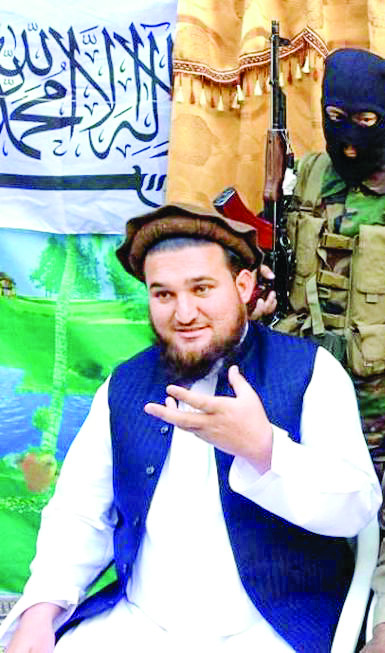
New Delhi: With reports of Pakistan military-backed terror groups carrying out operations in the Bal Abhinandan Mishraochistan region, The Sunday Guardian spoke to Ehsanullah Ehsan, former senior Tehreek-e-Taliban Pakistan commander who has also served as the organization’s spokesperson in the past. Based on what he found through his extensive and widespread network in the restive region, Ehsan returned with responses to queries shared by this newspaper.
He said the Pakistani military is using Lashkar-e-Taiba under the ISKP banner to serve multiple strategic purposes: easing pressure on regular forces by outsourcing operations in Balochistan, exerting pressure on the Afghan government, projecting LeT as a pro-state group to build public acceptance, and suppressing Baloch independence movements to safeguard Chinese investments.
Edited excerpts
Q. Has the Pakistani military shifted to using proxies in Balochistan?
A. Indeed. The Pakistani military has adopted a deliberate policy of activating its proxies in Balochistan after failing to counter the Baloch nationalist movements through direct military means. The strategy now is to confront them via proxy groups.
In recent days, ISKP has formally declared war on Baloch nationalist movements, despite there being no significant history of direct hostility between the two. This declaration is essentially aimed at proving ISKP’s loyalty to Pakistani agencies. Over the past three to four years, Pakistan’s intelligence apparatus has provided ISKP with established bases and safe havens in Balochistan, alongside financial and logistical support, and then deployed them to serve its interests in both Balochistan and Afghanistan.
From the outset, there has been a strong ideological and sectarian alignment between LeT and ISKP, as both subscribe to the Ahl-e-Hadith school of thought. In fact, roughly 70 per cent of ISKP’s original composition consisted of LeT fighters. Now that ISKP has shifted its operational focus to Balochistan, Pakistani agencies have been exploiting this compatibility to accelerate the integration of LeT militants into ISKP—a process advancing rapidly in the province.
Q. How would you characterise the relationship between LeT and the Pakistani state?
A. Lashkar-e-Taiba is not merely a cooperative partner; it is essentially the Pakistani military’s “B team” and most favoured proxy. The state has withstood considerable international pressure to protect it. It is important to note that LeT was created by Pakistani institutions themselves. For its creators, deploying this asset—wherever and whenever required—is done without hesitation.
Its deployment in Balochistan gained pace after ISKP’s retreat from Afghanistan and the establishment of its bases in Balochistan. Initially, this integration process took place covertly, but reports of such activities are now surfacing publicly.
Q. Did LeT have any prior footprint in Balochistan before this?
A. No. Historically, LeT was deployed in Kashmir. Its move into Balochistan began only after the initiation of what can be called “Project ISKP.” Before that, LeT had no operational presence in the province.
Q. What objectives does the Pakistani military seek to achieve by launching LeT in Balochistan?
A. Several. Firstly, the military is under pressure across the country and is engaged on multiple fronts. Deploying LeT allows them to counter opponents in Balochistan, relieve their regular forces, and at the same time provide employment to otherwise idle militants. Secondly, by using LeT under the ISKP banner, they can exert pressure on Afghanistan’s current government. Thirdly, it helps portray LeT as “loyal to the state,” generating public sympathy and paving the way for the group’s social normalisation.
Another important objective is to keep pro-independence movements in Balochistan occupied, thereby securing Chinese investments in the region.
Q. Where was LeT active before being redirected to Balochistan?
A. Previously, LeT operated in Pakistan’s border regions with Afghanistan, such as Dir, Buner, and certain tribal areas, as well as in Afghanistan’s Kunar province—where it later re-emerged under the ISKP banner. That presence no longer exists; the Islamic Emirate of Afghanistan has eliminated it from Kunar entirely. While some cells remain in parts of Khyber Pakhtunkhwa, most fighters have now been relocated to either Balochistan or Kashmir after receiving a green signal from state institutions. Going forward, they are expected to operate in Balochistan under the ISKP name and in Kashmir under the label of “freedom fighters.”
Q. You describe ISKP as essentially LeT under a new name. Can you elaborate?
A. As I noted earlier, ISKP is effectively the rebranded and restructured form of Lashkar-e-Taiba. The integration has been deliberate, drawing on shared ideology, overlapping networks, and direct state facilitation.




