Pakistan’s unregistered dhows fuel smuggling, narcotics trade and migrant movement as weak oversight and corruption turn the Makran coast into a trafficking hub.
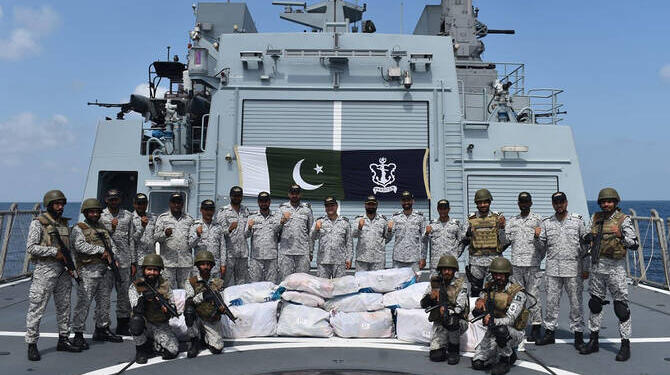
Unregistered Pakistani dhows linked to smuggling networks move through the Arabian Sea without tracking or valid documentation (Photo: File)
Across the busy shipping lanes of the Arabian Sea, a parallel maritime world moves almost invisibly. Hundreds of Pakistani wooden dhows—unregistered, untracked and often carrying fraudulent paperwork—sail through international waters without Automatic Identification System transponders. They function with recycled fishing licences or none at all. What appears at first glance to be a loose collection of rogue vessels is in fact the product of a deeper institutional collapse in Pakistan’s maritime governance, one that feeds fuel smuggling, narcotics trafficking, and unchecked human movement across the region.
Pakistan’s vessel registration system is fractured at every major point of responsibility.
The Mercantile Marine Department, which should maintain a single, verifiable registry of fishing vessels under the Pakistan Merchant Shipping Ordinance 2001, instead operates a fragmented database riddled with gaps. Sindh and Balochistan’s fisheries departments maintain their own parallel systems. The result is a patchwork of overlapping jurisdictions and contradictory records—conditions that trafficking networks exploit with ease.
Government documents admit that more than 2,000 fishing vessels in Balochistan operate without formal registration. Enforcement officers believe the real figure is far higher. They estimate that nearly 20,000 fibreglass speedboats, many brought in from Iran, work under temporary documentation or none whatsoever.
This environment has given rise to “paper vessels”—boats that exist solely in the ledgers of local authorities, bearing no link to the real craft moving at sea. The widespread recycling of fishing licences makes the situation even murkier. Expired, revoked or surplus licences circulate through informal markets, sold and resold to boat owners seeking superficial legitimacy. With provincial and federal authorities issuing licences simultaneously, there is no effective system to verify which vessel is tied to which document.
In 2020, Islamabad announced that a Vessel Monitoring System would soon cover its fishing fleet. The promise never materialised.
Despite repeated ministerial statements about low-cost tracking solutions, Pakistan still lacks a functional, centralised monitoring network for vessels operating either in coastal waters or the high seas. By 2022, maritime authorities openly admitted that no operational tracking system existed. The gap is stark when compared with India, which requires AIS transponders on all fishing vessels over 20 metres.
This is not merely a technological lag. It reflects institutional inertia and persistent failures in procurement. Year after year, funds earmarked for maritime surveillance equipment evaporate into administrative processes that deliver no measurable capacity. Pakistan has a coastline of 1,050 kilometres, yet its agencies rely on ageing patrol craft, outdated radar stations and communications systems that have not kept pace with regional security requirements.
These failures have created a permissive environment along the Makran coast—one of the busiest illicit maritime corridors in the region.
The same dhows moving millions of litres of subsidised Iranian diesel daily also transport high-value narcotics and carry irregular migrants across the Indian Ocean. Combined Maritime Forces interdictions repeatedly link “stateless dhows” carrying large narcotic consignments to departure points near Jiwani, Gwadar and Pasni.
The numbers are staggering. In October 2025, interdictions uncovered Pakistani-origin dhows transporting narcotics worth nearly one billion US dollars. These vessels typically sailed without AIS signals, without national markings and without any traceable documentation—yet they originated from the same Makran belt where fuel smugglers and human trafficking networks openly operate.
Research by the Global Initiative Against Transnational Organized Crime shows that dhows leaving this region often transport mixed cargoes: Iranian diesel, crystal methamphetamine, fishing gear, and undocumented migrants. The dhow’s traditional appearance and its legitimacy as a fishing vessel provide perfect cover for concealed consignments.
Pakistan’s maritime failures are not simply the result of inadequate budgets. Corruption holds the system together.
The Balochistan Fisheries Department has weathered several corruption scandals, with officials suspended for enabling illegal fishing and misusing departmental funds. The Maritime Anti-Corruption Network has identified Pakistan’s maritime sector as suffering from low integrity and chronically weak monitoring.
The corruption goes beyond individual bribes. Investigations have revealed networks involving customs agents, provincial officials, and maritime security personnel who provide advance notice of enforcement movements. These protection arrangements—which keep fuel smuggling networks functioning—extend equally to narcotics routes and migrant smuggling operations.
Pakistan’s ghost fleet is the visible manifestation of a maritime governance system that has shifted from dysfunction to informal facilitation. The absence of credible registration, the circulation of recycled licences, and the sheer scale of unregistered vessels are not administrative oversights—they are pillars of a system that allows traffickers to operate with predictable impunity.
Dhows intercepted with massive narcotics loads are regularly classified as “stateless”, yet they originate from well-known Pakistani departure points. This contradiction highlights Islamabad’s reliance on plausible deniability rather than a serious maritime enforcement strategy.
Until Pakistan builds a unified vessel registry, deploys credible tracking systems and confronts entrenched corruption across its maritime institutions, the Indian Ocean’s ghost fleet will continue to function as a central artery for transnational crime—not because it cannot be stopped, but because the system benefits from its continued existence.
(Aritra Banerjee is a columnist specialising in Defence, Strategic Affairs, and Indo-Pacific geopolitics. He is the co-author of The Indian Navy @75: Reminiscing the Voyage. Having spent his formative years in the United States before returning to India, he brings a global outlook and first-hand insight to his reporting from foreign assignments and internal security environments such as Kashmir. He holds a Master’s in International Relations, Security & Strategy from O.P. Jindal Global University, a Bachelor’s in Mass Media from the University of Mumbai, and Professional Education in Strategic Communications from King’s College London (King’s Institute for Applied Security Studies).
