
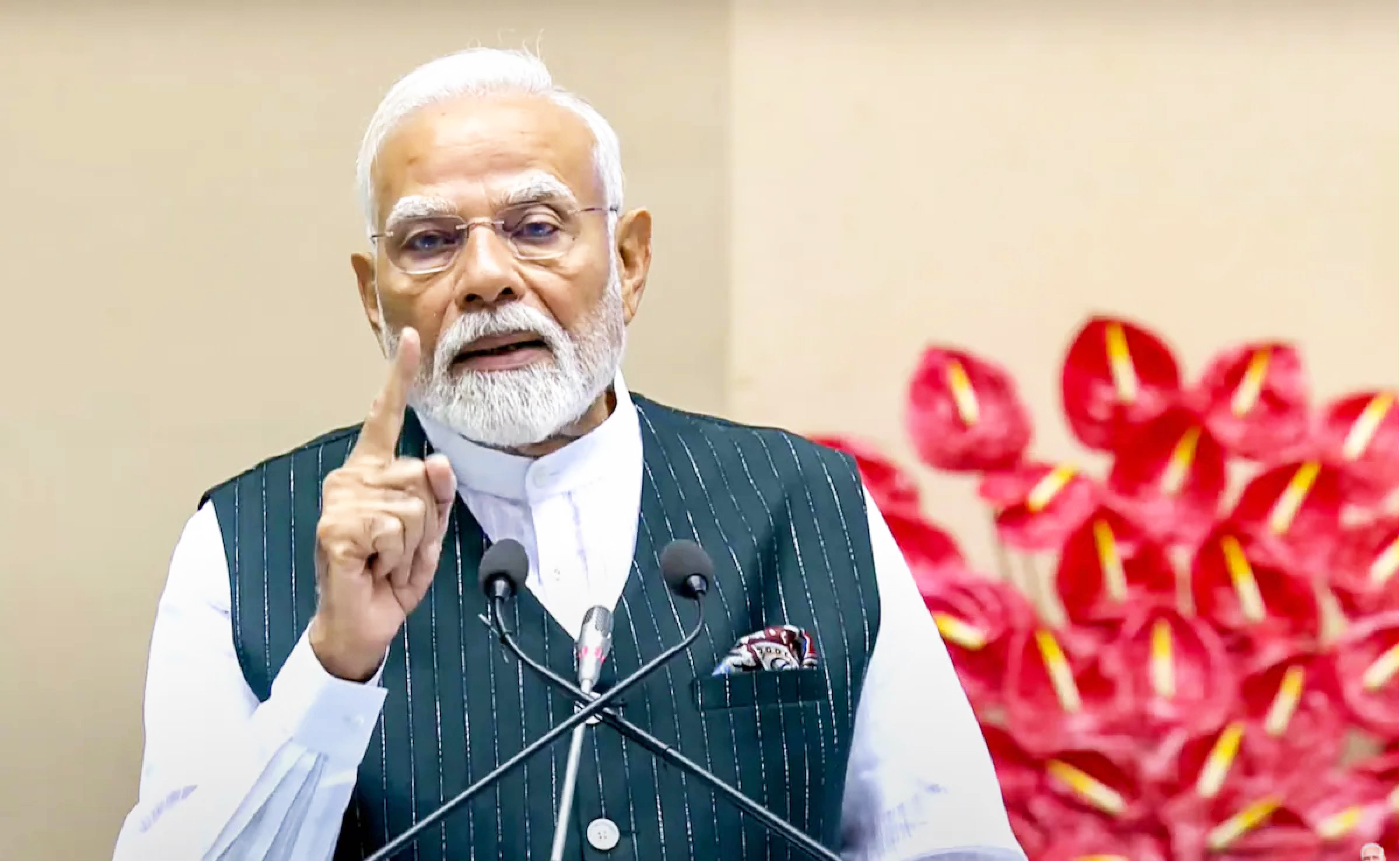
PM Modi slams Bengal’s governance, promises development and unity ahead of 2026 Assembly elections.
Kolkata: Laying the groundwork for the BJP’s Bengal push in the 2026 Assembly elections, Prime Minister Narendra Modi on Friday launched a blistering attack on the Mamata Banerjee-led Trinamool Congress Government, accusing it of jeopardising Bengal’s identity, fostering infiltration for vote-bank politics, and creating an environment hostile to investment and employment. The PM alleged that the TMC’s rule was marked by “lies, lawlessness and loot.”
Addressing a massive public rally at the Paribartan Sankalpa Sabha in Durgapur, once an industrial hub, he stressed the BJP’s resolve to usher in development as an antidote to what he called the misgovernance of the Mamata Banerjee regime.
He recalled Bengal’s past as an industrial and employment hub and contrasted it with the present state of affairs under the TMC Government.
“People used to come here from across India for employment. But today, the youth of Bengal are forced to migrate even for small jobs. This is the result of TMC’s misrule,” he said.
He blamed the TMC’s governance for Bengal’s economic downturn, noting that the State had become inhospitable for both industry and investors.
“TMC’s ‘Gunda Tax’ is deterring investment in Bengal. The State’s resources have fallen into the hands of the mafia, and Government policies are deliberately designed to enable Ministers to engage in blatant corruption,” he alleged.
From slamming the alleged teacher recruitment scam to claiming that Bengal’s youth are being forced to migrate due to poor governance, Modi’s speech was a political offensive laying the groundwork for the BJP’s Bengal push.
Modi began his speech with invocations of “Jai Maa Kali” and “Jai Maa Durga,” a departure from his usual “Jai Shri Ram,” signaling a deliberate shift to resonate with Bengal’s religious ethos. He highlighted projects like the Rs 1,950 crore BPCL city gas distribution initiative in Bankura and Purulia, and the Durgapur-Kolkata natural gas pipeline worth Rs 1,190 crore, aligning them with the “Make in India, Make for the World” vision.
“Durgapur, a steel city and a hub of Bharat’s workforce, will see its role strengthened today,” Modi declared, promising industrial revival. He also flagged off four Amrit Bharat trains, enhancing rail connectivity across Bihar and Bengal, a move aimed at showcasing tangible progress.
A significant portion of the speech targeted the Trinamool Congress, with Modi accusing the party of fostering “lies, lawlessness, and loot.” He cited recent incidents, including the Kolkata hospital and B-school rape cases, to question the safety of women under Trinamool Congress rule.
“Those shouting ‘Ma, Mati, Manush’ have failed to protect Bengal’s daughters,” he said, invoking the Trinamool’s slogan to contrast it with BJP’s commitment. Modi also pledged a “zero tolerance” policy against illegal immigrants, a stance that stirred controversy, and promised to empower Bengal’s youth by replacing “syndicates” with capable teachers.
At a time when the Trinamool Congress has raised the pitch that Bengali-speaking migrant labour was being targeted in BJP-ruled States, Modi accused the ruling party in Bengal of putting the State’s identity and national security at risk by promoting infiltration for vote-bank politics.
Politically, the rally signalled the BJP’s intent to consolidate its base in West Bengal, where it won 18 Lok Sabha seats in 2019 but struggled in subsequent State elections. The timing, just before Mamata Banerjee’s Martyrs’ Day rally on July 21, positions Modi as a counter-narrative to TMC’s identity politics.
Narendra Modi’s speech’s implications extended beyond development, hinting at a broader ideological battle for Bengal’s cultural soul.
Modi’s offensive comes soon after the appointment of Samik Bhattacharya – seen as a moderate, unifying figure – who too has sent out placatory signals to the minorities in the State who have long supported Mamata Banerjee.
The rally, with Samik Bhattacharya, Suvendu Adhikari and Sukanta Majumdar alongside Modi, reflected an effort to project party unity amid the different approaches of the three main leaders.
Samik Bhattacharya, the newly appointed State president, brings a different, more mellow flavour to the political battleground. Known for his calm demeanour and strong RSS roots, he has stressed party unity and outreach to minorities, urging Muslims to trust the BJP over TMC’s “violence and communalism.” He is expected to play a moderate card as compared to the more stringent postures adopted by his predecessor and Union Minister Sukanta Majumdar and Suvendu Adhikari, the Leader of the Opposition.
Adhikari, the Leader of the Opposition, has taken a more confrontational approach. Recently, he controversially advised Hindu Bengalis to avoid “Muslim-majority” areas like Kashmir following the Pahalgam terror attack, a statement that drew Trinamool Congress’s ire for echoing “terrorist agendas.”
This contrasts with Modi’s subtler cultural invocation, avoiding direct communal rhetoric while still appealing to Hindu sentiments through multiple references to Goddesses. Adhikari’s aggressive style, while energising the base, risks alienating moderates, a gap Modi’s development-focussed speech aims to bridge.
The Trinamool Congress swiftly countered, labelling Modi’s speech a “pack of lies” and mocking his shift to Bengali deities as a desperate bid to win over voters.
“Modi has been changed by Bengal and Didi,” the Trinamool Congress posted on X, highlighting the withholding of Central funds as evidence of the BJP’s neglect.
Adhikari’s hard-line stance and Bhattacharya’s inclusive rhetoric suggest a party grappling with its identity in Bengal, with Modi attempting to synthesise these voices.
Veteran political observer Suman Chattopadhyay told The Sunday Guardian: “As expected, Modi had done his homework well. He criticised the Mamata Government’s all-round law and order failures, woeful record of women’s safety, its endemic corruption in all matters including education and Government appointments. However, I would have been far happier and more hopeful, if the BJP’s tallest leader had spoken about his party’s vision for the development of the State. That is what people would like to hear – a positive statement of intent.”
As the monsoon clouds linger, the political storm ahead promises to test the BJP’s newfound cohesion and Trinamool’s resilience.




