
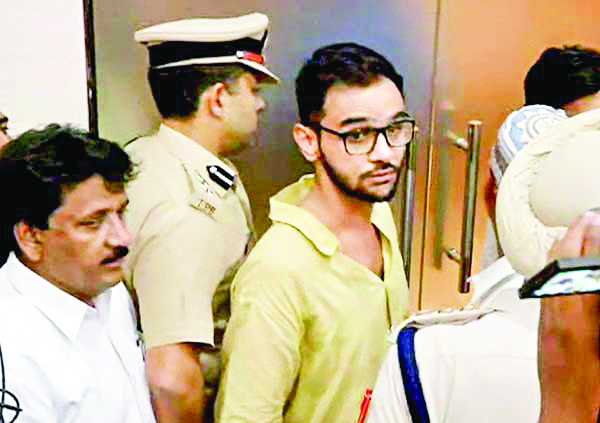
Court finds Imam and Khalid played key roles in orchestrated violence.
New Delhi: The Delhi High Court’s decision to reject the bail pleas of Sharjeel Imam and Umar Khalid is based on their “prima facie grave” role in a premeditated and well-orchestrated conspiracy behind the communal riots that engulfed the capital in February 2020.
The court in its detailed judgment, delivered on Tuesday, underlined that, as per the prosecution’s case, the alleged conspiracy was carefully timed to coincide with the State visit of then U.S. President Donald Trump.
Imam’s counsel had argued that he was already in custody from 28 January 2020, and therefore could not have attended the meetings where Trump’s visit was supposedly identified as the turning point for escalating the protests. The court brushed aside this submission as immaterial:
“It is irrelevant whether the appellant was physically present at the protest sites or in meetings post 28.01.2020. All the initial planning, creation of groups, conceptualisation, and incitement regarding the CAA/NRC had been completed by that point… the mere absence of the Appellants a few days or weeks prior to the ultimate riots may not be sufficient to mitigate their role.”
The court observed that while several co-accused such as Devangana Kalita, Natasha Narwal, and Asif Iqbal Tanha have previously been granted bail, the case of Imam and Khalid stood on a different footing because of their alleged centrality in “planning and designing the scheme of events.”
According to the judgment, Imam and Khalid are accused of delivering inflammatory speeches on communal lines with the intent of instigating mass mobilisation of members of the Muslim community. “The role of the Appellants—Sharjeel Imam and Umar Khalid—is prima facie grave in the entire conspiracy,” the bench said.
On Khalid’s plea of parity with others who secured bail, the court pointed to a 2021 Supreme Court order which had made clear that earlier bail rulings cannot be treated as precedents. “If a co-accused seeks parity, the same must be established and made out before the concerned Court,” it said, concluding that such parity did not apply here.
The argument of prolonged incarceration was also set aside. The chargesheet alone runs into 3,000 pages, supplemented by 30,000 pages of electronic evidence, with four supplementary chargesheet filed so far and 58 witnesses, including protected witnesses, whose statements were recorded before a magistrate. “A hurried trial would also be detrimental to the rights of both the Appellants and the State,” the court remarked.
Reinforcing the prosecution’s claim, the bench said the violence was “not a case of regular protest/riot matter, but rather a premeditated, well-orchestrated conspiracy to commit unlawful activities threatening the unity, integrity, and sovereignty of India.”
Among the detailed allegations placed on record are those against accused Athar Khan, Shadab Ahmed, Abdul Khalid Saifi, and Mohd. Saleem Khan, who is said to have coordinated the sequential disabling of nearly 30 CCTV cameras across a 4–5 km stretch in Chand Bagh and adjoining areas on 24 February 2020. Footage allegedly showed Saleem Khan personally dislocating one of the cameras, “confirming the execution of the plan.”
Once the cameras were disabled, “large-scale mobilisation and violent outbreaks allegedly took place,” with rioters reported to have used firearms, acid, swords, and sharp weapons against law enforcement. A slingshot device fixed to rooftops was allegedly used to hurl acid bottles at police personnel “to get maximum casualties,” which the court noted could not be dismissed as spontaneous but as part of the design.
The prosecution has further alleged that on 23 February 2020, groups of women were transported from Jahangirpuri to Shaheen Bagh and Jafrabad to swell the ranks of protestors, where they were allegedly provided with stones and chilli powder to target police and non-Muslims — part of a strategy of “disruptive chakka jaam” that sparked widespread violence across north-east Delhi.
Rejecting the bail appeals, the court concluded: “It becomes the arduous task of the Court to strike a balance between individual rights and the interests of the nation, as well as the safety and security of the general public at large. Therefore, these appeals do not succeed.”
At least 54 people were killed and hundreds injured in the Delhi riots, which also caused extensive destruction of public and private property.




