
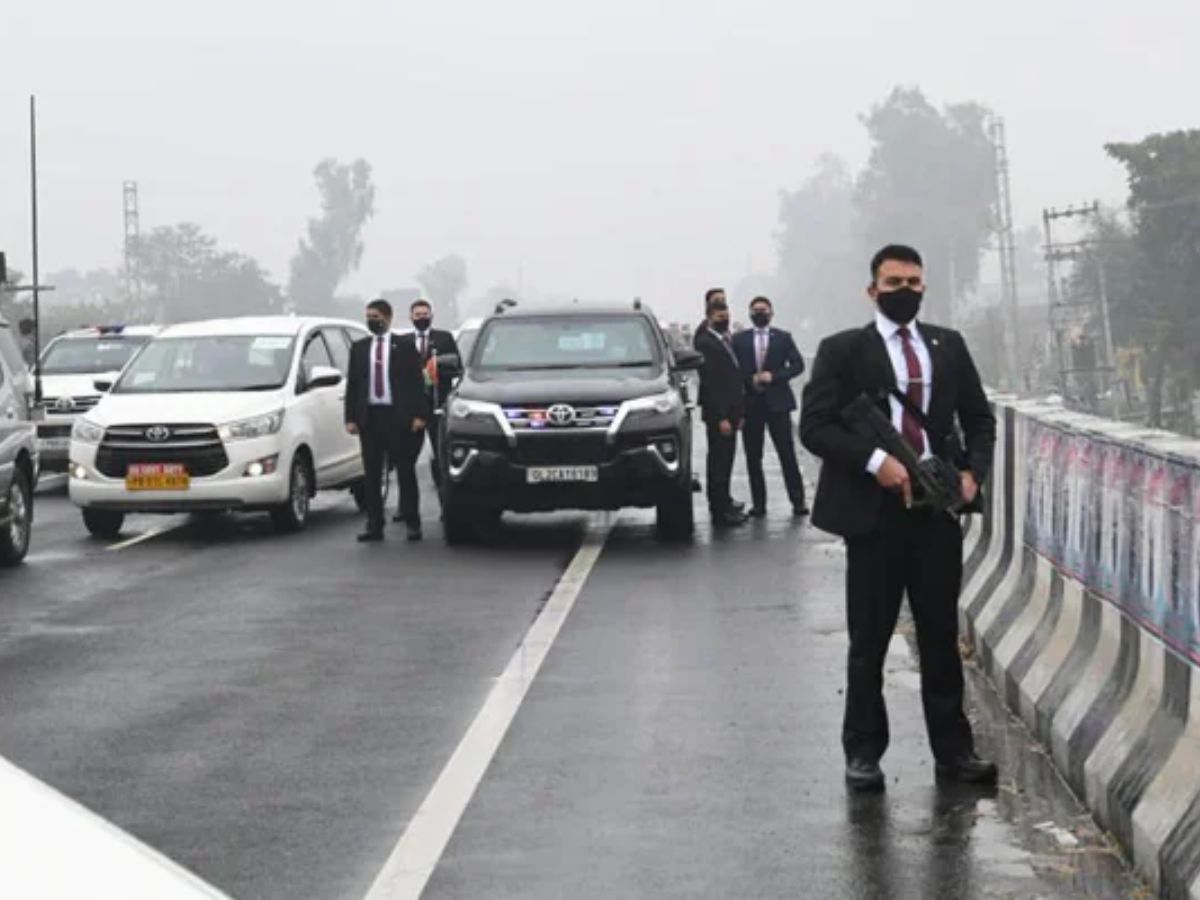
Chandigarh: In a significant administrative move, the Punjab government has initiated departmental action in the 2022 Prime Minister security lapse case, issuing a charge sheet for major penalty to Mukhvinder Singh Chhina, IPS (now retired), and warning letters to senior IPS officers Naresh Arora and G. Nageshwar Rao.
The action comes more than three years after Prime Minister Narendra Modi’s convoy was stranded on a flyover in Ferozepur for over 20 minutes on January 5, 2022, due to protesting farmers blocking the route. The incident was termed a grave security lapse and led to national uproar.
Earlier, the Supreme Court had denied the Punjab government’s request to access witness statements recorded by the Justice Indu Malhotra Inquiry Panel, which had investigated the episode. The apex court ruled in 2024 that the state must base disciplinary actions on the final inquiry report and evidence gathered through its mechanisms.
Action taken by the Punjab Government
According to top government sources and internal documents, the following steps have now been taken:
-
Mukhvinder Singh Chhina, IPS (Retd.): A charge sheet has been issued recommending a major penalty for failure in duty and lapses in managing the PM’s security protocol in his role as Additional DGP.
-
Naresh Arora, IPS: A warning has been issued for supervisory shortcomings and operational lapses during the Prime Minister’s visit.
-
G. Nageshwar Rao, IPS: A warning has also been served citing failure in field coordination and route security planning.
The Punjab government has decided to proceed with disciplinary proceedings under the AIS (Discipline and Appeal) Rules, without relying on confidential witness statements sealed by the Supreme Court.
Background: What happened on January 5, 2022?
Prime Minister Narendra Modi was scheduled to address a rally and lay the foundation stone for development projects in Ferozepur. However, his convoy came to a halt on a flyover near Hussainiwala due to a road blockade by protesting farmers.
Despite prior intelligence alerts and route planning responsibilities, the Punjab Police failed to clear the road or activate backup plans, forcing the PM to return to Bathinda airport. The Special Protection Group (SPG) flagged the situation as a severe security breach.
Inquiry by Justice Indu Malhotra Panel
On January 12, 2022, the Supreme Court constituted a five-member committee headed by former SC judge Justice Indu Malhotra. The panel included officials from the NIA, the Registrar General of the Punjab and Haryana High Court, and the DGP (Security) of Punjab.
The panel submitted its report to the court in August 2022, reportedly holding state-level officers responsible for not enforcing the Blue Book guidelines, poor communication, and inadequate coordination with central security agencies.
SC Verdict in November 2024
In November 2024, the Supreme Court rejected the Punjab government’s plea seeking access to witness depositions made before the inquiry panel. The court held that since the final report had already been shared with the state, it could proceed with its own inquiry and disciplinary action without relying on sealed testimonies.
This ruling placed the onus squarely on the Punjab government to ensure accountability of its officers involved in the lapse.
Delayed action, administrative consequences
The delay in initiating proceedings had drawn criticism from several quarters. However, with the Supreme Court closing the door on confidential records, the state government has now acted on the report’s findings, issuing formal departmental actions.
Experts view this decision as an effort to restore administrative credibility, particularly in matters involving VIP security. It comes amid a broader push by the Punjab government to project a zero-tolerance stance on lapses in high-profile law enforcement duties.
At the same time, some officers named in the probe have reportedly questioned the basis of the warnings, claiming that route decisions were influenced by political instructions and crowd conditions on the ground.
The chargesheet against Chhina could lead to a retrospective reduction of pensionary benefits or other penalties, depending on the outcome of the departmental proceedings.




