Days after banning the use of Coldrif cough syrup across Punjab, the Directorate of Health and Family Welfare has now issued an urgent directive discontinuing the use of eight specific intravenous (IV) fluids and injectable drugs.
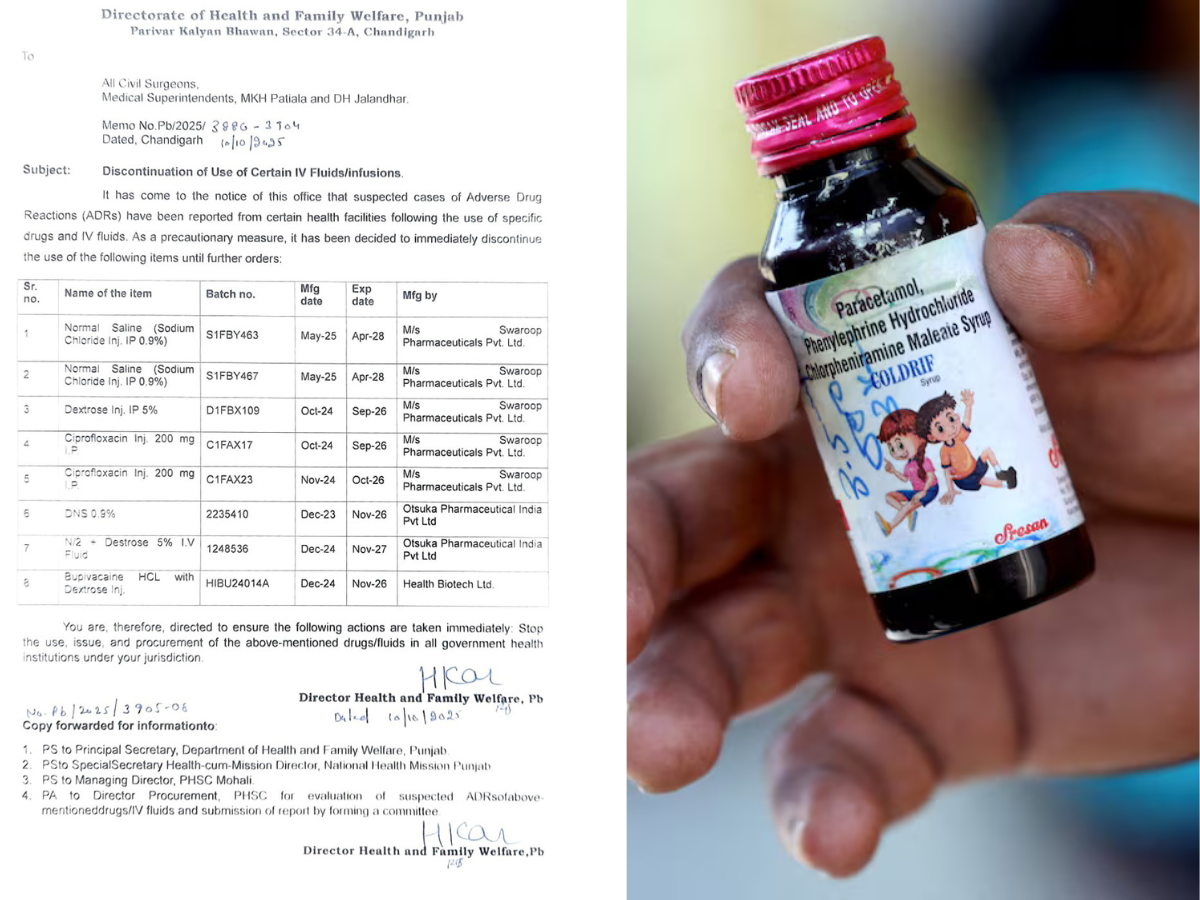
Days after banning the use of Coldrif cough syrup across Punjab, the Directorate of Health and Family Welfare has now issued an urgent directive discontinuing the use of eight specific intravenous (IV) fluids and injectable drugs. (Image Source: X.com/ANI)
Chandigarh: Days after banning the use of Coldrif cough syrup across Punjab, the Directorate of Health and Family Welfare has now issued an urgent directive discontinuing the use of eight specific intravenous (IV) fluids and injectable drugs manufactured by three pharmaceutical companies, after suspected cases of adverse drug reactions (ADRs) were reported from multiple health facilities in the state.
The directive, issued under Memo No. Pb/2025/3896-3104 from the Directorate’s Chandigarh office, is addressed to all civil surgeons, medical superintendents, and senior officials of government hospitals, including Mata Kaushalya Hospital Patiala and District Hospital Jalandhar. It mandates the immediate stoppage of use, issue, and procurement of the mentioned fluids and injections until further orders.
According to the memo, the department acted after receiving reports of adverse reactions following the administration of certain IV fluids and injections. As a precautionary measure, it has been decided to immediately suspend the use of the following items:
1. Normal Saline (Sodium Chloride Injection IP 0.9%) – Batch No. S1FBY463 (May 2025 – Apr 2028)
2. Normal Saline (Sodium Chloride Injection IP 0.9%) – Batch No. S1FBY467 (May 2025 – Apr 2028)
3. Dextrose Injection IP 5% – Batch No. D1FBX109 (Oct 2024 – Sep 2026)
4. Ciprofloxacin Injection 200 mg I.P – Batch No. C1FAX17 (Oct 2024 – Sep 2026)
5. Ciprofloxacin Injection 200 mg I.P – Batch No. C1FAX23 (Nov 2024 – Oct 2026)
6. DNS 0.9% – Batch No. 2235410 (Dec 2023 – Nov 2026)
7. N/2 + Dextrose 5% IV Fluid – Batch No. 1248536 (Dec 2024 – Nov 2027)
8. Bupivacaine HCL with Dextrose Injection – Batch No. HIBU24014A (Dec 2024 – Nov 2026)
Of these, six items were produced by M/s Swaroop Pharmaceuticals Pvt. Ltd., two by Otsuka Pharmaceutical India Pvt. Ltd., and one by Health Biotech Ltd.
The order, signed by the Director of Health and Family Welfare, Punjab, has instructed all district hospitals, civil hospitals, and primary health institutions to immediately stop the use and distribution of these batches. The department has also ordered an internal review to assess the reported ADR cases, emphasizing that patient safety remains the top priority.
A copy of the circular has been forwarded to the Principal Secretary, Department of Health and Family Welfare, Punjab; the Special Secretary, Health-cum-Mission Director, National Health Mission Punjab; and the Managing Director, Punjab Health Systems Corporation (PHSC) Mohali. The Director (Procurement), PHSC, has been asked to evaluate the suspected ADRs associated with these products and submit a detailed report after forming a committee for the purpose.
The sudden suspension comes close on the heels of the state government’s earlier decision to ban Coldrif syrup, which was being distributed in government hospitals. That move followed reports from several districts about possible contamination or side effects linked to its use. The two successive actions have signaled the government’s heightened scrutiny of the quality and safety of medicines being supplied to public health institutions.
Health department officials stated that the decision is purely precautionary and intended to prevent any further adverse reactions until a detailed laboratory evaluation and clinical safety assessment are completed. A senior officer said, “Patient safety cannot be compromised at any cost. Even a small number of adverse cases warrant immediate preventive measures.”
The directive has created a sense of urgency among hospital administrators who have been asked to identify and isolate the mentioned batches from their existing stock. Civil surgeons have been instructed to ensure compliance and confirm that no use or distribution of these drugs continues within their jurisdictions.
The Health and Family Welfare Department is also expected to coordinate with the Punjab Health Systems Corporation for supply chain verification to trace the origin and distribution of the affected batches. Officials said that any facility found violating the order or continuing use of the listed items could face departmental action.
The move underscores the state’s growing vigilance in monitoring the quality of medical supplies amid recent nationwide concerns about substandard pharmaceutical products. Punjab’s health administration appears determined to tighten its internal checks and uphold patient safety standards, especially within the government healthcare network.
As investigations progress, the Directorate is likely to issue further directions based on the findings of the expert committee. For now, all government hospitals in Punjab have been ordered to stay away from the listed IV fluids and injections, ensuring no patient is exposed to the potential risks identified in the advisory.
