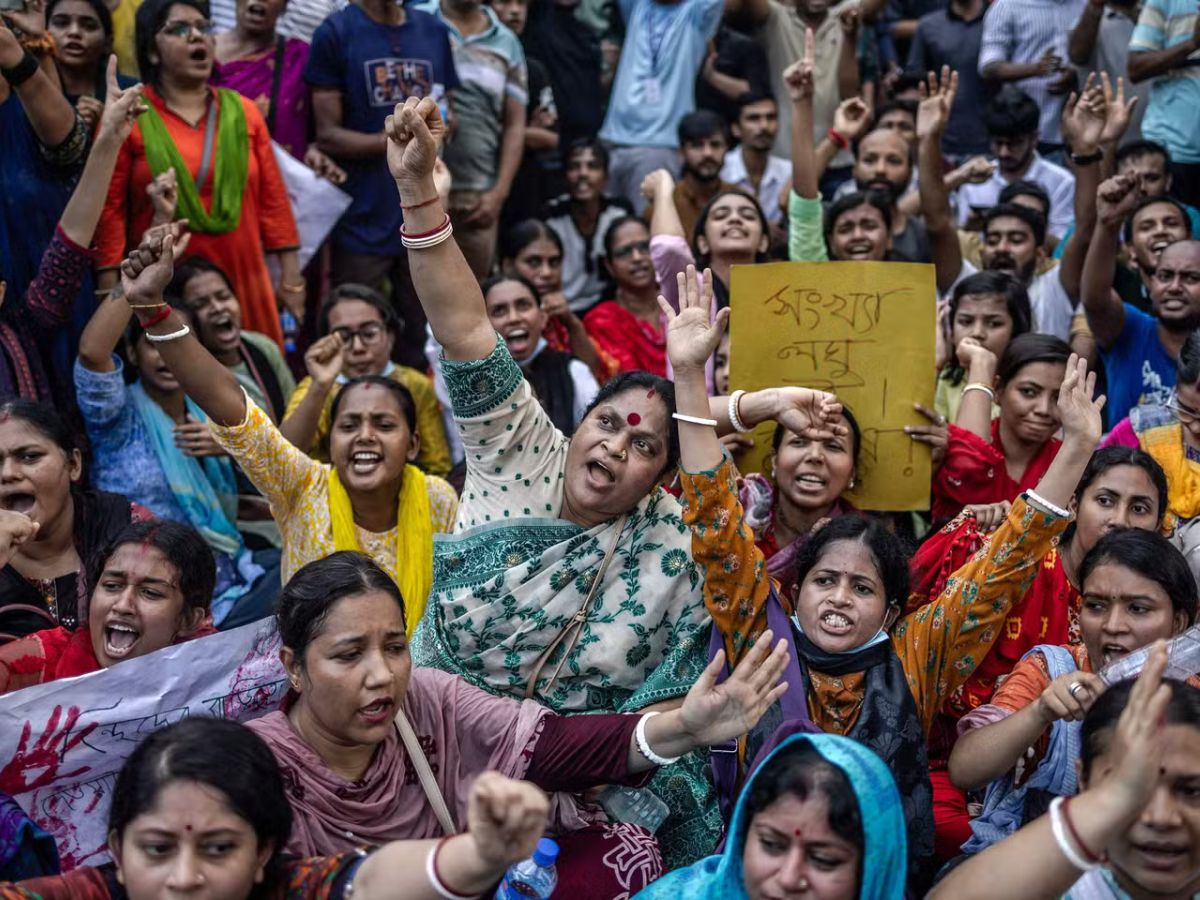
Image Credit: Le Monde
On an August night in 2024, a small group of Hindu families from Bangladesh gathered at a muddy riverbank near the Assam frontier, clutching children and a few bundles of belongings. They were fleeing attacks on their homes and businesses after weeks of unrest; by dawn, most had been stopped or turned back by India’s border guards. Incidents like this revived memories in the northeast of earlier refugee crises that once filled Assam and Tripura’s camps.
In Bangladesh, fear is driving the movement. As violence and intimidation spread last year, hundreds of minority Hindus and other vulnerable groups tried to cross into India seeking safety. Some were detained, others pushed back, and many crowded frontier areas pleaded to be let in. Reports from national and international media described Indian authorities arresting several Bangladeshis and noted that hundreds more waited along the border in August 2024. According to the Ministry of Home Affairs, 2,601 Bangladeshis were apprehended between January 1, 2024, and January 31, 2025.
Faced with these numbers, Indian security agencies hold the line. The Border Security Force (BSF) reported multiple incidents in which large groups gathered near fencing and said they were sent back in coordination with Border Guard Bangladesh, framed as routine management to prevent infiltration. Assam’s state government has also stepped up removals, arguing that both security and demographic balance are at stake.
Security agencies, on their part, have strengthened Indo-Bangladesh border controls with advanced surveillance, more personnel, and new technologies. These include thermal imagers, night-vision devices, Unmanned Aerial Vehicles (UAVs), Closed-Circuit Television (CCTV), sensors, and a Comprehensive Integrated Border Management System (CIBMS) pilot in Assam. Regular patrols, checkpoints, observation posts, and joint operations with the Border Guard Bangladesh (BGB) are conducted, while floodlights and boats secure both land and river stretches. Fencing has been reinforced, and intelligence networks expanded to track touts in sensitive zones.
Even if many who attempt to cross are fleeing genuine hardships, India needs to keep a strict vigil. Uncontrolled entry threatens security, fuels illegal networks, and risks demographic tensions in sensitive regions. Safeguarding borders and maintaining order are essential for stability, even as humanitarian concerns are addressed through lawful channels.
However, pushbacks and expulsions raise serious humanitarian concerns. Human Rights Watch and other groups have criticised recent removals as lacking due process and putting people at real risk, especially those who could qualify as refugees. Critics warn that such practices revive the old trauma of statelessness in Assam and Tripura and risk triggering new cycles of instability.
Bangladesh’s failure to safeguard its minorities is not just a domestic crisis; it spills across the border, fuelling unrest in India’s northeast. Each attack or wave of intimidation pushes vulnerable families to seek refuge, creating sudden pressures on Indian border states already scarred by past influxes. The result is renewed tension, agitation, and insecurity on Indian soil, showing how instability in Bangladesh directly undermines peace in India.
Local politics in the northeast quickly turn migration into mobilisation. Reports of attempted crossings and pushbacks have fuelled protests in Assam and Tripura, where memories of past refugee influxes remain strong. State leaders use these incidents to press New Delhi for tougher action, while civil society groups caution that heavy-handed responses could undermine rights and stability.
Families waiting on riverbanks demonstrate why this goes beyond headlines and why this is a crisis that disrupts the functioning of another country. Insecurity in Bangladesh directly feeds instability across the border. Unless minority fear is addressed in Bangladesh and taken care of, India’s border states will remain in the throes of renewed agitation and humanitarian emergencies.
(Aritra Banerjee is a defence and security Columnist)
