
New Delhi: While addressing the nation from the Red Fort on Independence Day, Prime Minister Narendra Modi mentioned the centenary year of the Rashtriya Swayamsevak Sangh (RSS) and praised the organization’s service to the nation. Along with this, while remembering India’s great personalities and those who sacrificed, he also paid humble tribute to Dr. Syama Prasad Mukherjee.
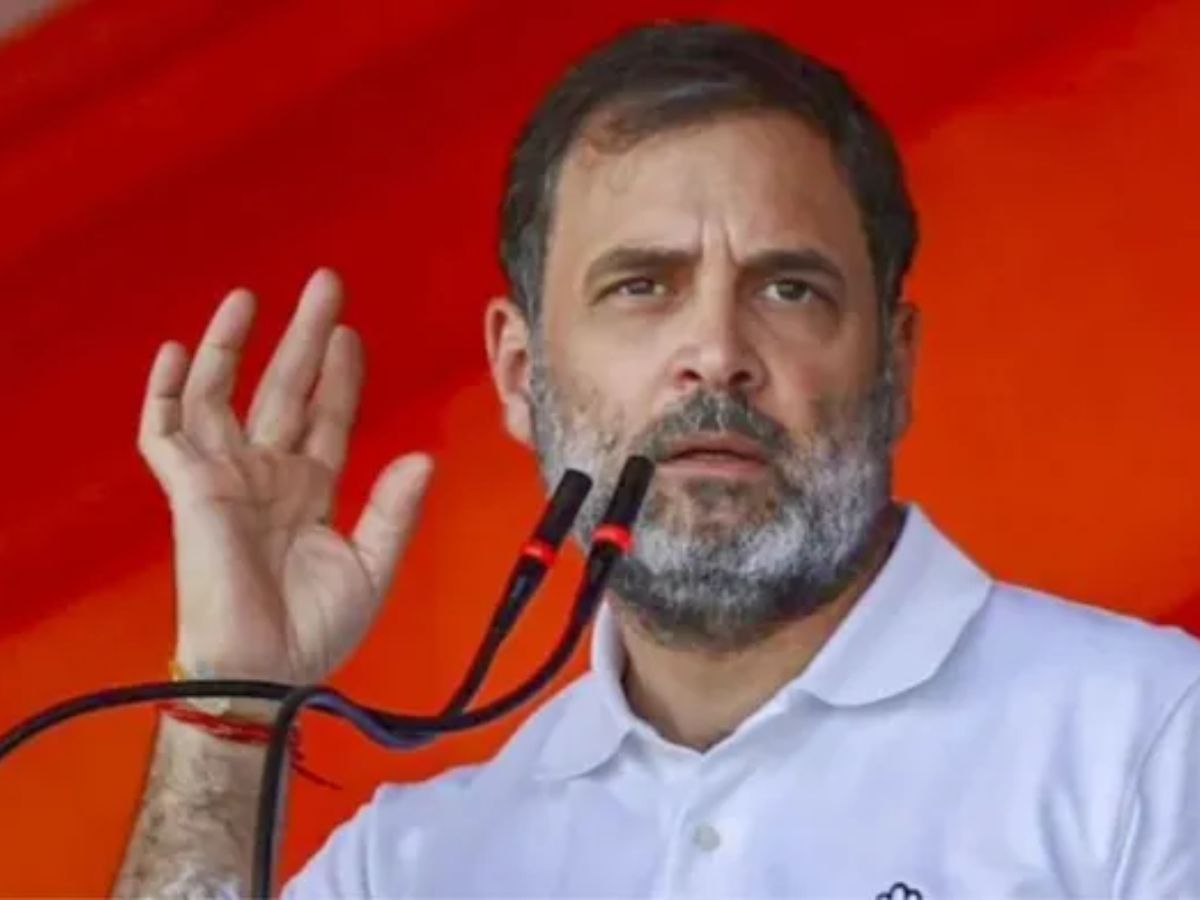
On this matter, Congress, and at this time Leader of Opposition in the Lok Sabha Rahul Gandhi, as well as party president Mallikarjun Kharge, expressed opposition and leveled baseless allegations. This is mere street-level opposition, but before doing so, do they have an answer to the question of why, on the national festival of Independence Day, Rahul Gandhi did not attend the Red Fort ceremony as per the tradition of his forefathers and of democracy? He was not seen even on Republic Day.
These ceremonies do not belong to any one party. Then why did Rahul Gandhi not make an effort to look into or understand Congress’s record of relations with the Sangh and with leaders who were staunch supporters of Hindutva? Why did Rahul Gandhi not get the information that Dr. Syama Prasad Mukherjee, founder of the Bharatiya Jana Sangh (now Bharatiya Janata Party), was a great leader in India’s freedom struggle and in the politics of independent India? He was a nationalist, a staunch Hindu leader, and an erudite educationist. He also played an important role in Pandit Jawaharlal Nehru’s first cabinet (the first council of ministers of independent India after the interim government).
On August 15, 1947, when the first council of ministers of independent India was formed, Dr. Syama Prasad Mukherjee was made Minister of Industry and Supply. His contribution was important in laying the foundation of modern India. He even sacrificed his life for the cause of making Jammu and Kashmir an integral part of India under the Indian Constitution by ending Article 370.
Then, Jawaharlal Nehru, Lal Bahadur Shastri, Indira Gandhi, Rajiv Gandhi, Narasimha Rao, and Pranab Mukherjee, from time to time, met RSS leaders, took their cooperation. Not only at the time of crisis and war, but even for power politics, they sought support from the Sangh. Political prejudices led to bans on the Sangh, but those bans had to be removed on legal grounds.
Call it coincidence or good fortune that I got the opportunity to do journalism in Delhi since 1971. From 1971 to 1975, I was a correspondent for the Hindusthan Samachar news agency. Since then, from reporting Red Fort ceremonies to covering Parliament and meeting top leaders of all parties and organizations, I have had many opportunities. Hindusthan Samachar’s chief editor and director Shri Baleshwar Agrawal, associate editor N.B. Lele, and bureau chief Ramshankar Agnihotri were prominent pracharaks of the Sangh. All of them introduced me to most Congress leaders.
The agency used to regularly get funds from Congress governments for providing news services. Later, I worked with publication houses of the Congress-supporting Birla family or Jain family—such as Hindustan Times and Times Group. Therefore, from Indira Gandhi to Narendra Modi, I got opportunities to meet and talk with prime ministers and presidents, and to understand the inside politics of the Sangh, BJP, Socialists, and Communists. Hence I can say that Congress, from time to time, took great advantage of the Sangh and kept deep contacts and relations with its leaders.
Rahul Gandhi may not know about the Nehru-Indira Gandhi era, but he must surely have heard the news of President Pranab Mukherjee—appointed by Congress itself—attending an RSS camp in Nagpur on June 7, 2018. On this occasion, Pranab Mukherjee said, “Nationalism is the core element of India.” While praising RSS founder Dr. Hedgewar, he described him as a great patriot. Taking Hedgewar’s name, he said that he was dedicated to the service of Bharat Mata and that he worked to organize the youth. From the RSS platform, he gave the message that while ideologies may differ, national interest and unity of the nation are supreme.
This was nothing new, because earlier also many Congress leaders had had contacts and relations with the Sangh—such as B.R. Ambedkar (1939), Mahatma Gandhi (1934), and Jayaprakash Narayan. Mahatma Gandhi praised the discipline of the RSS camp, the absence of casteism, and the simple lifestyle. Dr. Ambedkar praised the Sangh camp for treating everyone equally without hesitation. Jayaprakash Narayan described the RSS as a patriotic organization capable of bringing social transformation. During crises such as war with China or Pakistan, or during natural disasters like earthquakes and floods, Congress governments took help from RSS leaders and volunteers. In northeastern states, for protection from foreign powers and for promoting Hindu and Hindi, Congress governments took assistance.
Nowadays Rahul Gandhi is heavily dependent on his alliance with Uddhav Thackeray, son of Bal Thackeray. Perhaps he does not know, or knowingly ignores, the fact that the Thackeray family held staunch Hindu nationalist views and claimed credit for the demolition of the Babri Masjid, because for power everything is justified. Bal Thackeray did not openly oppose the Emergency imposed by Indira Gandhi. At that time, Shiv Sena maintained a soft stance toward the Congress government. Many opposition leaders were in jail, but no major action was taken against Thackeray or his party. That is why they were considered “power-supportive” during that period.
Even in the 1980s, there were local-level understandings between Shiv Sena and Congress (Indira Gandhi and later the Sanjay Gandhi faction) so that both could politically benefit from the agenda of Marathi Manoos and Hindutva. Indira Gandhi and Bal Thackeray had direct dialogue and relations. Indira Gandhi sometimes supported Thackeray because Shiv Sena was fighting against leftist and communist trade unions, which at that time were also a challenge for Congress. Both Shiv Sena and RSS ideologies were based on Hindutva. From the beginning, Thackeray did politics of Hindu identity and openly said, “I am a Hindutvawadi.”
In the 1980s, Bal Thackeray and Shiv Sena formed an alliance with the Bharatiya Janata Party. By the 1990s, this relationship became stronger, and in the Mumbai Municipal Corporation and Maharashtra Assembly, the BJP-Shiv Sena partnership under the umbrella of RSS became deeper. Bal Thackeray used to say: “I proudly say that I am a Hindu and I do politics of Hindutva.” He said that if Hindutva was attacked, then Shiv Sena would stand like a sword.
In the 1980s, Shiv Sena’s main agenda gradually became Hindutva and opposition to Muslim appeasement. After 1989–90, they openly supported the Ram Mandir movement along with BJP and RSS. On the demolition of the Babri Masjid (December 6, 1992), Bal Thackeray openly claimed that Shiv Sainiks had a hand in it. His statement was: “If my Shiv Sainiks have demolished the Babri Masjid, then I am proud of it.” He even said: “If Shiv Sainiks had not been there, would the Babri structure still be standing?”
Against this background, why are Rahul Gandhi and his president Kharge, forgetting all traditions, colors, and thoughts, relying only on the caste politics of Lalu Yadav and Tejashwi Yadav, or falling into the trap of foreign forces, trying to destroy the credibility of all constitutional institutions?




