Rahul Gandhi’s reform push falters as Congress bows to old Bihar equations.
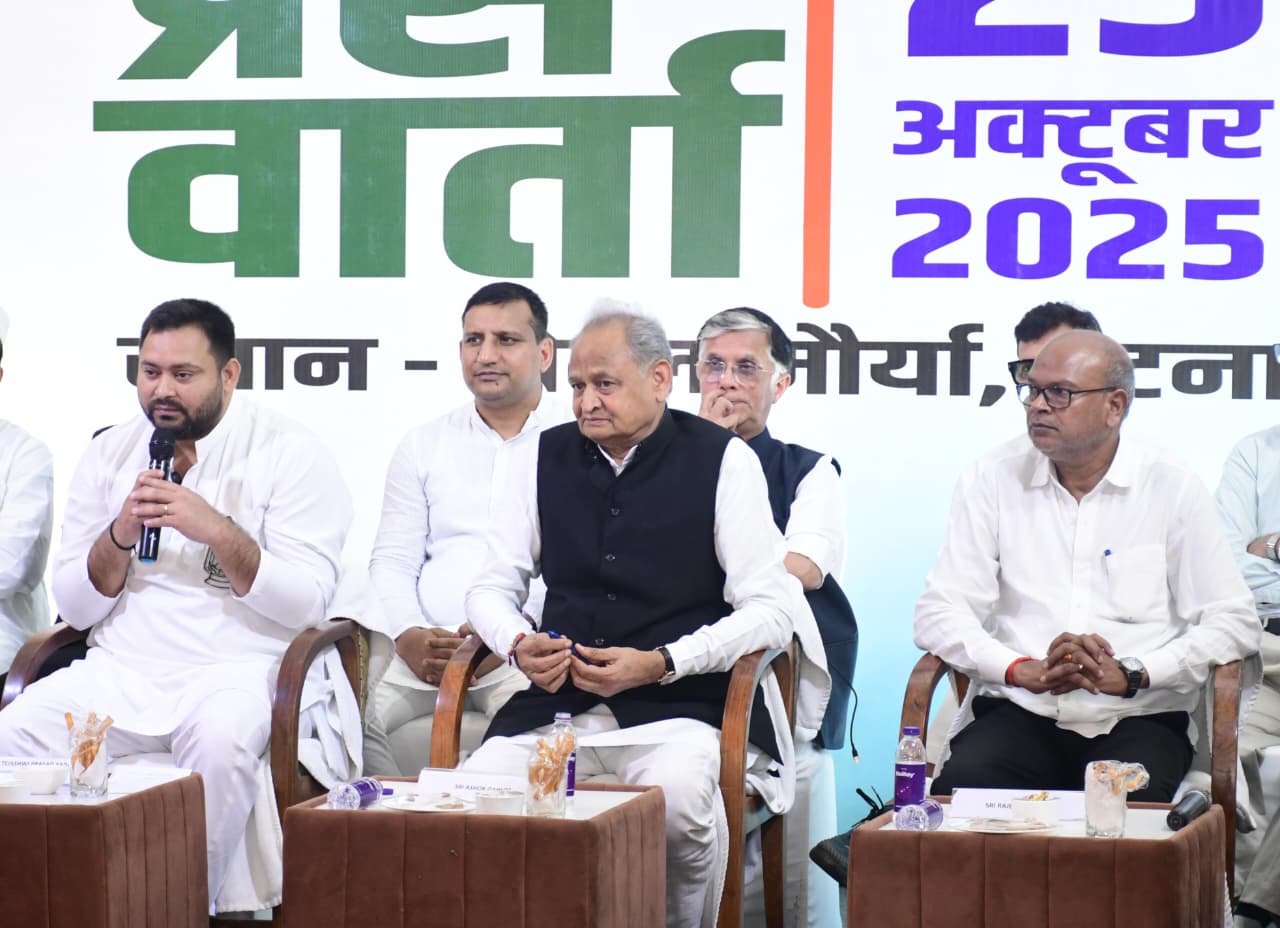
Ashok Gehlot meets RJD leaders in Patna as Congress in-charge Krishna Allavaru’s authority wanes, exposing party divisions in Bihar (Photo: X | Ashok Gehlot meets RJD leaders in Patna as Congress in-charge Krishna Allavaru’s authority wanes, exposing party divisions in Bihar.)
PATNA: When Congress leader Rahul Gandhi sent one his most trusted man Krishna Allavaru to Bihar earlier this year, it looked like the beginning of a rare experiment inside the Congress a deliberate attempt to end decades of quiet submission to senior partner Lalu Prasad Yadav led Rashtriya Janata Dal.
Allavaru came with impeccable credentials: an LLM from Georgetown, an MBA from INSEAD, and a reputation within Team Rahul as a clean, meticulous organiser who spoke the language of systems, not favours. As national in-charge of the Indian Youth Congress, he had already earned Rahul’s trust. His appointment to Bihar, replacing Mohan Prakash, was meant to signal that the state unit would no longer be run from Lalu’s drawing room.
For a party that once dominated Bihar 196 seats in 1985 with nearly 40 percent of the vote the scale of its decline is staggering. By the 2020 assembly election Congress was reduced to 19 seats and under 10 percent of the vote. Since the 1990s, the RJD has effectively dictated not only how many seats Congress would contest but also which hopeless ones it would get.
Allavaru’s mission was to change that equation. On his first visit to Patna, he made it clear that only those building the party’s independent strength would be rewarded with tickets or posts. During seat-sharing discussions, he refused to let the RJD dominate and stood firmly behind Rahul Gandhi’s line that Tejashwi Yadav should not be automatically projected as chief minister.
That stance was a shock to the local hierarchy. The Bihar Congress, long habituated to deference toward Lalu, viewed Allavaru as an outsider a technocrat from Delhi who neither spoke their idiom nor played their games. Dissent festered quickly. RJD leaders began complaining that Allavaru was “rigid” and “difficult,” while state-level Congress veterans accused him of alienating an indispensable ally. The standoff worsened until the party’s central leadership blinked last week over RJD’s anger with Allavaru’s reluctance to accept the seat sharing formula and not announce Tejashwi as the CM face.
Ashok Gehlot the seasoned Rajasthan leader known for his proximity to Congress matriarch Sonia Gandhi was dispatched to Patna to “firefight” the acrimony with the RJD. His very presence undercut Allavaru’s authority. Within hours, Gehlot met Lalu and Tejashwi and assured them of cooperation, signalling a return to the same accommodationist politics that Allavaru had been sent to end.
Technically, Allavaru remains Bihar in-charge. Practically, his wings have been clipped. The message to the state cadre is unmistakable: the line of command now runs through Gehlot’s room, not his. Once Gehlot accepted the seat sharing formula, social media posts against Allavaru, accusing him of taking money and selling tickets, cropped up on various platforms, all which were sponsored by state Congress leaders who were upset with his way of functioning.
The development has reopened an old question that Congress never answers whether it truly wants to rebuild itself in Bihar or is content surviving on borrowed oxygen from its allies. Every in-charge before Allavaru from Shakti Singh Gohil to Bhakta Charan Das to Mohan Prakash — began with talk of revival and ended by surrendering to RJD’s dictates. Das was even mocked by Lalu as “bhakchonhar Das” the “foolish Das” a humiliation the party leadership quietly swallowed. Allavaru’s approach, for all its abrasiveness, was the first genuine attempt to reverse that dependency. His insistence on autonomy was what set him apart and ultimately what made him inconvenient.
By sending Gehlot to manage peace and conceding ground to the RJD, the Congress high command has not only diminished Allavaru’s standing but also undermined the very idea of revival he was chosen to pursue. In Patna’s political circles, the consensus is that Rahul Gandhi’s experiment lasted barely a season. The party that once dreamt of reclaiming its lost base has again chosen the easier comfort of compromise. And with that, the hope of a Congress that could once again stand on its own feet in Bihar looks dimmer than ever.
