
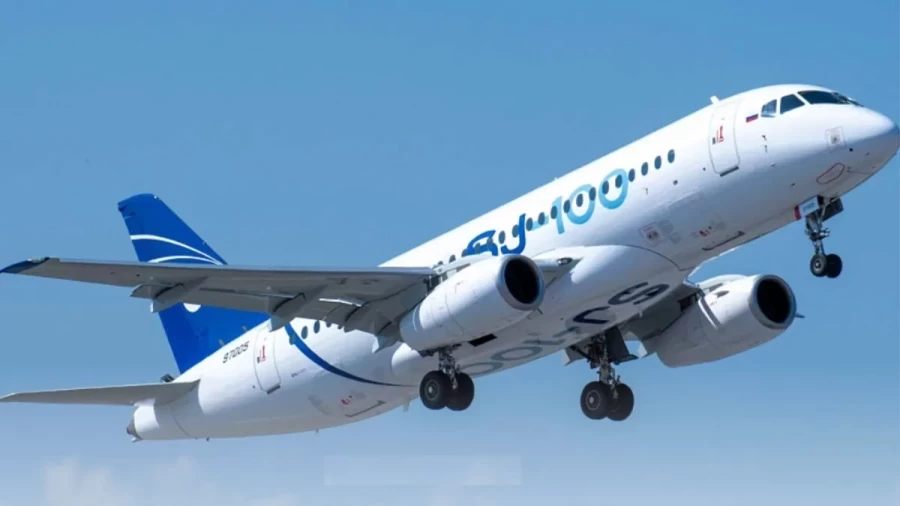
NEW DELHI: Russia’s decision to debut the Ilyushin IL-114-300 and the Superjet SJ-100 in India at Wings India 2026, beginning in Hyderabad on 28 January, marks a significant inflection point in India-Russia economic and industrial engagement, extending cooperation decisively into the civil aviation domain for the first time at scale.
Observers note that the move represents more than an airshow display: it signals Moscow’s intent to enter India’s fast-expanding regional aviation market with a long-term industrial proposition rather than a narrow sales pitch.
India’s aviation growth story has so far been defined by mega orders for narrow-body jets from European aircraft manufacturer Airbus and US-based Boeing. Beneath that headline market, however, lies a structurally important segment of smaller aircraft serving tier-two and tier-three cities.
Regional and short-haul operations, driven by airport expansion and the UDAN connectivity scheme, now carry an estimated 18–36 million passengers annually. This forms a demand base large enough to sustain a dedicated regional aircraft ecosystem and represents a multi-billion-dollar opportunity when aircraft acquisition, leasing, maintenance, training, and operations are combined.
It is this segment that Russia is now targeting with purpose, and given the decades-long defence ties with Moscow, Delhi will be more than willing to let them set up production lines in India.
The IL-114-300 is a 68-seat turboprop designed for short runways, underdeveloped airport infrastructure, and demanding operating conditions. It competes directly with aircraft such as the ATR 72-600, built by European turboprop manufacturer ATR, and the Dash-8 Q400, developed by Canada’s De Havilland, which currently form the backbone of India’s regional networks.
Industry estimates suggest the IL-114-300 is expected to be priced in the USD 20–35 million range once serial production stabilises, broadly comparable to ATR pricing, which typically falls in the USD 25–28 million list-price band.
The SJ-100, seating roughly 87–98 passengers, targets the upper end of the regional market dominated by the E-Jet family produced by Brazilian aircraft manufacturer Embraer. Its expected pricing, based on past disclosures and current positioning, lies in the USD 30–36 million range, placing it in the same bracket as smaller Embraer E-Jets such as the E170 and E175.
On pure sticker price, the Russian aircraft are not dramatically cheaper than existing options. Their significance lies elsewhere.
Both aircraft are being pitched alongside a willingness to participate in India’s “Make in India” programme, including licensed production, assembly, and local sourcing.
For India, industry experts note, this transforms the proposition from an import decision into an industrial one. Aircraft manufacturing and lifecycle support generate high-skill, long-duration employment across engineering, precision manufacturing, avionics, quality assurance, and maintenance. Even partial localisation creates supplier ecosystems that endure for decades once certified, anchoring recurring economic activity rather than one-time capital expenditure.
Maintenance, repair, and overhaul is a particularly large prize. Civil aircraft generate most of their economic value after delivery through spares, engine overhauls, training, and upgrades over a 25–30-year lifespan.
A Russian civil aircraft footprint in India would almost inevitably require a domestic MRO base, retaining foreign exchange, creating specialised jobs, and positioning India as a regional support hub for South Asia, West Asia, and parts of Africa. These downstream effects often exceed the economic impact of final assembly itself.
Strategically, the development is equally consequential. India’s civil aviation ecosystem today is structurally dependent on a narrow set of Western suppliers.
The entry of Russian aircraft introduces supplier diversification in a segment that is critical for domestic connectivity but less exposed to international politics than wide-body fleets. For India, this improves bargaining power across pricing, delivery schedules, and support terms. For Russia, the Indian market offers scale, engineering talent, and geopolitical stability at a time when access to Western civil aviation markets remains constrained.
Discussions around industrial partnership are expected to involve India’s state-owned aerospace major Hindustan Aeronautics Limited, which already possesses aerospace manufacturing capability, certification experience, and state-of-the-art hacking.
If realised, such cooperation would mark one of the most substantial civil aviation manufacturing initiatives in India since the public-sector aircraft programmes of earlier decades and could accelerate learning relevant to India’s own long-delayed regional aircraft ambitions.




