
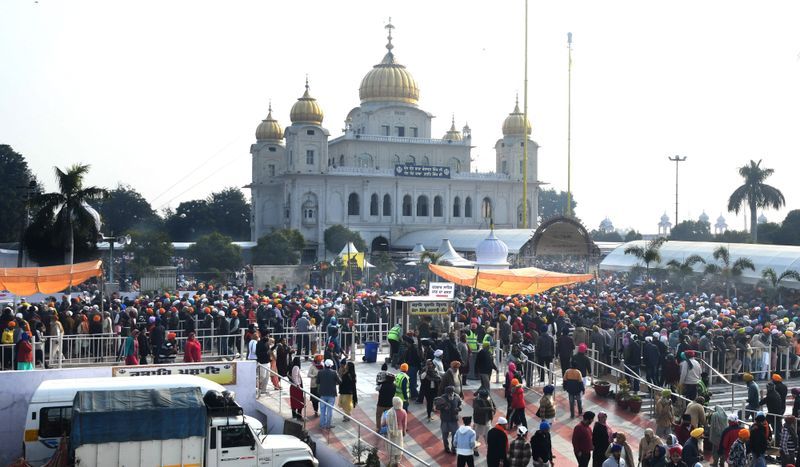
Chandigarh: Fatehgarh Sahib’s Shaheedi Jor Mela, one of the most significant religious congregations in Punjab’s calendar, once again witnessed a heavy political and administrative presence this year, underlining how large scale religious commemorations are increasingly doubling up as platforms for governance display and political signalling.
The three-day mela, held to commemorate the martyrdom of Guru Gobind Singh’s Sahibzadas and Mata Gujri, saw top political leaders from Punjab and neighbouring Haryana, senior bureaucrats, and police officials making coordinated appearances, alongside formal announcements on security, transport and health arrangements.
Politicians Participation
Punjab Chief Minister Bhagwant Mann paid obeisance at Gurdwara Fatehgarh Sahib and personally reviewed the arrangements for the mela. Mann held a media briefing ahead of the main congregation, outlining the state government’s preparations and directing departments to ensure smooth conduct of the event.
Haryana Chief Minister Nayab Singh Saini also visited Fatehgarh Sahib during the mela and paid obeisance along with a delegation from the Bharatiya Janata Party. BJP Punjab working president Ashwani Sharma was part of the delegation that bowed in reverence at the shrine.
Senior functionaries of the Shiromani Gurdwara Parbandhak Committee were present throughout the samagams, coordinating religious programmes and interacting with the district administration on crowd management. Granthis and sewadars from the gurdwara addressed devotees on the historical significance of the martyrdom.
At the administrative level, senior district officials, including the deputy commissioner and superintendent of police of Fatehgarh Sahib, remained stationed on site. Sector-wise supervision was entrusted to SP rank officers, with continuous monitoring during peak congregation hours.
Security and Policing Arrangements
The Punjab Police deployed around 3,000 personnel for the mela, according to official briefings issued by the district administration. The entire mela area was divided into multiple security sectors, each under a gazetted officer.
CCTV surveillance was significantly expanded, with around 200 cameras installed in and around the gurdwara complex, parking areas and approach roads.
Anti sabotage checks, foot patrols and vehicle frisking points were set up at all entry routes. Police control rooms functioned round the clock, and additional women police personnel were deployed considering the large presence of women and children among pilgrims. Senior police officers stated that the security blueprint was drawn keeping in mind the scale of the congregation and recent security alerts in the region, and that there was close coordination between district police, intelligence units and traffic authorities.
One of the major announcements made by the Punjab government pertained to transport facilities for pilgrims.
The state arranged around 200 shuttle buses to ferry devotees from designated parking zones to the gurdwara complex. In addition, more than 100 e-rickshaws were deployed on approved routes to assist elderly pilgrims and families.
Traffic movement around Fatehgarh Sahib town was regulated through diversion plans, with heavy vehicles restricted during peak hours. Parking sites were earmarked on the outskirts, and shuttle services operated continuously to prevent congestion near the shrine.
Officials said these measures were aimed at reducing stampede risks and ensuring faster emergency access if required.
The health department set up six temporary dispensaries in and around the mela area, supplemented by 20 Aam Aadmi Clinics placed on alert to handle medical emergencies. Ambulances with medical staff were stationed at key locations, while referral linkages were established with nearby hospitals.




