
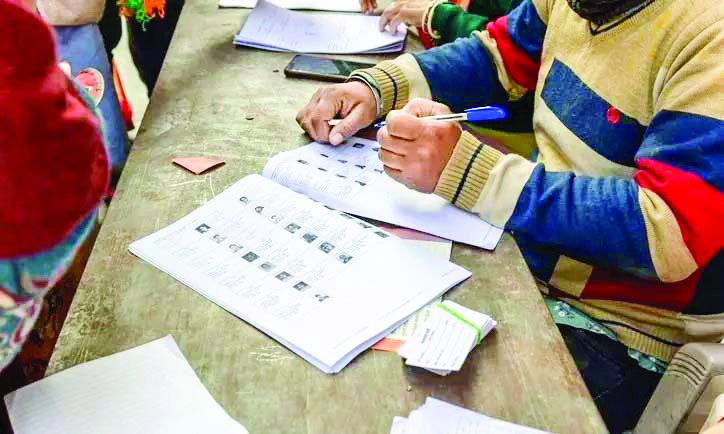
NEW DELHI: Political tensions in West Bengal have reignited, with the Special Intensive Revision (SIR) of the voter list emerging as the newest point of confrontation between the ruling Trinamool Congress (TMC) and the opposition Bharatiya Janata Party (BJP).
Both parties have launched fierce verbal attacks, accusing each other of attempting to manipulate the electoral process ahead of the crucial 2026 Assembly elections.
The TMC has alleged that the Election Commission is functioning under the influence of the BJP, deliberately targeting genuine voters to tilt the electoral balance. The party has described the SIR as a “disguised NRC,” asserting, “This is not SIR; this is a backdoor NRC.”
The BJP, however, has strongly defended the voter list revision, arguing that the exercise aims to establish a transparent and authentic electoral roll by identifying and removing “Rohingyas, infiltrators, and ghost voters” from the state’s records.
The controversy deepened after Union Minister and BJP MP Shantanu Thakur claimed that nearly 1.2 crore illegal voters might be deleted from West Bengal’s rolls under the Election Commission’s ongoing SIR exercise.
Addressing a gathering in North Bengal, Thakur stated that the process would remove “Rohingyas, infiltrators, and ghost voters,” thereby paving the way for “real and meaningful change” in the state’s political landscape.
Thakur said a clean voter list would empower citizens seeking development and transparency, enabling them to vote freely for change. He added that no refugee would be displaced, assuring that once granted citizenship, they would regain their voting rights.
His remarks, however, drew a strong rebuttal from TMC MP Mamata Bala Thakur, a prominent Matua community leader and the Union Minister’s own aunt. She warned that the SIR process could ultimately harm Matua refugees, a group that has traditionally supported the BJP.
“It is the Matua refugees who will suffer the most because of SIR. Those who support the BJP will find their names missing from the rolls. The TMC will not be affected — in fact, our strength will only increase,” she stated.
Accusing the BJP of creating confusion over citizenship and voter registration, Mamata Bala Thakur demanded clarity from the party’s top brass. “Let the state BJP leadership and the Union Home Minister first decide what they actually want. They have left the refugees completely puzzled,” she remarked.
Notably, the Matua community, consisting largely of Hindu refugees from Bangladesh, wields considerable electoral influence in North 24 Parganas and Nadia districts. Over the past few elections, the community has become a critical vote bank courted by both the TMC and the BJP.
The political storm worsened after reports surfaced that two residents of Nadia district in Bengal had received NRC notices from the Assam government, giving the TMC a renewed opportunity to criticise the Centre.
Bengal Chief Minister Mamata Banerjee described the move as part of a larger political conspiracy to target Bengal’s diverse social fabric and to pressure officials through Central interference.
Banerjee alleged that four officers had pressured BLROs to prepare documents as instructed, claiming the state government was sidelined in the SIR process. Calling it “a fraud that excludes the public,” she warned it could disenfranchise minorities, refugees, and migrant workers.
Emphasising Bengal’s diverse social fabric, she said any attempt to target a particular community “will not be tolerated.”
Banerjee reiterated that the SIR was nothing more than a “backdoor NRC” and warned that Bengal would resist any move to erase legitimate voters. “If genuine voters are removed, Bengal will respond in a way no other state can,” she said defiantly.
She also questioned the practicality and intent of the voter list revision, remarking, “How can a proper voter list be prepared in just 15 days? It’s simply impossible.”
As the heated exchanges between the TMC and BJP continue, the SIR controversy has rapidly evolved into one of the most contentious political issues in Bengal’s pre-election discourse. With both sides hardening their positions, the dispute over voter rolls appears set to dominate the state’s political narrative in the run-up to the 2026 Assembly polls, signalling a bitter electoral battle ahead.




