UK PM Keir Starmer hails India’s growth, praises Modi’s Viksit Bharat 2047, and calls new India–UK trade deal a “breakthrough moment” in global ties.
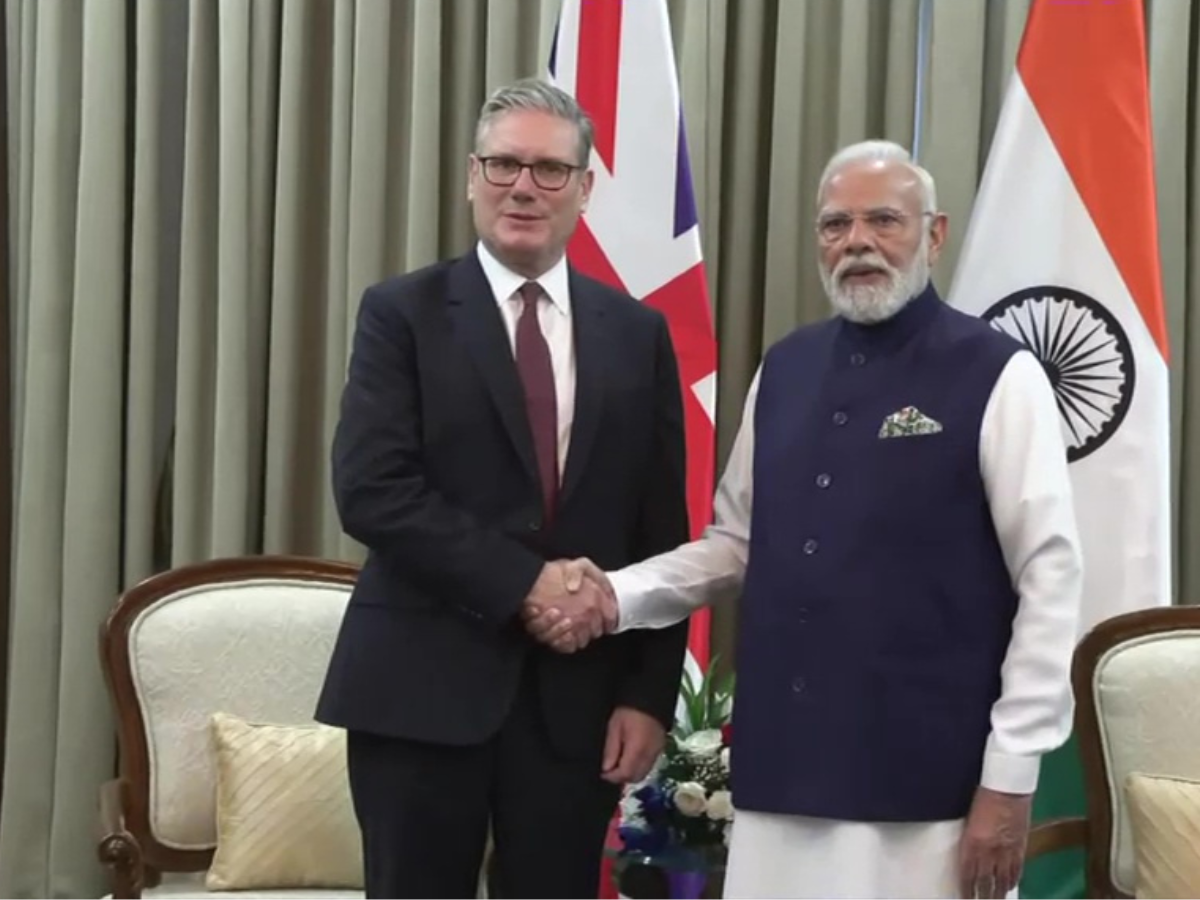
UK PM Keir Starmer meets PM Modi in Mumbai, hailing the India–UK trade deal as a "breakthrough moment" and a new chapter in global partnership (Photo: ANI)
New Delhi: British Prime Minister Keir Starmer on Thursday lauded India’s rapid economic ascent and Prime Minister Narendra Modi’s Viksit Bharat 2047 vision, describing the newly signed UK–India Comprehensive Economic and Trade Agreement (CETA) as a “breakthrough moment” that reflects a confident, future-focused partnership between the two nations.
Starmer’s two-day high-profile visit to India (October 8–9, 2025)—his first official trip since taking office—was marked by optimism and substance. It came at a time when India–US ties are passing through a turbulent phase, making London’s outreach particularly significant. The United Kingdom, often seen as Washington’s most trusted ally, has in this instance chosen an independent path, signalling a willingness to recalibrate its foreign policy to reflect India’s growing global stature.
The visit also underscored that India has firmly positioned itself as an indispensable global player—both as an emerging market and a strategic actor. In today’s environment, no major global conversation or partnership—whether on trade, security, or the future of South Asia—can be successful without involving India. In that context, this visit stands out as an important development, especially given the depth and level of engagement witnessed between the two sides.
Diplomatic observers in both capitals described the visit as “a success on both substance and symbolism,” showing that India now occupies a central place in global decision-making and commands independent engagement from major powers.
Speaking in Mumbai, Starmer said everything he had seen during his visit “proved” that India was on course to become the world’s third-largest economy by 2028. Congratulating Prime Minister Modi for his leadership, he added, “We want to be partners on that journey.”
The visit follows Modi’s trip to London in July 2025, during which the two sides concluded the long-negotiated Comprehensive Economic and Trade Agreement. Starmer called it “the most ambitious trade deal India has ever done,” adding that it marked “the start of something modern and forward-looking.”
According to official estimates, bilateral trade currently stands at about USD 54.8 billion, and under the new deal is projected to grow by £25.5 billion (≈ US $34 billion) by 2040. UK exports to India could increase by nearly 60 percent, officials said.
Starmer described the agreement as “a huge win for both nations,” saying it would “unlock jobs, innovation, and investment on both sides.”
He also reaffirmed Britain’s support for India’s wider international role, saying the two countries “sit together in the Commonwealth and G20, and we want to see India taking its rightful place in the UN Security Council.”
Both leaders discussed regional and global developments, including peace and stability in the Indo-Pacific, West Asia, and the ongoing Ukraine conflict.
Starmer said India’s consistent call for “dialogue and diplomacy” underscored its standing as a stabilising voice in international affairs.
The British prime minister noted the symbolism of meeting in Mumbai, “the heart of India’s growth story,” and said the past two days of talks between Indian and British business leaders had been “incredibly productive,” with “a real buzz of collaboration and ideas.”
Starmer led a 125-member delegation, the largest-ever UK trade mission to India, including leaders from business, academia, and culture—reflecting the intent to convert diplomatic goodwill into concrete partnerships.
Both sides reaffirmed their commitment to the India–UK Roadmap 2030, which envisions expanded cooperation across trade, technology, education, climate action, and defence.
Starmer concluded by calling the India–UK relationship “a pillar of stability and economic progress amid global uncertainty,” adding that beyond the text of the agreement “lies the shared confidence and spirit that define our partnership.”
