
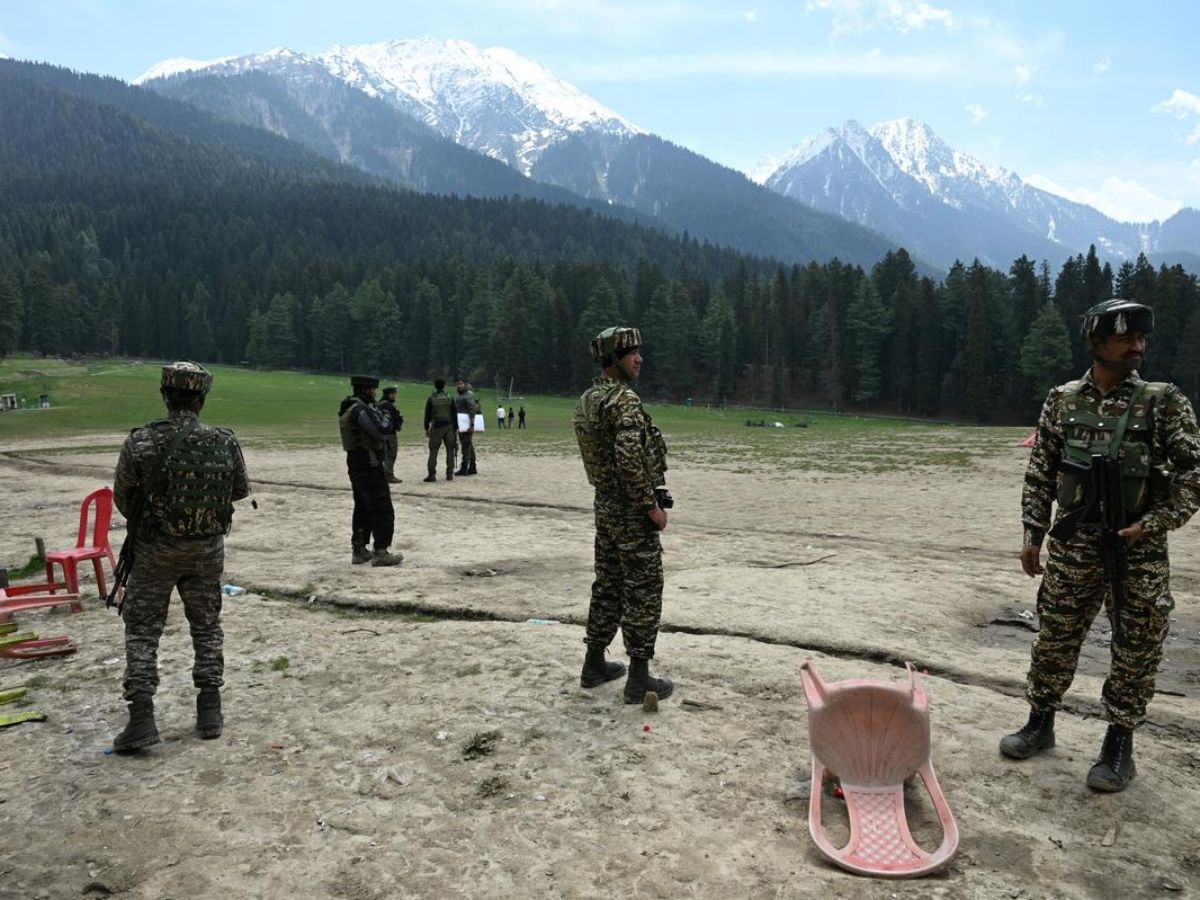
Revealing the precision and stealth of Indian forces, the three Pakistani terrorists killed in Kashmir on Monday were caught completely unaware, until it was too late to escape
According to details accessed by The Daily Guardian, the build-up to the operation that led to the elimination of the terrorists who carried out the 22 April Pahalgam massacre began when security forces first picked up indications of their presence in the area on 22 May. However, it was only on 22 July that movement was confirmed, triggering the deployment of operational units.
Following this confirmation, security teams moved swiftly and began closing in on the suspected hideout.
A 12-member unit tracked one of the terrorists, identified as Hamza Afghani alias Afghani Bhai, while maintaining distance to avoid alerting the group. By following him, the team was led to the hideout used by all three terrorists, which was covered with a plastic sheet strung between trees to shield them from the rain.
Upon reaching the site, members of the team spotted one of the terrorists, Jibran, preparing tea, while Yasis alias Suleiman Shah, their leader and a former commando in the Pakistan Army, was found sleeping.
The terrorists were challenged, and in the ensuing gunfight, all three were neutralised on the spot.
The three terrorists, all highly trained in military warfare, had so far successfully avoided detection, which was a key reason they had managed to evade a robust surveillance and tracking network that Indian agencies had activated following the Pahalgam attack for almost 100 days.
As reported by this newspaper earlier, it was confirmed by Home Minister Amit Shah in Parliament on Tuesday that all three belonged to Pakistan. Security forces were able to identify them using Pakistani voter numbers found on their person. Chocolates manufactured in Pakistan were also recovered from the site.
Officials believe that additional material directly linking the terrorists to Pakistani state support may have been recovered but has not yet been made public for strategic reasons.
All three were designated A-category terrorists and members of the Lashkar-e-Taiba. The time taken by the agencies to officially confirm their identities and involvement in the Pahalgam massacre was, according to Shah’s statement in Parliament, due to the requirement of multiple levels of forensic verification before public disclosure.
To that end bullet shells recovered from the 22 April massacre site were matched with rounds fired from weapons seized after Monday’s encounter. As reported by this newspaper earlier, these included an American M9 pistol and two AK-47 assault rifles which were flown to the Central Forensic Science Laboratory (CFSL) in Chandigarh on a special aircraft late Monday night.
At 4 AM Tuesday, a ballistic report was presented to Home Minister Shah. In a video call attended by six CFSL scientists, it was confirmed that the bullets matched conclusively linking the recovered weapons to the Pahalgam killings.
The identities of the three terrorists were further corroborated by arrested overground workers who had provided them shelter and logistical support during the planning and execution of the massacre.




