
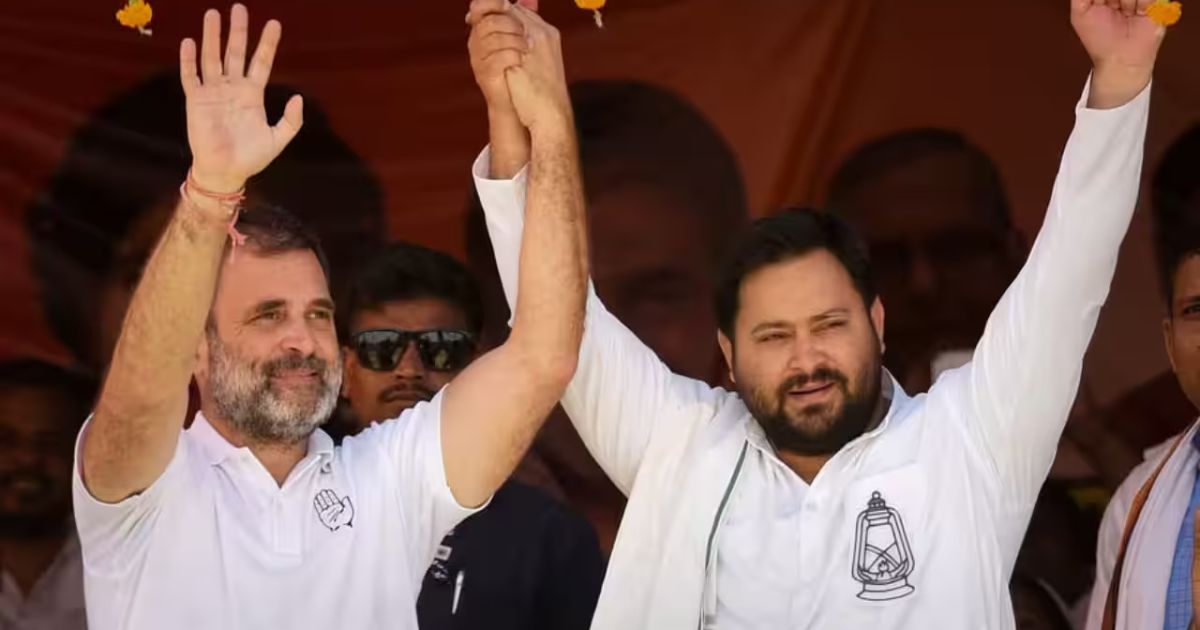
New Delhi: Before the Bihar Assembly elections, the threat of an election boycott by Tejashwi Yadav, coupled with the stance of Rahul Gandhi and the support from Congress leaders, is beginning to resemble a Maoist-Naxalite path. This raises a serious question—could Bihar once again drift away from electoral politics toward violence and anarchy?
Tejashwi Yadav, leader of the Rashtriya Janata Dal (RJD), while opposing the Special Revision of the Voter List in Bihar, threatened to boycott the elections, saying, “We can collectively consider boycotting the election. That option is open to us.” Bihar Congress in-charge Krishna Allavaru also said that all options are open and that a collective decision will be made. “This is the Election Commission’s and Chief Election Commissioner Gyanesh Kumar’s voter list,” he said. “We will continue this battle, and if needed, take the biggest possible decision. A big fight is coming.”
Rahul Gandhi has previously stated that he is fighting against the Indian state—a language not far from that of Maoists. Ironically, the same Congress party whose leadership in Chhattisgarh was decimated by Maoists now has leaders like Telangana Chief Minister Revanth Reddy calling the Naxal movement a social movement. While the return of communist parties is not visible, on certain issues their language often mirrors that of the Congress.
At one point, Maoists held sway over large parts of Chhattisgarh, Bengal, Odisha, Jharkhand, Madhya Pradesh, Andhra Pradesh, Telangana, and Maharashtra.
When the Modi government came to power, nearly one-fourth of India’s districts were under the grip of red terror. According to Ministry of Home Affairs data, there were 126 Maoist-affected districts in 2013. As of April 2025, that number has come down to just 18.
The audacity of the Maoists can be gauged from two recent incidents. Commenting on the RJD and Congress leaders’ statements on boycotting elections, BJP MP Rajiv Pratap Rudy said that Tejashwi already sees defeat looming and is looking for excuses.
“Either he knows he has lost the election, so he wants to abandon the field early—or he’s planning a bigger political game,” Rudy said.
According to the Election Commission, during the revision of the electoral rolls in Bihar, a door-to-door survey revealed that over 52 lakh voters were not found at their registered addresses, and more than 18 lakh voters had died. The Election Commission has given every citizen and political party one more month to add or correct names. When parties claim to have lakhs of members, why don’t they deploy workers or hire agencies to help in correcting the electoral rolls?
A petition has also been filed in the Supreme Court against the revision process. However, both the courts and the Election Commission must rely on Bihar’s own government staff to carry out the work.
In reality, the influence of Naxalites in Bihar has been steadily declining. After the bifurcation of Bihar and Jharkhand in 2000, a Special Task Force was established to curb the activities of Naxalites, left-wing extremists, and organized crime gangs.
In 2004, 14 districts in Bihar were affected by insurgency. Continuous operations with the help of central paramilitary forces have led to the decline of Naxalite presence. The number of such districts dropped to 16 in 2018 and to 10 in 2021.
Currently, eight districts—Munger, Lakhisarai, Jamui, Nawada, Gaya, Aurangabad, Rohtas, and Kaimur—are categorized by the Ministry of Home Affairs as “limited Naxal-affected” rather than “severely affected.” Over the last five years, Naxalite incidents in Bihar have fallen by 72%.
The number of wanted hardcore armed Naxal cadre has also dropped significantly—from 190 in 2020 to just 16 by December 2024. Currently, only two border areas adjacent to Jharkhand remain affected.
At present, Naxalite activity is concentrated in two areas of the Bihar-Jharkhand border, primarily the Gaya–Aurangabad axis, where the Bihar-Jharkhand Special Area Committee (BJSAC) operates. Due to consistent anti-Naxal operations and the arrest of top Maoist leaders, the influence of left-wing extremism in this area has greatly diminished. Only about seven armed Maoists, operating in three small groups, are reported active here.
Union Home Minister Amit Shah has vowed to eliminate Naxalism from the country by March 2026. Judging by the success of the security forces, this goal seems achievable—though challenges remain.
Maharashtra Chief Minister Devendra Fadnavis recently warned that “urban Naxals” from outside the state are using foreign funds to spread rumors and divert people in Gadchiroli—a former Naxal stronghold—from the path of development. His comments came during a public program in Gadchiroli.
After the Bhima-Koregaon violence, the National Investigation Agency (NIA) and other agencies brought the issue of urban Naxalism into focus. These agencies revealed how individuals in cities were raising funds and spreading propaganda for their comrades in the jungles.
When the Home Minister set a deadline for ending Naxalism and security forces began work accordingly, the Intelligence Bureau warned that although jungle combat may reduce, propaganda networks will continue spreading disinformation.
Just days after the Maharashtra Assembly passed the Special Public Security Bill, CM Fadnavis declared on 22 July 2025 that “urban Naxals from outside the state are spreading falsehoods and using foreign funds to obstruct development projects.”
According to a report, demonetization of Rs 500 and Rs 1,000 notes had a significantly positive impact on insurgency-prone regions. Left-wing extremists had deposited illicit funds in the accounts of supporters and villagers. After demonetization, crores of rupees were seized from various extremist groups. Their opposition to demonetization revealed their discomfort.
Since cash hoarding is a major source of terrorist financing, much of the cash held by them became useless post-demonetization. The move also halted the circulation of high-quality counterfeit currency printed in Pakistan.
Officials believe that the jungle war against Naxals will end by 2026. People in affected areas now support security forces, feeling safer and seeing development. Since the NIA’s crackdown on foreign funding in 2019, the problem of urban Naxalism has reduced significantly.
However, some elements still try to provoke unrest and stoke public emotions.
The Union Home Ministry is already working on a post-2026 strategy, which includes monitoring urban sympathizers of the Naxal movement. Teams are being set up to monitor content circulated on social media and track funds used for mass disinformation campaigns.
Before last year’s Lok Sabha elections, there was a massive campaign surrounding the Indian Constitution. Naxalite sympathizers are reportedly planning to incite people against the Constitution using similar campaigns, mostly through social media.
They know that if a propaganda wave begins and people are incited, all the progress made could be undone. They’ve done this before and will likely continue misleading and provoking innocent villagers.
So the question remains—by echoing such rhetoric, are Tejashwi Yadav and Rahul Gandhi pushing the nation toward disorder and anarchy?




