
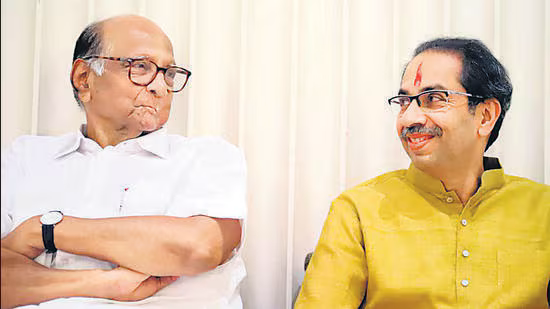
NEW DELHI: For decades, Maharashtra’s politics revolved around two powerful families—the Thackerays and the Pawars. Their names became synonymous with authority, influence and, at times, fear. Governments rose and fell around them, alliances shifted with convenience, and ideology often proved secondary to the pursuit of power. Principles were flexible; power was paramount. However, the 2026 Mumbai and other municipal elections across Maharashtra have made one reality unmistakably clear: voters are no longer willing to tolerate dynastic politics, repeated betrayals of loyalty, and unrestrained ambition.
Under Prime Minister Narendra Modi’s leadership, the Bharatiya Janata Party has steadily dismantled the once-formidable political fortresses of the Congress across much of India, emerging as the principal national alternative. The municipal verdicts in Mumbai and Maharashtra signal the end of an era dominated by Sharad Pawar and the Thackeray family. If anything, Sharad Pawar’s political journey is even longer and more emblematic of opportunistic politics than that of the Thackerays.
For nearly six decades, Pawar functioned as a Maratha strongman, employing every possible tactic, alliance and manoeuvre—from state to national politics—in pursuit of the highest office. In my 1993 book “After Narasimha Rao, Who?”, I wrote at the beginning of a chapter on Pawar that his favourite sports were kabaddi, kho-kho and wrestling—sports that demand agility, sudden reversals and tactical throws. Pawar, I argued, embodied these traits in politics: quick to switch sides like kabaddi, adept at knocking out rivals like kho-kho, and ready to floor even mentors or protégés when the moment demanded. By 2026, however, voters had decisively pushed him out of the political arena, rejecting not only these manoeuvres but also what many perceived as political “match-fixing”.
What unfolded in the municipal and civic elections was not accidental. Long-standing bastions such as Mumbai, Thane and Pune crumbled. Uddhav Thackeray’s Shiv Sena and Sharad Pawar’s Nationalist Congress Party were pushed to the margins, while the Congress was left virtually irrelevant in Mumbai. The public delivered a clear message: lineage is no substitute for credibility. Democracy, though sometimes slow, ultimately settles accounts.
Both the Thackeray and Pawar families transformed politics into a family enterprise rather than a sustained ideological movement. As long as power was within reach, principles were negotiable. The 2026 results demonstrate that those who treat politics as deception eventually stand exposed by the same process. The outcomes across Maharashtra’s 29 municipal corporations underscore how decisively voters have curtailed the influence of both families.
Sharad Pawar rose within the Congress as the most prominent leader after Yashwantrao Chavan. Yet, when he realised the top national post was beyond reach, he split the party. Over the years, he forged and broke alliances not only with leaders like Vasantrao Naik, Vasantdada Patil and Shankarrao Chavan, but also with Indira Gandhi, Rajiv Gandhi, P.V. Narasimha Rao and Sonia Gandhi—always recalibrating for power. He served three terms as Maharashtra Chief Minister and held influential Union portfolios, but the dream of becoming Prime Minister remained unfulfilled. Now, even the ambition of passing power to a political heir in Maharashtra appears shattered. For the Thackerays, losing control over municipal bodies is particularly damaging, as these institutions formed the backbone of their political dominance.
Their emotionally driven vote base has weakened. Balasaheb Thackeray’s rise was not rooted in a structured ideological movement but in emotional mobilisation and aggressive rhetoric. Shiv Sena, founded in 1966 in the name of Marathi pride, soon revealed that proximity to power was its true fuel. Historical contradictions underline this reality. During the Emergency in 1975, Bal Thackeray openly supported Indira Gandhi, praising her as a “strong leader” while opposition figures were jailed and the press censored. Shiv Sena did not lead any significant resistance during that period. Later, after the Babri Masjid demolition in 1992, Bal Thackeray claimed Sena’s role in the event, gaining popularity within Hindutva politics. Yet the same party subsequently aligned with the Congress—the very force it had long branded anti-Hindu—underscoring political branding over ideological consistency.
After Bal Thackeray, Uddhav Thackeray inherited leadership. His defining political move was his abrupt shift from alliance with the BJP to partnership with Sonia Gandhi and Sharad Pawar after 2019, driven largely by the denial of the Chief Minister’s post. The formation of the Maha Vikas Aghadi was less a political experiment and more an ideological surrender for power.
The BJP’s municipal success is not attributable to a single leader but to the combined force of Narendra Modi’s credibility, Amit Shah’s strategy and Devendra Fadnavis’s organisational execution. Modi remains the most influential political brand among urban, middle-class and economically weaker voters. In metropolitan centres such as Mumbai, Pune and Nagpur, elections were fought as much on Modi’s image—development, stability and clean governance—as on local issues.
Amit Shah’s contribution lay in systematically weakening the opposition from within. The split in Shiv Sena that brought Eknath Shinde into the BJP-led alliance, followed by the division in the NCP with Ajit Pawar, destabilised both rival families. This was not a short-term tactic but part of a long-term strategy spanning from 2022 to 2026. On the ground, Devendra Fadnavis translated this strategy into results. Managing three distinct political formations—the BJP, Shinde faction and Ajit Pawar group—required organisational discipline and balance. His emphasis on urban infrastructure projects such as the Mumbai Metro, Coastal Road and Samruddhi Expressway reinforced the perception of accelerated development.
The 2026 municipal verdict sends an unambiguous message: emotional slogans alone no longer suffice. Strategy, organisation and stable leadership now determine political success. At present, this combination firmly favours the BJP in Maharashtra, marking the close of one political chapter and the opening of another.




