October 12 marks 26 years since Gen. Pervez Musharraf forced Prime Minister Nawaz Sharif from office and declared himself chief executive.
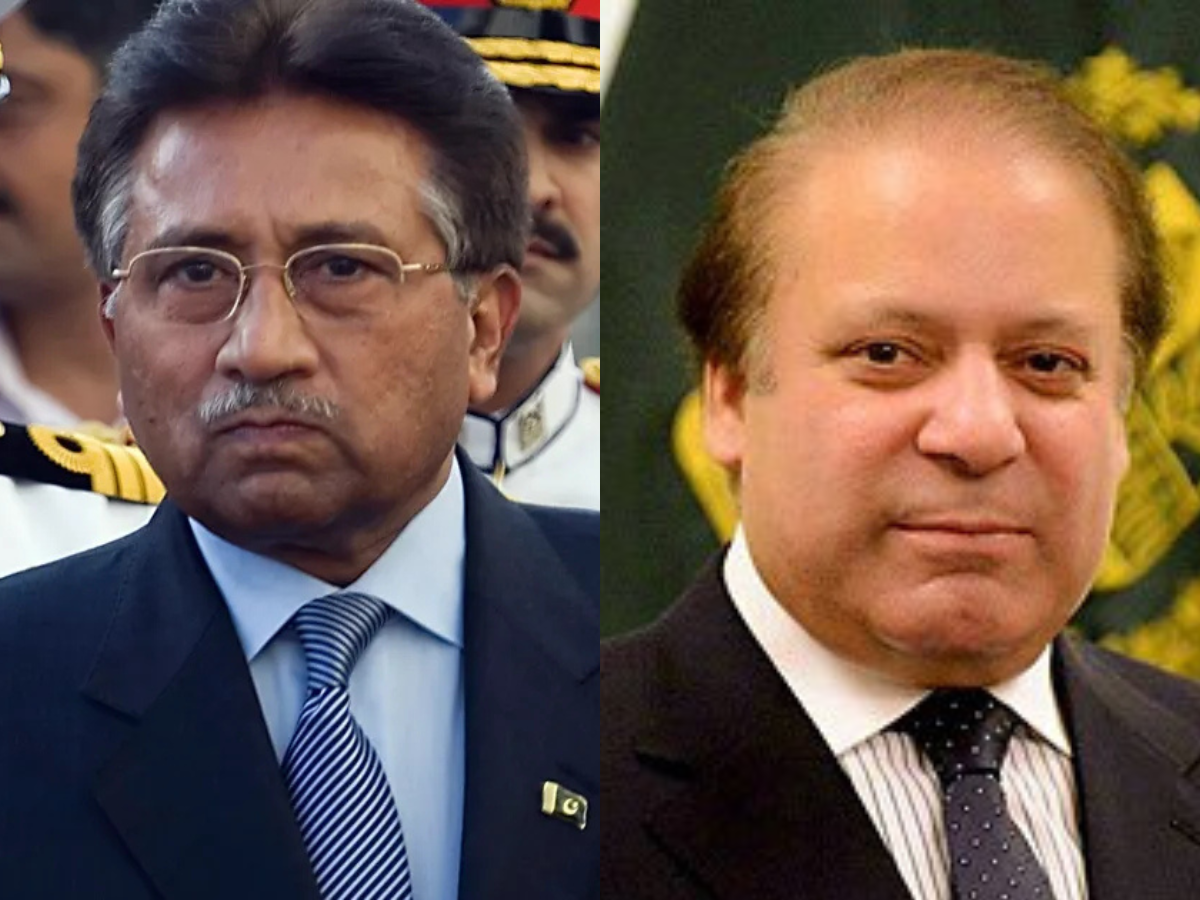
(Image Source: X.com/ANI)
October 12 marks 26 years since Gen. Pervez Musharraf forced Prime Minister Nawaz Sharif from office and declared himself “chief executive.” He suspended the constitution, retained the ceremonial husk of parliament, and promised reform that never arrived. What he did deliver was a durable template: elections and cabinets on the surface, the generals’ veto underneath. The coup did not end; it professionalised.
In Musharraf’s narration of the takeover, there were corporate titles and technocrats placed as poster faces to at least provide a surface-level dress-up to the khaki in control. That approach entrenched a structure in which civilian actors perform within boundaries enforced by the military and its intelligence arms.
The Supreme Court’s 2012 Asghar Khan judgment documented how the security establishment had already “polluted” the 1990 vote by funnelling money to preferred politicians: proof that manipulation pre-dated 1999 and later adapted rather than receded.
The choreography matured again in 2018, when opposition parties accused the military of midwifing Imran Khan’s rise; they formed the Pakistan Democratic Movement to protest “interference.” In 2024, Pakistan returned to the polls amid arrests, media pressure, and the sidelining of Khan’s party symbol.
Independent observers and scholars described these conditions as deeply flawed for elections. Military courts then resumed or secured trials for civilians linked to the May 2023 unrest, prompting criticism from rights groups and Western governments.
Today’s military leadership has refined the security rationale into a standing permission slip. In 2025, after the worst India–Pakistan crisis in years, Army Chief Asim Munir’s stature only grew, capped by his promotion to field marshal— a telling consolidation of military primacy over a nominally civilian system. Munir’s public statements point to a constant message: deterrence first, politics later. The signal to Islamabad’s political class is unmistakable.
In recent months, Pakistan’s military has repeatedly framed domestic politics through the lens of Indian threat— warning of “swift” responses and invoking nuclear brinkmanship narratives in ways that, disputed or not, dominate the airwaves and crowd out debate on governance. The point is less the precise wording of any one speech than the steady use of external peril to justify internal control.
The costs are heaviest on Pakistan’s peripheries, where security policy doubles as domestic rule. In Pakistan-administered Kashmir, price-rise protests in May 2024 left four people dead and more than a hundred injured; fresh clashes this month killed at least eight. These are political crises being managed primarily as security problems.
In Khyber Pakhtunkhwa, years of air and drone strikes in counter-insurgency campaigns have normalised the use of force from the sky on Pakistani soil, with rights groups warning about civilian risk and the shrinking space for peaceful assembly under new public order rules.
In Balochistan, families continue to rally against disappearances and extrajudicial killings. International reporting and NGOs document a grinding cycle: insurgent violence, sweeping crackdowns, and a politics that rarely answers to the people most affected. The absence of credible accountability—no civilian authority above the military in practice—sustains this loop.
What ties these theatres together is not simply coercion; it is impunity. When soldiers are the final court of appeal, courts and cabinets become scenery. That is why no prime minister has completed a full term, why elections read as legitimising rituals, and why dissent is increasingly securitised. Human Rights Watch’s 2025 chapter on Pakistan details a continuing clampdown on expression and civil society after the 2024 vote; Amnesty International has flagged legal changes that chill protest. These are not one-off excesses; they are features of a system built to endure.
Foreign partners often prefer “stability” which in Pakistan tends to mean dealing with the commanders who can deliver quick decisions. That short-term convenience comes with long-term costs: a brittle polity, peripheral regions governed by force, and a political class conditioned to seek military favour rather than public consent.
Twenty-six years after 1999, the task is not merely to “restore” civilian rule but to build it: protect media and association rights, end military trials of civilians, publish a credible road map on missing persons, and subordinate security policy to elected oversight. Without those basics, Pakistan will keep trading legitimacy for control and keep getting neither security nor prosperity in return.
(Aritra Banerjee is a defence, foreign affairs, and strategic affairs columnist, and co-author of The Indian Navy @75: Reminiscing the Voyage. He holds a Master’s in International Relations, Security and Strategy, and writes extensively on security, geopolitics, and military history with bylines in leading national and international outlets.)
