China’s private maritime security companies are expanding in the Indian Ocean, blending commercial escort services with strategic influence. Learn how this grey-zone presence is reshaping regional maritime security.
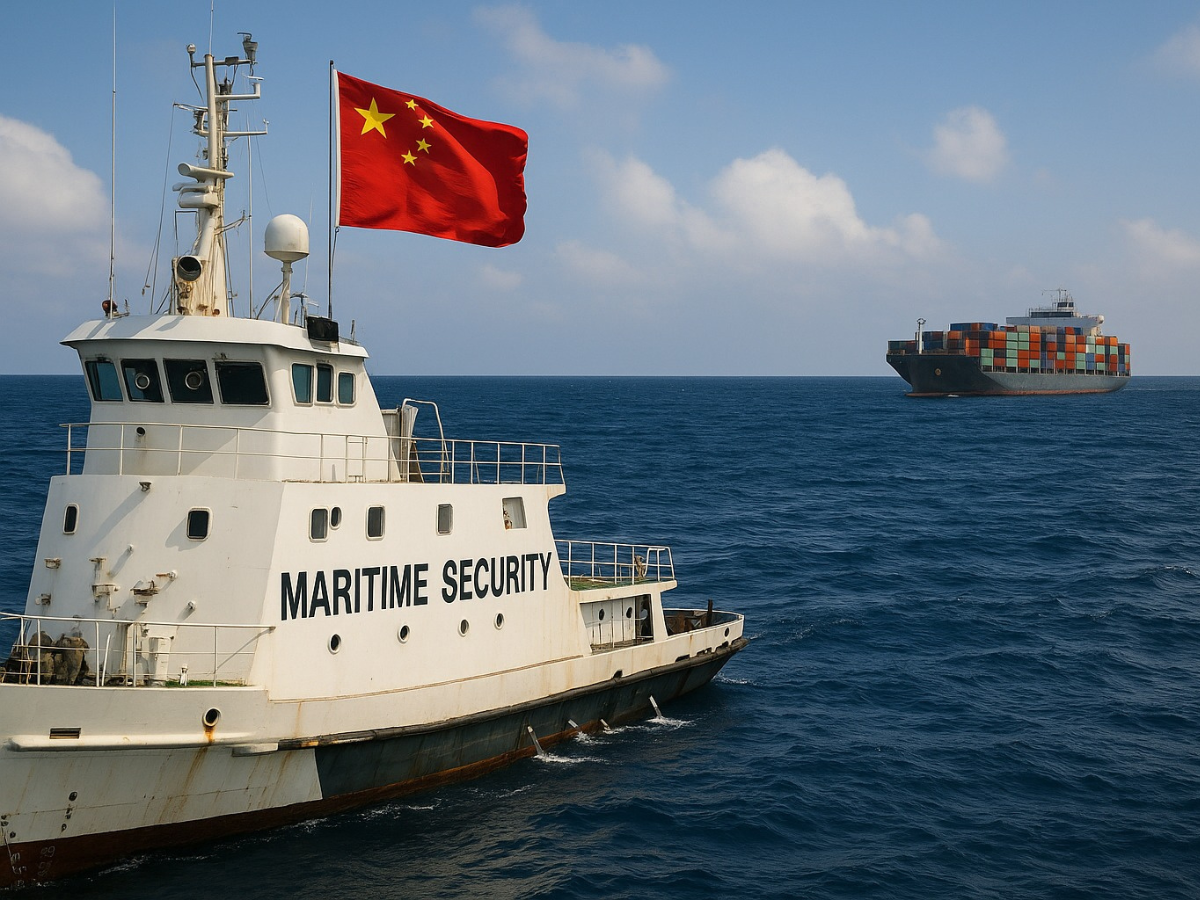
China’s private maritime security companies are expanding in the Indian Ocean, blending commercial escort services with strategic influence.
Private maritime security companies are not new to the Indian Ocean. For years, firms from Europe and the Gulf have offered escort services to protect vessels from piracy. But a new player has entered the field with a very different agenda: China. Through commercial “maritime security companies,” many staffed by former PLA veterans, Beijing is quietly building a grey-zone naval presence along Africa’s eastern seaboard.
These companies, registered as private escorts or shipping protection outfits, operate in the Gulf of Aden, around the Horn of Africa, and increasingly near Somali waters. Officially, they safeguard Chinese commercial vessels from piracy. Unofficially, they extend China’s maritime situational awareness, gather intelligence, and create familiarity with regional waters—all without deploying PLA Navy assets directly.
AIS data from shipping trackers shows Chinese-flagged escort vessels operating alongside commercial fleets, often shadowing convoys at extended distances. Their patterns mirror naval escort logic but under civilian classification. This arrangement fits neatly with China’s doctrine of “military-civil fusion,” where state and commercial entities support national security objectives jointly.
Unlike Western private security firms, which focus strictly on protection, Chinese firms maintain close ties to state institutions. Many senior staff are retired naval officers. Several companies share board members with logistics firms that supply China’s base in Djibouti. Their vessels are equipped with advanced communications systems compatible with Chinese naval networks.
This makes them more than commercial entities—they are extensions of national strategy.
For Africa, this development carries implications. Private security companies can operate in legal grey areas, especially in waters with fragmented jurisdiction. Their presence complicates maritime governance, blurs lines between commercial and military activity, and introduces a new actor not bound by the same transparency expectations as navies.
Somalia’s recent defence agreement with Pakistan adds another layer. As Islamabad assists Somalia’s navy, Chinese-made systems and Pakistan-linked security contractors may enter Somali waters. This creates overlapping spheres of influence that reinforce, rather than dilute, China’s reach.
The rise of Chinese maritime contractors also challenges the cooperative frameworks established by EU NAVFOR, the Combined Maritime Forces, and the Indian Navy. These missions function on transparency and shared reporting. Grey-zone actors do not. Their movements, intentions, and data collection processes remain opaque.
Western policymakers have begun to take notice. Reports from European think tanks highlight the increase in Chinese “private” escorts in the Western Indian Ocean since 2021. US naval analysts view them as part of Beijing’s broader pattern of shaping security environments through quasi-state entities before formalising presence later.
For India, this trend demands careful monitoring. A grey-zone maritime actor cannot be countered through conventional diplomatic channels because it is neither fully civilian nor fully military. But its presence changes the operational picture at sea—especially around chokepoints like the Bab el-Mandeb.
African governments will need to consider the long-term consequences of this shift. Private maritime security is useful, but not when it becomes a backdoor for foreign influence. Transparency, licensing, and monitoring frameworks must evolve to prevent misuse.
China’s new privateers are not pirates, but they navigate the same waters with far more strategic purpose. Their rise suggests a new phase in the Indian Ocean’s security landscape—one in which influence comes cloaked in commerce, and power sails under a different flag.
(Aritra Banerjee is the co-author of the book 'Indian Navy @75: Reminiscing the Voyage')
