
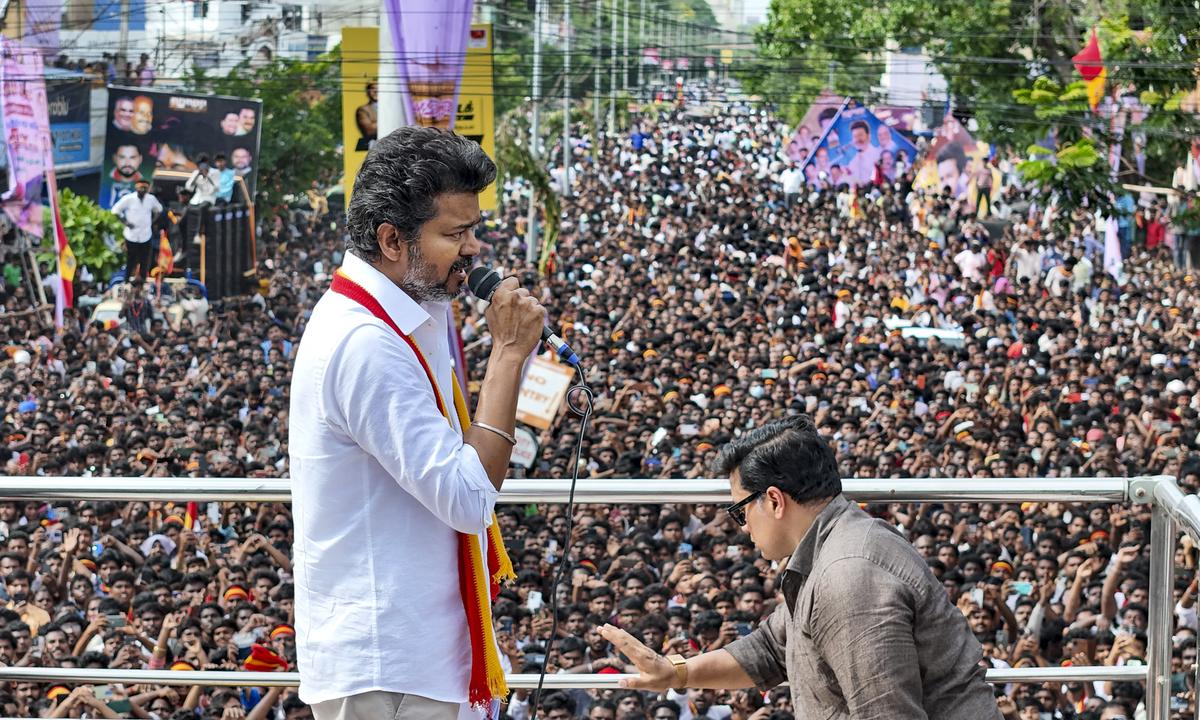
NEW DELHI: Tamil Nadu is set to witness a triangular contest in the upcoming Assembly elections, scheduled to be held in the coming months, with the entry of actor-turned-politician Vijay adding a fresh dynamic to an already competitive political landscape. In the three-cornered fight, the ruling DMK-led alliance—comprising the Congress and Left parties—will face the opposition NDA, which includes the BJP, the AIADMK and several regional outfits. Vijay’s Tamilaga Vettri Kazhagam (TVK) is positioning itself as a third front, seeking to consolidate anti-DMK sentiment and redraw the state’s electoral equations.
As the state moves closer to polling day, TVK is attempting to mobilise voters disenchanted with traditional Dravidian parties, particularly those opposed to the DMK. Political observers note that Vijay’s entry has the potential to disrupt established vote-sharing patterns, especially among youth and first-time voters. His presence could prove decisive in several constituencies by splitting the anti-DMK vote, thereby altering outcomes in closely fought seats.
Analysts estimate that Vijay’s popularity could translate into a vote share of around 10-12 per cent. While TVK may not secure a large number of seats on its own, it could emerge as a significant spoiler—particularly for the BJP-led NDA, which is banking on the consolidation of anti-DMK votes. If TVK manages to convert even a portion of its vote share into seats, it could pose a serious challenge to the NDA’s electoral calculations.
Vijay’s political foray is also being closely watched in the context of minority politics. Belonging to the Christian community, which accounts for about 7 per cent of Tamil Nadu’s population, his rise could impact the DMK’s traditional hold over minority voters. When combined with Muslim voters, minorities are estimated to constitute around 12 per cent of the electorate. There is also speculation that some smaller regional parties may align with TVK ahead of the elections. While it remains uncertain whether TVK will dent the DMK or the AIADMK more, Vijay has clearly emerged as a new electoral force, keeping both Dravidian majors on edge.
At the centre of the contest remains the ruling DMK-led alliance, which is seeking a renewed mandate after completing its term with a strong emphasis on welfare schemes and social justice initiatives. The party’s confidence stems from its recent electoral dominance, including sweeping victories in the 2019 and 2024 Lok Sabha elections and the 2021 Assembly polls.
Despite projecting confidence in overcoming anti-incumbency, the DMK faces challenges arising from governance fatigue and persistent allegations of corruption. Another contentious issue is the perception of one-family dominance, with influence extending from Chief Minister M.K. Stalin to Deputy Chief Minister Udhayanidhi Stalin, son-in-law Sabareesan, and other close associates, whose reach is seen across politics, real estate, cinema and media. In this backdrop, the government’s aggressive rollout of welfare schemes is widely viewed as an effort to blunt the impact of incumbency.
On the other side, the BJP-AIADMK alliance believes it has an opportunity to turn the tables by consolidating anti-incumbency sentiment and projecting itself as a credible alternative to the DMK. The BJP has adopted a more pragmatic approach by embracing coalition politics in Tamil Nadu and working closely with Dravidian-origin allies.
Political observers say the NDA’s strategy is focused on expanding into a broader anti-DMK political and social coalition. This includes leveraging the AIADMK’s traditional support base among OBCs and Dalits, building on the BJP’s appeal among the middle class and upper castes, and capitalising on discontent against the Stalin government. With organisational backing and campaign support from the Centre, the AIADMK-led NDA is betting on this multi-pronged approach to mount a serious challenge in the forthcoming Assembly elections.




