
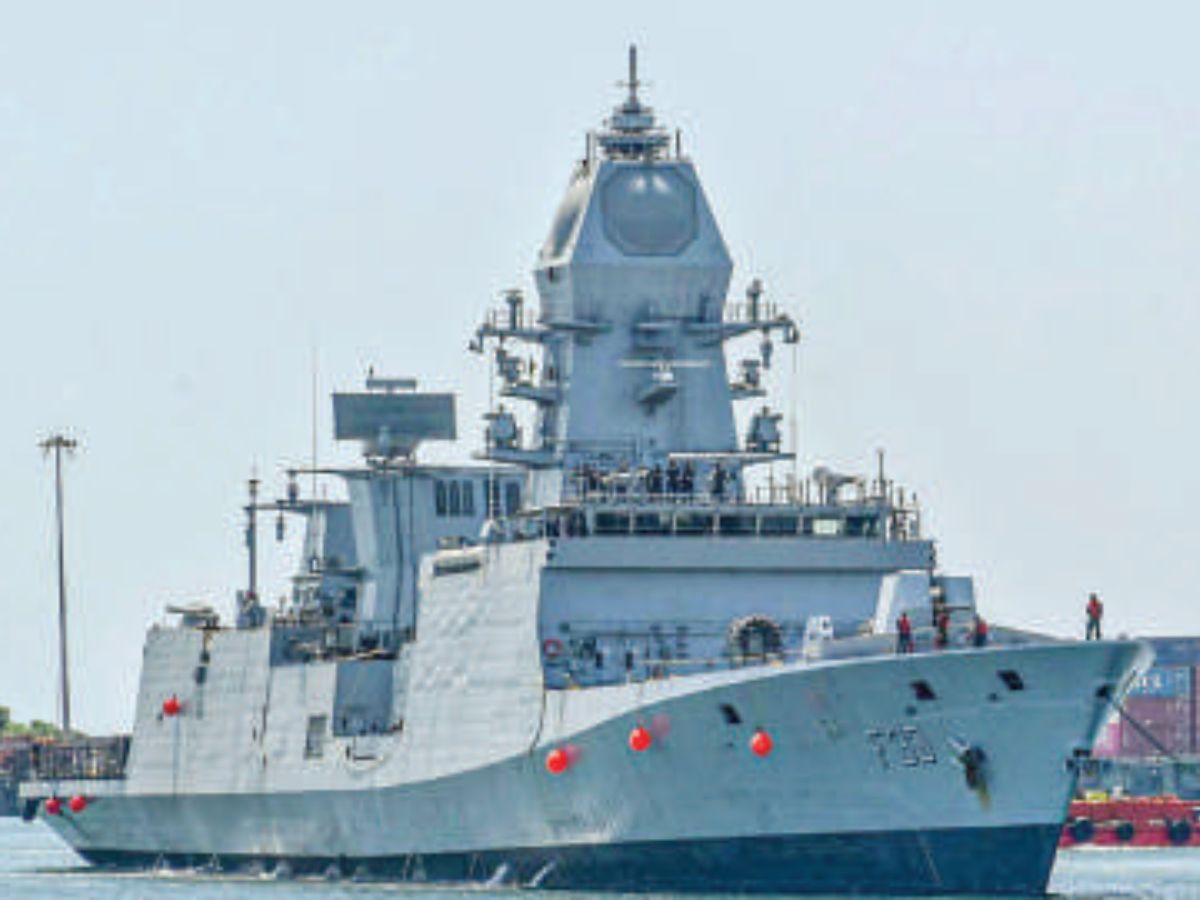
Vadodara: It’s intriguing to witness how a nation that has long been preoccupied with security concerns emanating from the northwest frontiers and continuously criticised for its sea blindness is working to place itself strongly into three tripods and six principles of the grand vision of sea power propounded by Alfred Thayer Mahan, a renowned US Navy strategist in the late 19th century. The recent move by the Government of India to revitalise the country’s shipping sector through a Rs 69,725 crore package is being considered as a step forward towards the Mahanian theoretical endeavour to sea power that evolved around the unification of a robust maritime commerce, formidable naval fleet, and strategic outreach. This is the vision which consequently helped Britain and the United States to become leading sea powers of the world in the past. In the near future, it would be interesting to observe how India and China, a near-ideal case for the Mahanian sea power of the future, are utilising the vision of naval strategist Alfred T. Mahan in developing their maritime doctrine and consequent strategic manoeuvring in the Indian Ocean or Indo-Pacific region. Delhi’s recent push for the development of ports and the shipping industry, whether it is the Sagarmala project or the Rs 69,725 crore package to transform the country’s shipbuilding and maritime sector, must be viewed as a significant step forward towards its rise as a sea power, an acceptance of the grand vision of Mahan as well as its own visionary thinker, diplomat and historian of modern India, K.M. Panikkar.
The shipping sector has been one of the weakest links in India’s rise as a sea power. The development in the shipping sector must be matched with India’s recent efforts to make a true-blue water navy and enhanced outreach in the Indian Ocean or Indo-Pacific region. A nation with a strong shipping sector may or may not be a sea power, but a strong shipping sector or merchant navy is a prerequisite for sea power status. Before becoming sea powers, both Britain and the United States of America met the requirements of a strong shipping industry, and importantly, China, which has already turned to Mahanian ideas of sea power, is moving in the same direction. However, India’s shipping sector, which was not as promising as that of China, South Korea, and Japan in the recent past, is currently striving for advancement. Government of India is attempting to position itself in the top 10 globally for shipbuilding and ship repair. The Amrit Kaal Vision 2047 sets an even more ambitious goal for India: by 2047, it hopes to rank among the top five in this sector.
Years before the country gained its Independence, eminent historian R.K. Mookerji wrote about how poor shipping and shipbuilding conditions in the colonial era were hurting the nation’s progress and how a nation that depends on foreign ships cannot guarantee its economic growth. But even though Mookerjee made compelling arguments about the importance of indigenous shipping and the significance of the seafaring mindset for the advancement and development of a country like India, it did not get the deserved attention either during the colonial period or even after many years of Independence.
A shift in the role is imminent. A country bracketed into the criterion “colonies” under the Mahanian idea of sea power is now currently preparing to become a sea power by fostering the nation to satisfy the three prerequisites of sea power—production, shipping, and colonies—along with the Mahanian six principal conditions, namely geographical position, physical conformation, extent of territory, number of populations, character of the people, and character of the government. Interestingly, Mahan’s nineteenth-century concept of sea power included India as a source of raw resources and a new market for the then-dominant sea powers, Britain and the United States of America. However, “colonies” must be interpreted differently when talking about sea power in the 21st century. It now only refers to markets for industry and cheap labourers, with a stronger economic connotation and fewer political presumptions.
There is a change. India, like China, has turned to Mahan. Panikkar’s maritime vision, which was somewhat confined between the Mahanian framework and the British Raj’s perspective on the Indian Ocean region, is no longer disregarded by India’s policymakers. Indeed, the country is once again looking for the revival of its robust maritime tradition of the past, putting an end to its “sea blindness” and myopia towards an export-led economy. The efforts are being supplemented by its enhanced strategic outreach in the ocean region, as well as improved power projection capabilities of the Indian Navy.
It seems that now India is on the path of acquiring sea power status in the Indian Ocean and Indo-Pacific region and is certainly benefiting from the visions of Alfred T. Mahan and K.M. Panikkar. In the near future, we may witness a competition or collaboration between China’s Mahan-Maoist and India’s Mahan-Panikkar models in the Indian Ocean region. It will be interesting to see how India is managing its balancing act in the multipolar Indo-Pacific. The “logic of geography” or “spatial maritime security paradigm” is one of the prime enablers of most of the geopolitical thinkers of the 19th and 20th centuries; many of them are complimenting India’s ascent as a sea power in the current global and regional political scenario. However, the “logic of geography” cannot work alone; it must be supported by the “logic of economics” and “logic of security.”
Dr Amit Kumar is Assistant Professor at the Department of Maritime Security, School of National Security Studies, Central University of Gujarat, Vadodara.




