
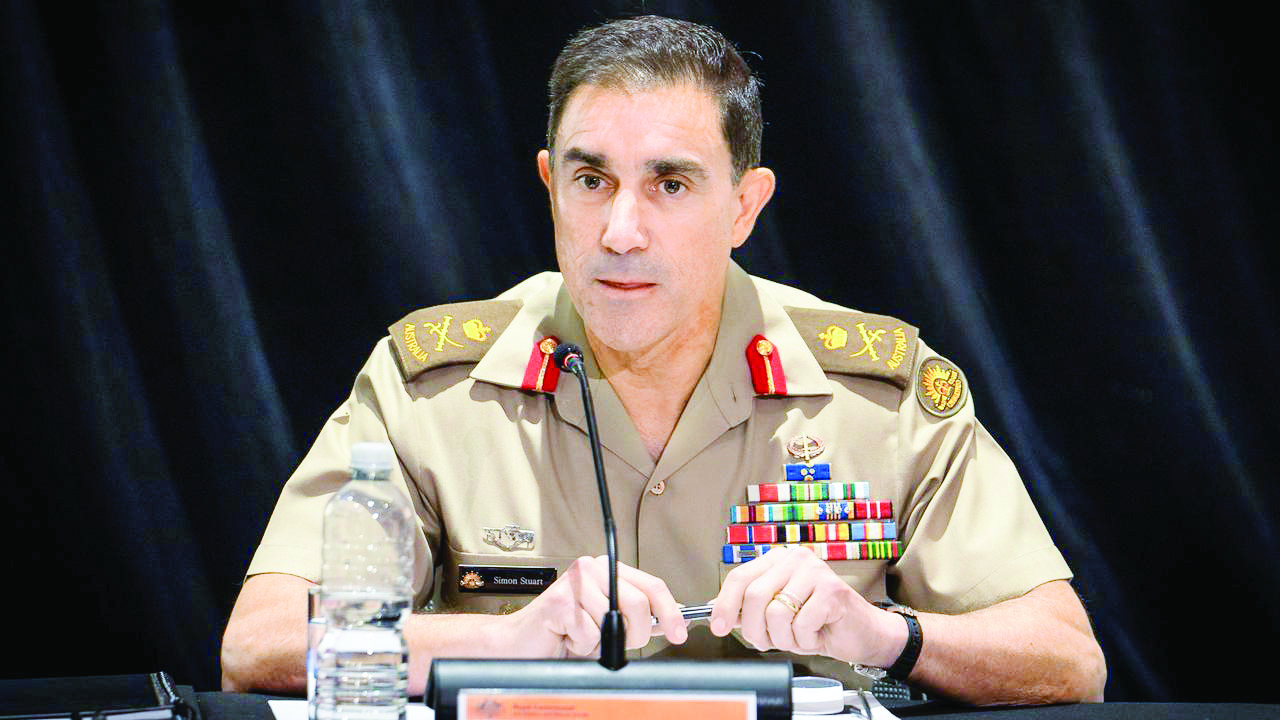
NEW DELHI: When the Australian Army Chief, Lieutenant General Simon Stuart, lands in India for his official visit from August 10-14, 2025, it won’t just be another high-level military courtesy call. For the Indian Army, this is about cementing a partnership that is moving well beyond symbolic gestures into the realm of serious, structured cooperation. For too long, public debate around the Indo-Pacific has been dominated by images of warships and maritime manoeuvres.
Yet the ground reality—quite literally—is that land forces are just as critical to keeping the region stable, resilient, and prepared. In that space, the India-Australia Armyto-Army relationship is becoming one of the region’s most quietly consequential alignments. Discussion of the Indo-Pacific almost always centres on sea lanes, chokepoints, and naval firepower. This makes sense given the geography.
But it also risks underplaying a hard truth: without capable, wellconnected land forces, no amount of naval deterrence can guarantee stability. Humanitarian assistance after cyclones, stabilisation in restive areas, counterterrorism, or even reassuring smaller nations through training missions—these are all land-centric missions. Both India and Australia, as continental powers with expeditionary capability, understand this reality well. Their evolving Army partnership reflects a shared belief that credible land capabilities, backed by deep professional trust, are not a “nice-tohave” but an essential layer in the Indo-Pacific’s security architecture.
AUSTRAHIND: TRAINING TOGETHER FOR MODERN THREATS
Nothing illustrates this better than Exercise AUSTRAHIND, the flagship bilateral field exercise between the two armies. First held in 2016, it began as a focused counter-terrorism drill. Over time, it has grown into a full-spectrum training engagement that blends closequarter battle, joint tactical planning, and interoperability in complex terrain. The next edition, scheduled for November 2025 in Australia, will put troops through their paces in three challenging environments— dense jungles, urban landscapes, and contested “grey zone” scenarios that mirror the increasingly ambiguous and hybrid threats militaries face.
For soldiers on both sides, this exercise is a laboratory for developing real-time solutions to practical problems: combining tactics, sharing intelligence rapidly, and adapting plans on the fly. The lessons travel both ways. Australian troops learn from the Indian Army’s counter-insurgency depth in Kashmir and the Northeast; Indian soldiers absorb insights from Australia’s experiences in the South Pacific and multinational coalition operations.
THE ARCHITECTURE BEHIND THE ENGAGEMENT
Exercises like AUSTRAHIND don’t happen in isolation. They sit atop a carefully maintained architecture of dialogue and planning. The Army-to-Army Staff Talks, held annually since 2016, have become a core decision-making platform— a space to align doctrines, identify capability gaps, and set priorities for joint activities. These link directly to higher-level formats, such as the 2+2 Ministerial Dialogue (last held in New Delhi, November 2023) and Defence Policy Talks (Sydney, July 2023).
The advantage of this multi-tier approach is its agility: an idea discussed during an exercise debrief can travel up the chain, be shaped into a proposal at staff talks, and then garner policy support at the ministerial level. That agility is especially useful for coordinating beyond the bilateral space— for example, aligning approaches to post-disaster logistics in the Indian Ocean or supporting capacitybuilding missions in Southeast Asia.
KNOWLEDGE PARTNERSHIPS: THE CLAWS CONNECTION
The Centre for Land Warfare Studies (CLAWS), the Indian Army’s autonomous think-tank, has quietly become an important bridge in the relationship. CLAWS has previously worked with Australian counterparts, and the upcoming Memorandum of Understanding, to be signed during Lieutenant General Stuart’s visit, will significantly expand that collaboration. The MoU’s scope goes beyond polite academic exchange. It includes joint studies drawing on both nations’ operational experience in land warfare, counter-terrorism, and stabilisation operations. It envisions scenario-gaming exercises, structured strategic discussions, and scholarly exchanges that will inform operational thinking directly.
Australian participation in flagship events like the Chanakya Defence Dialogue, organised by CLAWS for the Ministry of Defence and the Indian Army, will give Canberra’s military thinkers direct access to India’s strategic community— and vice versa. The logic is simple: the better the two armies understand each other’s doctrines, the faster they can align in a crisis.
INVESTING IN THE NEXT GENERATION
Strategic trust isn’t built only between generals and policymakers; it starts with young officers in the field. The Young Officers Exchange Programme, conceived by the late General Bipin Rawat and launched in 2022, is specifically designed for this purpose. By embedding junior officers in each other’s units, exposing them to different training environments and command cultures, the programme seeds familiarity early in careers. Years from now, when these officers are in senior roles, that familiarity will make coalition planning faster and joint operations smoother. Add to this the crosspostings at institutions such as India’s Defence Services Staff College and Australia’s Army Command and Staff Course, and you have a steady conveyor belt of leaders who can speak the same operational language even before they meet in person.
FROM PARADE GROUNDS TO PRODUCTION LINES
The India-Australia Army relationship is also extending into the defence industrial domain. Indian firms have begun supplying Australia with tactical intelligence, surveillance, and reconnaissance (ISR) systems, protected mobility vehicles, and battlefield platforms. In parallel, Indian Army’s Army Design Bureau (ADB) and Australia’s Digger Works are exploring co-development of cost-effective, combat-tested solutions tailored to modern operational demands. This is not just about selling equipment; it’s about designing together for the realities of contemporary conflict, from ruggedised communications to adaptable armoured platforms. If successful, this model could become a template for how Indo-Pacific armies collaborate with industry to boost resilience and selfreliance.
WHY THIS MATTERS FOR THE INDOPACIFIC
The Indo-Pacific is not a single, homogenous security theatre. It’s a patchwork of maritime choke points, littoral states, island nations, and continental interiors— each with its own vulnerabilities. In many of these contexts, land forces are the first to respond and the last to leave. By building deep interoperability, India and Australia are creating a force multiplier that extends beyond their own territories.
Whether it’s humanitarian assistance in a cyclone-hit island state, joint peacekeeping in a conflict zone, or deterrence posturing alongside partners in a grey-zone flashpoint, the ability to deploy land forces together with confidence is a tangible strategic asset. This also dovetails with India’s stated aim of being a net security provider in the region, and Australia’s interest in ensuring stability across both its Pacific and Indian Ocean neighbourhoods.
LOOKING AHEAD: FROM TRUST TO STRATEGIC HABIT
What sets the India-Australia Army partnership apart is its balance of the practical and the strategic. It isn’t a headline-grabbing alliance, but a steadily cultivated habit of working together in training areas, in classrooms, in think tank forums, and increasingly in the industrial sphere. Lieutenant General Stuart’s visit is likely to produce further commitments, but the real story lies in the operational and intellectual habits that have already taken root. These are the habits that, in a crisis, make the difference between a hesitant response and a seamless one. For the Indo-Pacific, an environment where strategic shocks are becoming more common, such habits are worth their weight in deterrence.
Ashish Singh is an awardwinning senior journalist with over 18 years of experience in defence and strategic affairs.




