
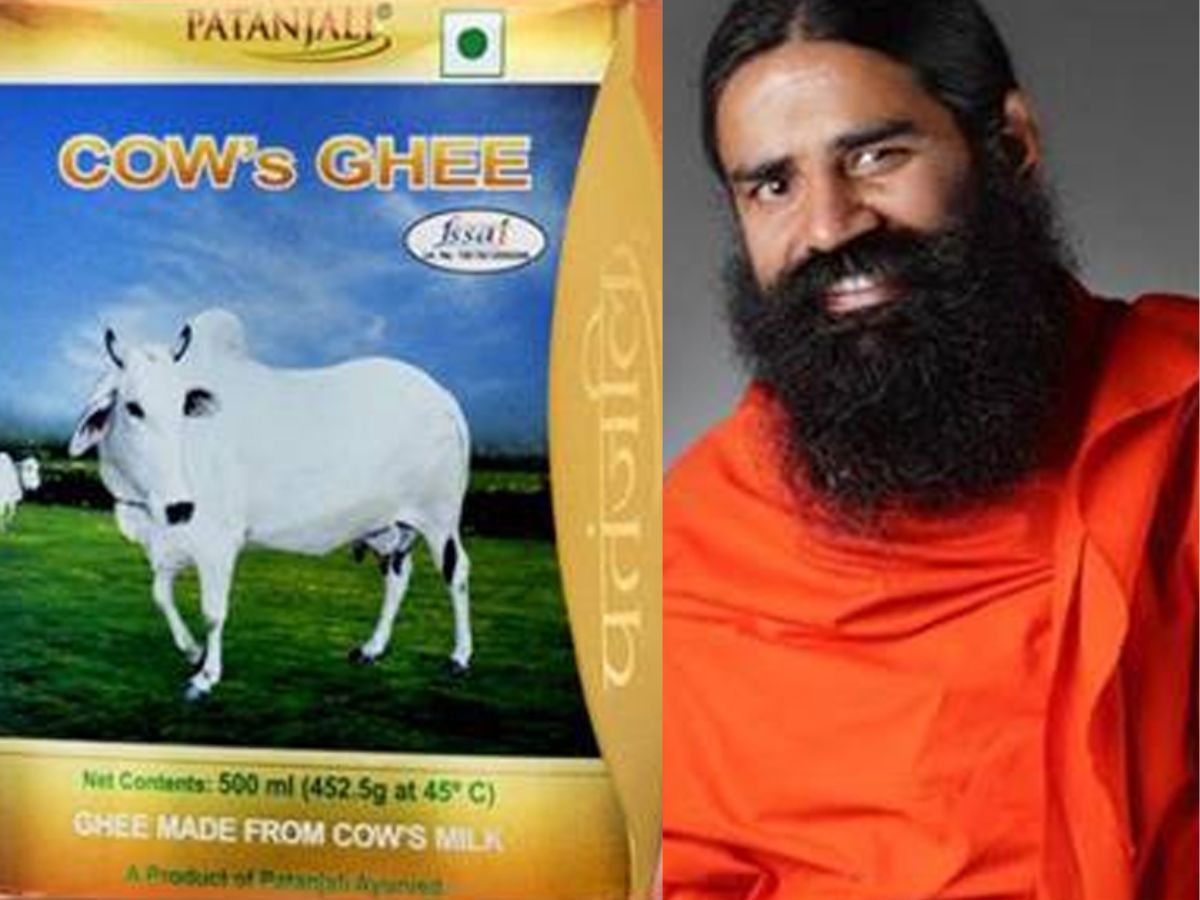
New Delhi: Yoga guru Baba Ramdev and his company Patanjali have courted another controversy after a sample of their ghee failed quality-control testing.
Following the test failure, the company is now facing substantial penalties imposed by a local court in Uttarakhand. Both state and national laboratories confirmed irregularities in the sample, classifying it as adulterated, which led authorities to impose a cumulative fine of more than Rs 1.40 lakh on the manufacturer, distributor, and retailer involved.
However, Patanjali has strongly refuted the findings. According to the company, the case filed under the Food Safety Act and the subsequent court order are “incorrect” and “legally unsustainable”. Patanjali has claimed that the re-test was conducted after the sample’s expiry date, rendering the result invalid as per law. The company argued that the court passed an adverse order without considering key legal points. Patanjali also stated that it is filing an appeal before the Food Safety Tribunal and remains confident that the tribunal will overturn the judgement in their favour based on the merits of the case.
A message sent to the company seeking its version did not elicit any response.
The origins of the case go back to October 2020, when Senior Food Safety Officer Dilip Jain collected a ghee sample from Karan General Store in Kashni, Pithoragarh, during a routine inspection. Initial testing at the Government Laboratory in Rudrapur showed that the product failed to meet required standards and contained adulterants.
Patanjali Ayurved Limited challenged these findings, prompting authorities to send the sample to the National Laboratory in Ghaziabad for a conclusive analysis.
Sources indicate that the national lab also declared the sample substandard, strengthening the case against those involved in its sale and distribution.
Subsequently, the Food Safety Officer filed a complaint before the Additional District Magistrate, Pithoragarh. After hearing arguments and reviewing all evidence, ADM Yogendra Singh delivered his verdict this past Thursday, ruling against the accused parties.
The court imposed a penalty of Rs 100,000 on Patanjali Ayurved Limited, Rs 25,000 on the distributor Brahm Accessories (Dharchula Road, Pithoragarh), and Rs 15,000 on the retailer, Karan General Store.
The detailed lab report shows that the ghee failed specifically on the Reichert-Meissl (RM) value parameter. The sample showed an RM value between 26.5 and 26.8, below the mandatory minimum of 28 for pure ghee. The product was categorised as “substandard”—not necessarily containing harmful toxic substances, but still in violation of FSSAI quality norms due to this deviation.
The analysis also emphasised that the product was substandard, with no presence of toxic adulterants, but did show a “minor deviation” from the prescribed benchmark.
Patanjali responded by stating, “The judgment does not anywhere state that Patanjali cow ghee is harmful. It only notes a slight variation from the standard RM value. The RM value represents the content of volatile fatty acids, which naturally evaporate when ghee is heated. This is a natural phenomenon and does not compromise the quality of the product. A small fluctuation is as normal as a minor difference in haemoglobin levels in the human body.”
The company further argued that the parameters used for the test were not applicable at the time the sample was taken and therefore invoking them is legally flawed. Patanjali also asserted that the referral laboratory lacked NABL accreditation for testing cow ghee, making its findings legally questionable.
Calling the assessment “ridiculous and highly objectionable”, the company claimed that an unqualified lab had incorrectly labelled their premium cow ghee as substandard.
Meanwhile, local farmers say Patanjali’s operations have affected their livelihoods. Satash Bhatt, president of Parvatiya Kishak Udhyam Bagwan Sangatan, Janpath Rudra Prayag, told the publication that herbs have traditionally been grown by mountain farmers, but due to a lack of production facilities, many are now abandoning the practice. He said that instead of supporting these cultivators, companies like Patanjali have begun growing their own herbs in the mountains, which has further hurt the farmers. He urged the government to create a mechanism that requires Ayurvedic companies in Uttarakhand to procure herbs directly from local farmers.
Harish Singh Pundher, former pradhan of Mayali in Rudraprayag, told The Sunday Guardian that Patanjali’s claims of sourcing herbs with the help of local farmers were untrue. He asserted that the company has never contacted or collaborated with farmers in the region, and that its claims are “entirely false.”
This is not the first time Patanjali has been embroiled in such matters. Over the years, the company has faced several regulatory actions, product recalls, and allegations of misleading promotions. Patanjali has repeatedly attracted criticism for its aggressive marketing claims, especially in the Ayurvedic, health and immunity-boosting product categories.
One of the most controversial episodes was the promotion of “Coronil” during the Covid-19 pandemic. Patanjali marketed it as a cure for Covid-19, drawing strong objections from medical experts and regulators due to the absence of scientific verification. The Ministry of AYUSH and the World Health Organization (WHO) distanced themselves from the product.
Similarly, in the edible oil segment, Patanjali’s advertisements were challenged by competitors—including the Solvent Extractors’ Association of India (SEA)—for allegedly misleading consumers and disparaging rival products.
One of its major ongoing legal battles involves misleading medical advertisements. In 2022, the Indian Medical Association (IMA) approached the Supreme Court, accusing Patanjali of publishing ads that falsely claimed to cure chronic ailments such as diabetes, hypertension, and asthma, while simultaneously undermining modern allopathic medicine. The Supreme Court in 2024 reprimanded Baba Ramdev and Acharya Balkrishna multiple times for breaching orders to stop airing such advertisements.
The court temporarily suspended the advertisements of several products and demanded the publication of unconditional apologies. As a consequence, the Uttarakhand licensing authority suspended manufacturing licences for 14 Patanjali products.
Although the contempt notices were eventually withdrawn after Patanjali issued full-page public apologies, the Supreme Court maintained that it would not hesitate to reopen proceedings if any further violations occurred.
Patanjali has also faced several product-quality and FSSAI-related penalties. In 2016, its mustard oil advertisement accused competitors of selling adulterated, neurotoxin-laced oil—claims that the Advertising Standards Council of India (ASCI) deemed highly misleading. The FSSAI later issued a showcause notice to Patanjali.
That same year, a Haridwar court fined Patanjali Rs 11 lakh after finding that the company was misbranding products and selling items manufactured by third-party companies under Patanjali labels—an error the company acknowledged.
The Defence Ministry’s Canteen Stores Department (CSD) also suspended the sale of Patanjali’s amla juice after it was deemed unfit for consumption by a state laboratory.
The most recent controversy prior to the ghee incident occurred in 2025, when the FSSAI ordered the recall of a batch of Patanjali red chilli powder (batch number AJD2400012) after it was found to violate the Food Safety and Standards (Contaminants, Toxins and Residues) Regulations, 2011. The batch reportedly did not meet essential safety and quality benchmarks.
Such recalls are significant as they directly impact consumer trust and raise questions about the company’s internal quality-control mechanisms. Under regulatory norms, companies must pull back the entire defective batch from retail markets and issue clarifications to authorities.




