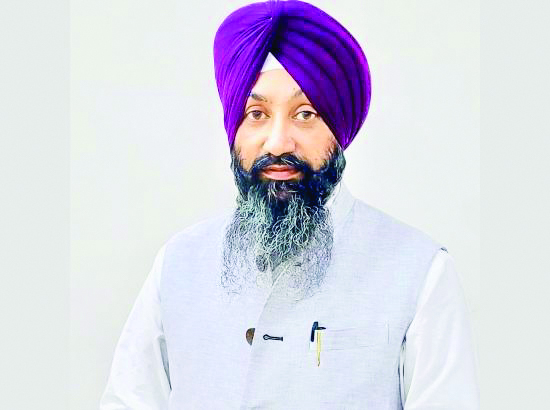
CHANDIGARH: In a political shift that marks a departure from decadesold electoral patterns, the Bharatiya Janata Party (BJP) has begun to gain ground in rural Punjab, regions where it once had virtually no organisational presence and was even denied entry during heightened political tensions. On Thursday, the party announced Harjit Singh Sandhu as its candidate for the upcoming bypoll to the Tarn Taran Assembly seat, which fell vacant following the death of Aam Aadmi Party (AAP) MLA Kashmir Singh Sohal in June.
The Election Commission has yet to declare the polling date, but the BJP’s announcement is being seen as part of a broader rural strategy that has been unfolding quietly and persistently over the past two years. From political exclusion to weekly presence Until recently, rural belts in districts such as Khadoor Sahib, Tarn Taran, and Faridkot were considered off-limits for the BJP.
These areas have historically been influenced by strong radical narratives, where identity politics, agrarian concerns, and religious sentiment often eclipsed any centralised, development-driven political discourse. Even during the BJP’s long alliance with the Shiromani Akali Dal (SAD), the party’s role in rural constituencies was negligible; it contested and held sway primarily in urban seats, leaving the village networks to its senior partner. The BJP’s rural invisibility was reinforced by its urban merchant-class voter base, its perception as a party of the Hindi-speaking belt, and its lack of strong Sikh farmer leadership. In many parts of rural Punjab, especially during politically charged moments, party workers found themselves unwelcome — a reality most visible during the farmers’ protests against the now-repealed central farm laws.
The transformation began two years ago, when BJP leaders started visiting rural pockets aggressively, meeting people directly in village gatherings, religious events, and local markets. This sustained outreach included appointing village presidents and coordinators from within the same communities that radical mindsets had earlier influenced. Party strategists say this has been crucial in breaking down mistrust, as these local representatives are not seen as outsiders but as known figures within the village social fabric. Parallelly, the BJP established weekly outreach camps, each drawing 400– 500 residents, where party teams help villagers apply for Ayushman Bharat health cards, explain central welfare schemes like PMKisan, Ujjwala Yojana, and Jal Jeevan Mission, and assist with pension and scholarship forms. In villages where saffron flags were once a rare sight, BJP’s tents and counters have become a regular fixture.
A key factor aiding the BJP’s rural entry has been the political weakening of the Shiromani Akali Dal. Once the undisputed political force in Punjab’s villages, SAD’s dominance has been eroded in recent years due to a combination of anti-incumbency, factional splits, and its perceived mishandling of key religious and political issues, including the Bargari sacrilege cases and the 2015 police firing incidents. Its exit from the BJP-led NDA in 2020 over the farm laws severed the old seat-sharing arrangement that had kept BJP away from rural contests.
Since then, the BJP has been forced to reinvent its electoral map in Punjab, contesting rural seats on its own for the first time in decades. The Tarn Taran bypoll, though a single seat, offers an opportunity to test whether the party’s outreach efforts can translate into actual votes in areas once controlled exclusively by its rivals.
The selection of Harjit Singh Sandhu as the BJP’s candidate for Tarn Taran reflects this strategic shift. While not yet a household name across the state, Sandhu has a profile the BJP believes can appeal to both rural voters and sections of the Sikh electorate. Tarn Taran, a district with deep religious significance and a history of political volatility, demands a candidate who can navigate both development issues and the region’s layered identity politics.
BJP insiders say Sandhu’s candidacy is meant to signal that the party is willing to back local faces with direct rural connect, rather than parachuting in leaders from urban strongholds. The bypoll will also be a measure of whether the BJP’s welfaredriven narrative can counter the emotional appeal of AAP, Congress, and SAD in a constituency that has never before elected a BJP MLA.
The rural areas of Khadoor Sahib, Tarn Taran, and parts of Faridkot have long been cited by political analysts as spaces where radical influence — rooted in historical grievances, religious mobilisation, and diaspora-linked narratives — is more pronounced. This has traditionally posed a challenge for parties like the BJP, whose nationalistic messaging is often interpreted through the lens of Punjab’s unique socio-political identity. By appointing local-level presidents and coordinators from within these communities, BJP has sought to bridge this gap, allowing political messages to be carried by familiar, trusted voices.
In addition, the party’s camps have focused on non-political service delivery as an entry point, offering tangible benefits before ideology. Speaking to The Sunday Guardian, a BJP senior leader said the party’s immediate focus in these areas is not on winning votes but on winning trust. “Votes may come later. For now, people must believe that we are here for them — not just for elections,” the leader remarked, underscoring the party’s long-game approach.
Though the Tarn Taran bypoll itself will not alter the arithmetic of the Punjab Vidhan Sabha in any significant way, it carries symbolic weight. A credible performance — even if not a win — would boost BJP morale and provide data points for planning in similar constituencies in the Malwa and Majha belts ahead of the 2027 state elections. For the Congress, AAP, and SAD, the BJP’s rural foray is a challenge to longheld assumptions about voter loyalties.
AAP, which swept rural Punjab in 2022, will be keen to retain Tarn Taran and demonstrate that BJP’s welfare camps have not dented its grassroots network. Congress, eyeing a revival in Punjab, sees the bypoll as a chance to reassert itself in Majha. SAD, meanwhile, faces the uncomfortable prospect of losing further rural ground to its former ally.
BJP leaders say the weekly camps will continue beyond the bypoll, regardless of the outcome, as part of a sustained strategy to normalise the party’s rural presence. “For decades, people in these areas only saw BJP leaders on TV. Now we are sitting with them in their pinds, helping them get benefits they didn’t know they were entitled to. This is not just election work, it’s relationship-building,” said another senior party functionary overseeing the outreach in Tarn Taran district.
The challenge will be translating administrative goodwill into electoral gains, especially when competing against entrenched local loyalties and deeply emotional issues. Political observers note that BJP’s welfare push will have to be accompanied by credible local leadership and a sensitive handling of Punjab’s cultural and political complexities if it is to avoid being seen as merely transactional.
As the date of the bypoll is awaited, the BJP’s presence in rural Punjab is already a political storyline in itself — a narrative of a party once shut out of villages now holding weekly camps under shamianas, drawing 400-500 residents at a time, and led on the ground by village-level leaders who themselves come from communities that once kept the BJP at arm’s length. The Tarn Taran contest will reveal whether this slow but steady rural march can turn goodwill into ballots.
