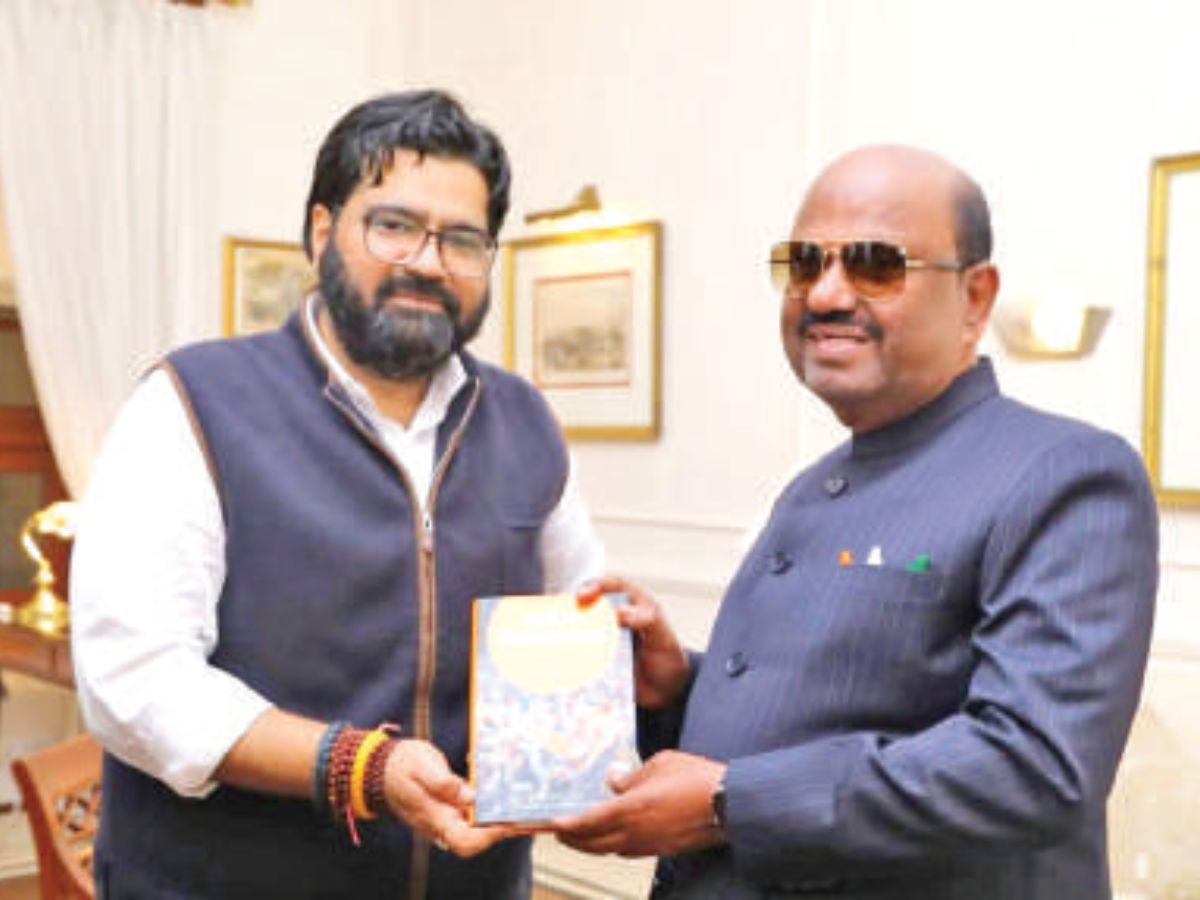
Independent Member of Parliament (Rajya Sabha), Kartikeya Sharma with Governor of West Bengal, C. V. Ananda Bose. (Image: File)
“Vande Mataram is not merely a song; it is the voice of India’s soul. It was banned by the British, and in an independent India, any overt or covert attempt to suppress it is something patriots will not accept,” said West Bengal Governor C.V. Ananda Bose while speaking at India News Manch 2025, organised by ITV Network.
The Governor further said that as Vande Mataram was born in Bengal, he has decided to organise Vande Mataram Yatras across the state. “Two yatras have already been held as part of the 150th anniversary celebrations. We plan to organise Vande Mataram Yatras at 150 locations. This song represents the soul of India and stands as a powerful symbol of patriotism and inspiration for the people of the country,” he said.
Earlier this week, under the banner of ITV Network, the two-day India News Manch conclave was held in the national capital, bringing together prominent political leaders, policymakers and subject-matter experts from across the country. The platform hosted extensive deliberations on key national concerns, governance challenges, and the future roadmap and priorities of India.
Speaking at the conclave, Union Minister for Law and Justice, Parliamentary Affairs and Culture Arjun Meghwal addressed the issue of judicial reforms. He said the government is working on two parallel fronts to reduce the pendency of cases. Meghwal highlighted technological upgradation, including strengthening court infrastructure and the expansion of the e-Courts project, for which an allocation of Rs 7,210 crore has been made. He also spoke about encouraging Alternate Dispute Resolution mechanisms such as arbitration, mediation and conciliation. He added that technologydriven “ageing analysis” of cases in the Supreme Court and High Courts would help identify matters pending for decades and enable systematic resolution of delays.
Simultaneously, Union Minister for Communications and Minister for Development of the North Eastern Region Jyotiraditya Scindia said India today has the world’s most affordable telecom network, with call tariffs having fallen by 97 per cent and data prices reduced by over 94 per cent since 2014. Highlighting India’s technological strides, Scindia said the country has developed its own indigenous 4G stack, which has been deployed on over one lakh BSNL towers. This, he said, enables a smooth transition to 5G and positions India to take a leadership role in 6G through the Bharat 6G Alliance, with a target of contributing 10 per cent of global 6G patents by 2027.
Similarly, Union Minister for Road Transport and Highways Nitin Gadkari said that development and progress are ongoing and continuous processes, stressing that innovation, technology and sustainability lie at the core of India’s growth narrative. Emphasising the importance of technology, he said knowledge today is closely connected with agriculture, industry and infrastructure. “Innovation, entrepreneurship, science, technology, research, schemes and successful practices together constitute knowledge, and the conversion of knowledge into wealth is the future,” he said. Gadkari reiterated his commitment to sustainability, stating, “No material is waste and no individual should be left behind.” He added that the road sector has undergone a major transformation, and what is visible today is only the beginning.
Speaking at a different session, Union Minister of Labour and Employment and Minister of Youth Affairs and Sports Mansukh Mandaviya highlighted the reforms introduced in the labour sector. He said the new labour codes ensure better access to employment opportunities and safeguards for youth. Even in cases where an appointment letter has not yet been issued, the system recognises applications and protects workers’ rights in the event of workplace accidents or disputes. Mandaviya said the Labour Ministry has worked consistently to modernise policies, simplify procedures and ensure that young people benefit from fair and secure employment opportunities.
Similarly, Union Minister for Culture and Tourism Gajendra Singh Shekhawat said India is advancing simultaneously on two fronts—rapid digitalisation and artificial intelligence on one hand, and the preservation of ancient knowledge traditions on the other. Referring to Aryabhata, he noted that Indian civilisation has long embraced scientific inquiry and made advanced astronomical discoveries centuries ago. He emphasised the need to digitise ancient manuscripts written on bark, cloth and handmade paper to safeguard India’s knowledge heritage and counter misleading global narratives. He added that India is among the few civilisations with an unbroken cultural history spanning over 10,000 years, despite centuries of foreign rule. The redeveloped North and South Blocks, he said, will house world-class museums showcasing this continuous Sanatana heritage.
Reflecting on India’s economic journey, Union Minister of State for Social Justice and Empowerment Ramdas Athawale said that during the UPA era, India was ranked 10th globally but has now risen to the fourth position after a decade of sustained efforts. He added that the government’s long-term vision is to make India the world’s largest economy by 2047, coinciding with the 100th year of Independence.
Meanwhile, opposition leaders also participated in the conclave and shared their views on pressing political issues. Speaking on the 2026 Assembly elections, Abhishek Manu Singhvi asserted that 2026 would belong to the Congress and its allies. He claimed that out of the five states heading to polls, the BJP would lose in four. Singhvi further said the BJP would also be defeated in Assam, alleging that the people of the state are no longer with the ruling party and are ready for change.
On the issue of opposition unity, Congress leader Sachin Pilot described the I.N.D.I.A. alliance as a strong and credible alternative to the BJP. He further stated that the Congress remains the only party with the organisational strength to challenge the BJP, asserting that Congress workers are active from Kerala to Kashmir, reflecting the party’s nationwide reach and grassroots presence.
Former Uttar Pradesh Chief Minister and Samajwadi Party president Akhilesh Yadav launched a sharp attack on the central government, expressing concern over the weakening rupee against the US dollar. He said per capita income figures themselves reflect the fragile state of the economy and accused the BJP of relying on loud slogans rather than delivering tangible economic outcomes. Targeting welfare politics, he remarked, “If the BJP gives ₹10,000 and wins elections, what will happen if we give ₹40,000? We are giving ₹40,000—now the BJP should raise it to ₹60,000.”
Iqra Hassan, Samajwadi Party MP from Kairana in Uttar Pradesh, also voiced strong objections to reports suggesting the renaming of the MNREGA scheme. She said changing the name would amount to a waste of public funds and questioned the logic behind altering the identity of a scheme that has proved effective and widely accepted. “If the scheme is working well, why should its name be changed?” she asked.
From the Congress camp, Punjab Congress President Amarinder Singh Raja Warring categorically ruled out any alliance with the Aam Aadmi Party (AAP) in Punjab. Speaking at India News Manch, he said the BJP has failed to establish any meaningful political presence in the state, adding that Punjab’s political landscape remains distinct from the BJP’s broader national expansion strategy.
