
“I don’t know how I will stay here but I cannot return home. If I go back, they will kill me.”
These are the words of a Hindu priest who has entered India via the India-Bangladesh border after a mob of radicals gathered outside a temple in Chandpur area of Chittagong district a few months ago, alleging that the priest had insulted the Prophet.
Speaking to The Sunday Guardian exclusively from an undisclosed location in India, the priest, Anik Goswami said that the intention of such radicals was to ensure that Hindus left Bangladesh and that “this would be their success.”
According to the priest, in March last year, he received a call from an unknown number on his mobile which pertained to a death threat.
“The sender was an unidentified person. He sent a WhatsApp message to me which pertained to a death threat. I asked the sender who he was when he sent me a screenshot of an objectionable social media post and claimed that I had been insulting the Prophet,” he said.
The priest further claimed that soon after this, he approached the Chandpur police station but the cops told him that they could not do anything about it.
“I had written nothing objectionable on my social media accounts. After I got the death threat, I immediately contacted the Chandpur police and informed them about the messages I had received. However, they told me they could not do anything about it,” he said.
The priest further said that because his wife was expecting a child, he maintained a low profile for some time but about 10 days later, the screenshot sent to him by the unknown sender went viral on social media.
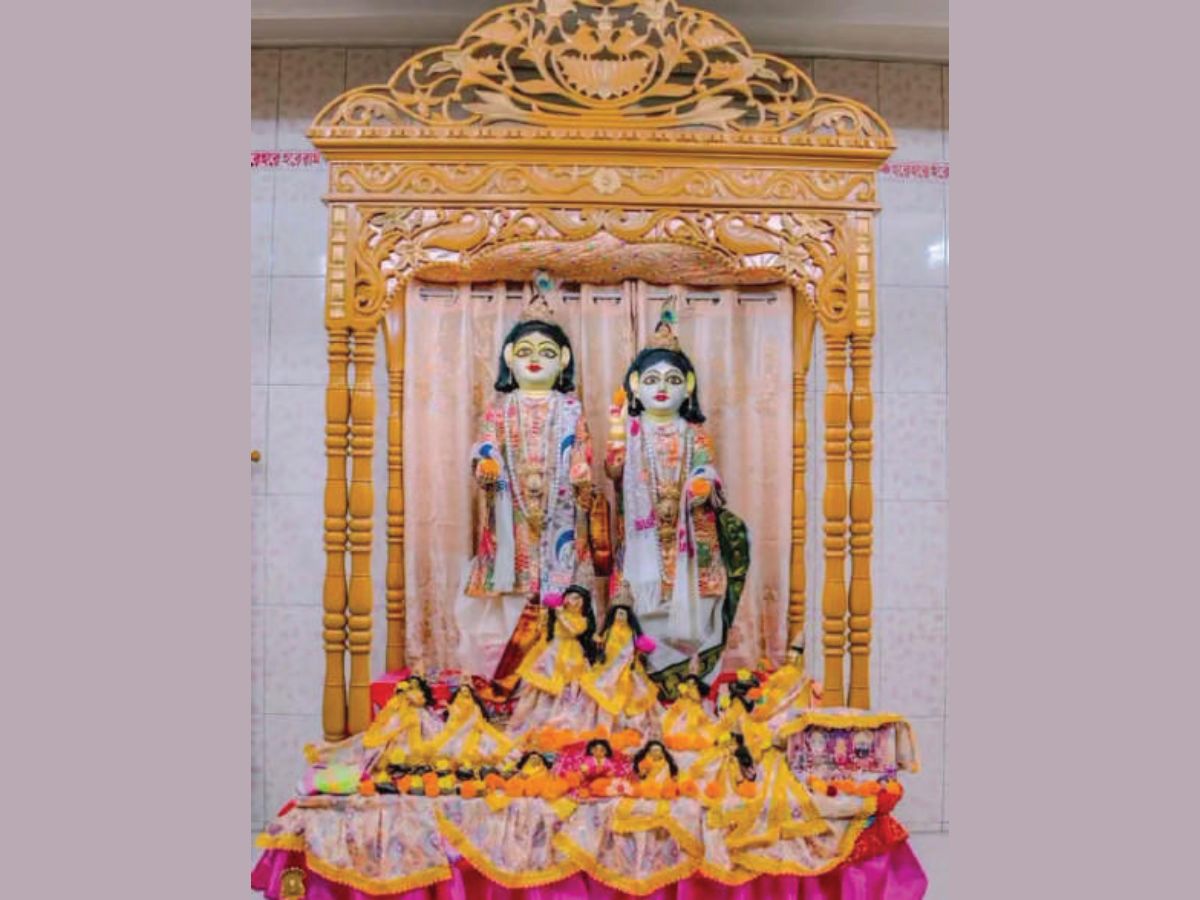
The temple in Chandpur’s Puranbazar, where the mob had gathered to hunt for Goswami is dedicated to Chaitanya Mahaprabhu, the founder of Gaudiya Vaishnavism and Goswami would conduct Bhagavad recitals there. Goswami says he is also associated with the ISKCON movement.
When the armed attackers arrived outside the temple, the priest hid inside the temple premises.
“Soon after the screenshot of the post went viral on social media, about 600 people gathered around the Chandpur temple near which I stayed with my family. They were armed and wanted to kill me. They claimed that I had abused the Prophet. I fled from the spot,” he told this newspaper.
After escaping, Goswami entered India a few days later.
Videos of the mob gathering have gone viral on social media. The mob can be seen gathered outside the temple while a group of policemen are seen chasing the protesters. In one of the videos which is 1:36 minute long, one of the protesters can be heard saying that the priest had “joked about the Prophet” and that he had been “hiding inside the temple.” The men later ransacked the temple.
Sharing the video on his Facebook page on December 26, Prosenjit Biswas, a digital creator from Bangladesh wrote that “the men belonged to the Touhidi Janata group.”
Goswami said that the men who had been hunting for him as part of the Touhidi group in Chandpur in March were led by members of the Jamaat-e-Islami, a hardline Islamist political party.
He said that while he managed to arrive in India, his family continued to reside at an undisclosed location in Bangladesh and he was worried for them.
“I have no money. We had a house but now nobody resides there. Nobody is there to look after my wife and daughter because I had to come here to save my life. I can’t even return home,” he said.
He said that he didn’t know how long he would be able to survive without money in India but couldn’t return because a return to Bangladesh would mean an invitation to death.
“I used to conduct Bhagavad recitals and would stay near the temple. I propagate Sanatan Dharma which is why I can’t stay there. Only those who eat and sleep with them (radicals) can be there now,” he said.
Kushal Chandra Chakraborty, sahmukhpatra of the Bangladeshi Sammilita Sanatani Jagran Jote told The Sunday Guardian that several Islamic groups operate under the banner of “Touhidi Janata.”
“Several groups like the Bangladesh Islami Chhatrashibir (the male student wing of the Bangladesh Jamaat-e-Islami), Hefazat-e-Islam, Islami Shasantantra Chhatra Andolan, Majlis-e-Islam and the Hizb-ut Tahrir operate under the banner of the Touhidi Janata. The Hizb-ut Tahrir is the most radical of them all and is behind some of the most violent criminal incidents,” Chakraborty said.
He said that the Touhidi Janata is behind several violent incidents against minorities.
“They operate under the same banner. It doesn’t have any committee but they lead processions and spread violence together. They were the ones behind the attacks on temples and mazaars and Baul supporters in Manikganj and Thakurgaon and other areas in November,” he said.
Chakraborty said that on July 4 last year, members of the Chhatrashibir and Islami Chhatra Andolan had gheraoed him in the vice chancellor’s office inside the Chittagong University when he had gone there to attend an interview for promotion.
“I had a photograph with the UP Chief Minister Yogi Adityanath which was clicked when I had gone to visit the Deen Dayal Upadhyaya University in Gorakhpur. They alleged that I was acting as an Indian agent which is why I was attacked. The protesters had locked the administration building too,” he said.
The Touhidi group has repeatedly disrupted Durga Puja celebrations in Bangladesh and has also been involved in violent clashes with the police.
In 2021, the group was among the several Islamic groups to oppose Indian Prime Minister Narendra Modi’s visit to Bangladesh. A crackdown on the protesters from different groups by the Sheikh Hasina government had led to at least 12 deaths back then.
Members of the minority Hindu community in Bangladesh have been under attack from the radical groups in Muslim-majority Bangladesh especially in the aftermath of the ouster of former Bangladesh PM Sheikh Hasina in August 2025.
In a report released on December 31, Ain o Salish Kendra (ASK), a Bangladeshi human rights organisation said that the number of people killed in mob lynching has more than doubled in 2024 as compared to 2023.
The organisation said that “the incidents of killing people in the name of mob justice were quite concerning,” Bangladeshi media reported.
Bangladeshi news platform Prothom Alo reported that the organisation found that “some 128 people were killed in mob violence in 2024, including 57 in Dhaka division, 19 in Rajshahi, 17 in Chattogram, 14 in Khulna, seven in Barishal, five each in Rangpur and Mymensingh and four in Sylhet.”
However, daily Kaler Kontho reported that at least 166 people were killed in incidents of mob violence across Bangladesh, according to data compiled by the organisation.
Commenting on the same, Sheikh Hasina’s Awami League remarked that “this marked a dramatic escalation as the number was nearly seven times higher than the number of deaths recorded in similar incidents five years earlier.”
On December 18, 27-year-old Dipu Chandra Das was set on fire after he was beaten to death by a mob and hanged from a tree in Bhaluka’s Mymensingh area after the police allegedly gave the blood-thirsty mob easy access to Das.
Eight days later, 29-year-old Amrit Mondal, alias Samrat, was killed by a group of locals at Hosaindanga Old Market in Pangsha subdistrict around 11 pm.
While the Muhammad Yunus-led interim government condemned the killing, it claimed that there was no communal angle involved to the violence and said that Mondal has two cases lodged against him including one of murder.
However, Hindu groups questioned the government’s version of the sequence of events questioning how a Muslim man named Selim who was detained along with Mondal survived while the latter was killed.
On Saturday morning, a Hindu businessman named Khokon Chandra Das, who was reportedly attacked and set on fire on the New Year’s eve, died due to the severe burn injuries that he had suffered in the attack. Petrol was poured over Khokon Das in Damudya subdistrict of Shariatpur after which he was first admitted to the Dhaka Medical college and later shifted to the National Burn Institute.
Khokon Das (50), who ran a pharmacy at Keurbhanga Bazar in Shariatpur, was on his way home when he was allegedly stabbed in the lower abdomen by a mob, beaten up and set ablaze after being doused with petrol. He survived only because he managed to jump into a nearby pond, as per local media reports. His wife told the Bangladeshi media that she didn’t know why he was attacked. “We need justice. My husband is a simple man; he did not harm anyone. He did not hurt anyone,” she was quoted as saying by a Bangladeshi newspaper.




