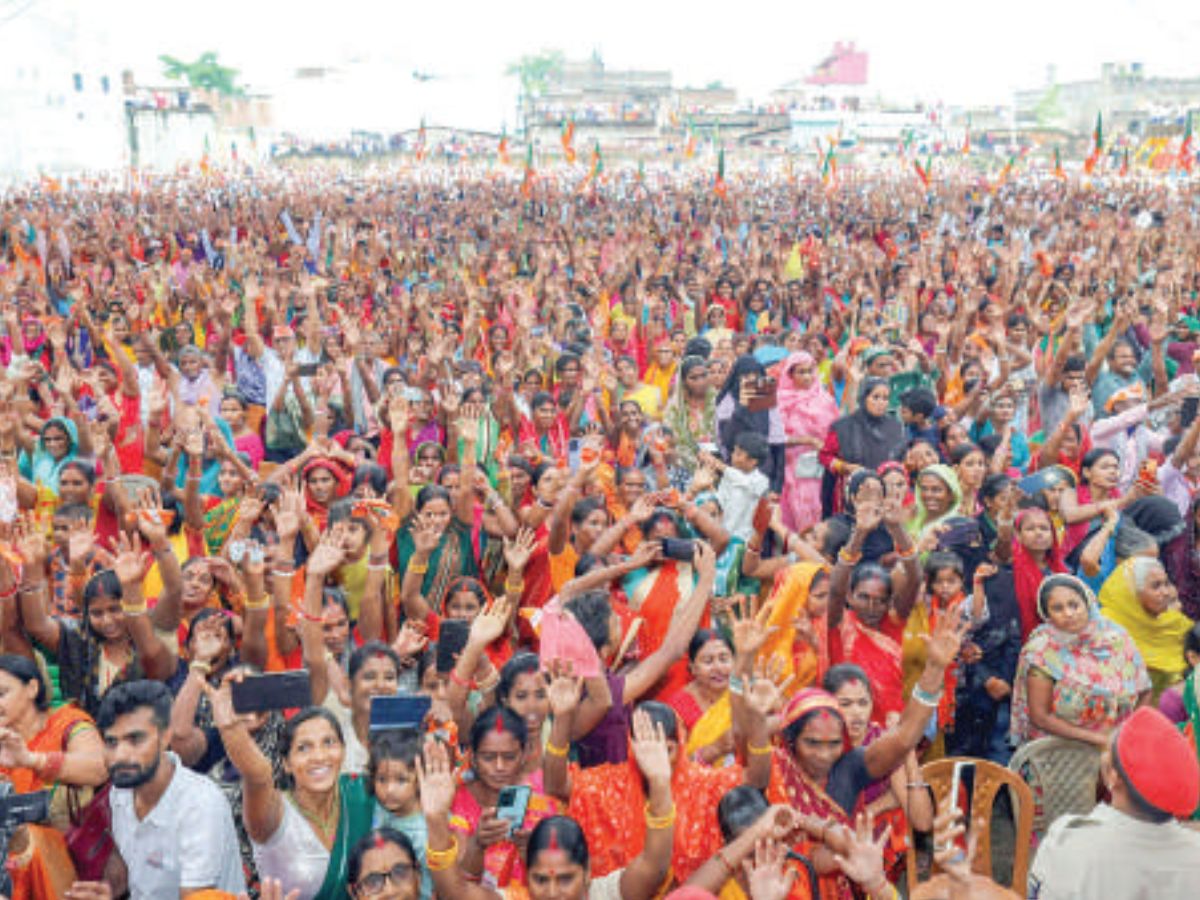
People wave during an NDA election rally addressed by Union Home Minister Amit Shah for the Bihar Assembly election, in Munger on Thursday. (Image: ANI)
New Delhi: Official deployment records reviewed by The Sunday Guardian show that officers from the Gujarat cadre form only a small fraction of those appointed by the Election Commission of India (ECI) as observers for the ongoing Bihar Assembly elections, contradicting social media claims that “only Gujaratis” were being sent to supervise the polls.
According to the data examined by this newspaper, 243 IAS officers have been designated as general observers across Bihar’s 243 Assembly constituencies, while 38 IPS officers have been assigned as police observers. Together, they form the core of the central observer team responsible for monitoring polling, expenditure, and adherence to the Model Code of Conduct. Among them, only 15 IAS officers belong to the Gujarat cadre—covering less than 10% of the constituencies—while none of the 38 IPS officers are from Gujarat.
A senior officer familiar with the process said the “Gujarat-heavy” narrative was “factually misplaced.” “There’s been some chatter that too many from Gujarat are being posted, but the numbers don’t support that claim,” the officer said.
The cadre-wise data shows a wide and balanced spread. IAS officers have been drawn from 27 state cadres, with the highest representation coming from Madhya Pradesh, Uttar Pradesh, and Maharashtra—together accounting for nearly one-third of the total. Tamil Nadu, Gujarat, Karnataka, Delhi (AGMUT), Chhattisgarh, Odisha, and West Bengal follow next, while smaller cadres such as Meghalaya, Tripura, Arunachal Pradesh, Mizoram, Nagaland, and Sikkim have one or two officers each.
The spread indicates that the ECI’s system of rotation and officer availability drives the deployment, rather than any political or regional preference. The AGMUT cadre—covering Arunachal Pradesh, Goa, Mizoram and the Union Territories—is administratively unique, as it is controlled by the Ministry of Home Affairs and allows officers to be transferred across multiple UTs and smaller states.
The IPS deployment reflects a similar pattern. The 38 police observers represent 20 cadres, led by Madhya Pradesh, Uttar Pradesh, Kerala, Tamil Nadu, Andhra Pradesh, and AGMUT. Karnataka, Rajasthan, and Punjab also feature multiple officers, while the rest contribute one or two each. There are no IPS officers from Gujarat among the police observers in Bihar.
A political analysis of the postings shows that 81 of the 243 IAS officers—roughly one-third—belong to cadres from non-BJP-ruled or opposition-ruled states, including Karnataka, Himachal Pradesh, Telangana, Tamil Nadu, West Bengal, Punjab, Kerala, and Jharkhand. Another 17 officers are from centrally administered or mixed-governance cadres such as AGMUT.
The remaining 145 IAS officers belong to BJP-ruled or NDA-aligned states, including Gujarat, Madhya Pradesh, Uttar Pradesh, Maharashtra, Rajasthan, Haryana, and Chhattisgarh. Among the 38 IPS officers, most belong to cadres from NDA or BJP-ruled states, with none from Gujarat.
At present, only ten of India’s 31 states and Union Territories have non-NDA governments, meaning the majority of state cadres feeding into the observer pool are naturally drawn from regions ruled either directly by the BJP or by its allies.
The Election Commission has reiterated that the observer appointments follow a rotation and seniority-based system that ensures both administrative and geographical diversity. “Observers are drawn from across cadres to ensure balance and operational readiness,” a senior ECI official said.
Opposition parties, including the Congress and the RJD, had earlier alleged a “pattern” of deploying Gujarat-cadre IAS officers to key election roles, calling it politically motivated. However, the numbers reviewed by this newspaper suggest otherwise. Gujarat-cadre officers account for only about 6% of IAS observers and none of the IPS observers—making their overall presence marginal.
