
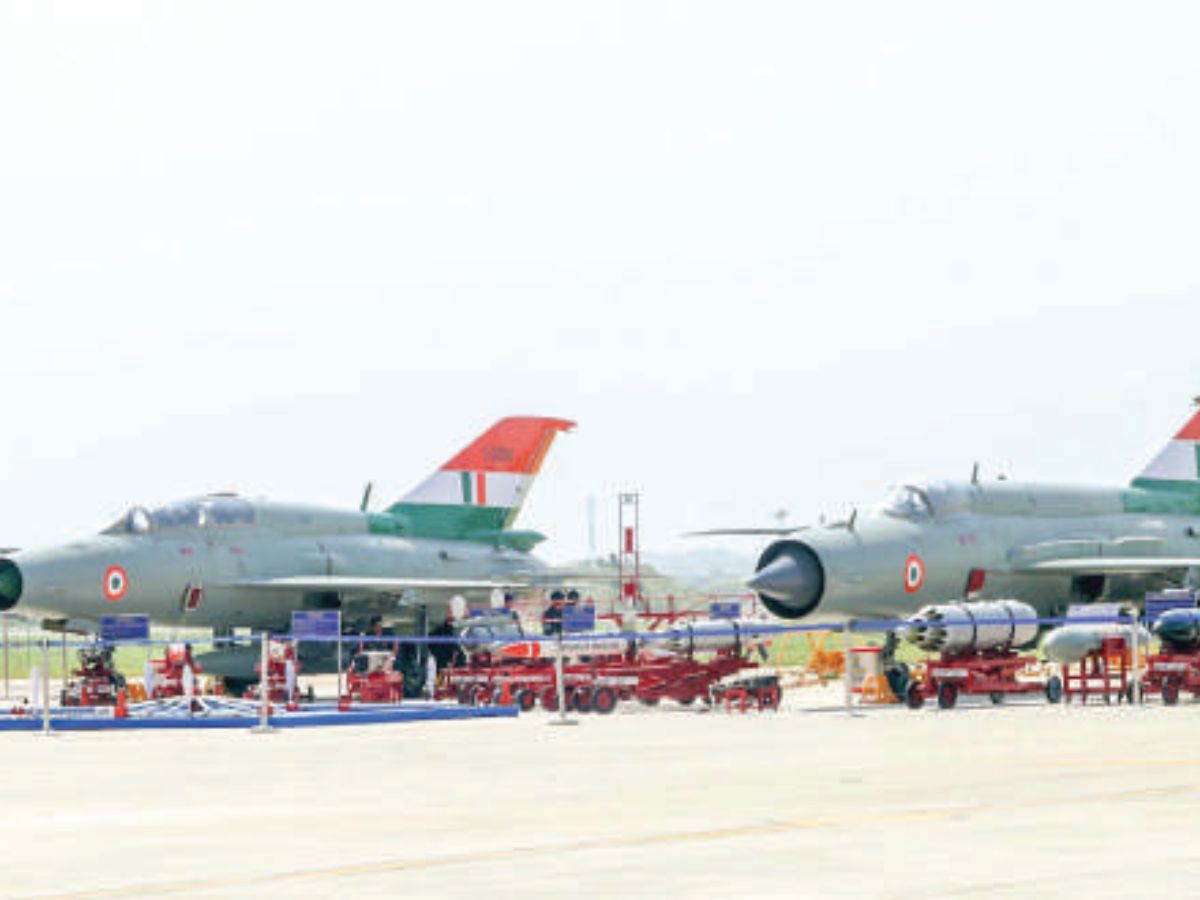
New Delhi: On 26 September 2025, the skies over Chandigarh fell silent to a sound that had defined Indian air power for more than six decades. The Indian Air Force’s MiG-21s—Soviet-designed jets that once gave India its supersonic edge, shaped generations of fighter pilots, and fought in every major conflict since the 1960s—roared into the sunset for the final time. With a ceremonial flypast by the “Panthers” of No. 23 Squadron, water cannon salutes, aerobatic displays, and a gathering of veterans and dignitaries, the IAF bid farewell to an aircraft that was equal parts workhorse, icon, and controversy.
Defence Minister Rajnath Singh captured the mood at the event: The MiG-21 is not just an aircraft or machine, it is proof of deep India-Russia ties, and national pride. Since 1963, when it first joined us, this journey of more than 60 years is unmatched in its own right. It has shaped our confidence, strengthened our strategy, and helped us establish ourselves on the global stage.
Yet as the applause faded, the farewell left India not only with memories, but also with questions about the void its absence creates.
A SUPERSONIC LEAP
When the MiG-21 entered IAF service in 1963, it was nothing short of revolutionary. India, still emerging from the trauma of the 1962 war with China, urgently needed modern air power. The MiG-21, with its delta wing, blistering climb rate, and ability to touch Mach 2, catapulted the IAF into the jet age.
It was an aircraft built as an interceptor, designed to streak skyward and shoot down enemy bombers, but in India, it became much more. Pilots adapted it for ground attack, reconnaissance, and strike roles, often stretching the design well beyond its Soviet intent. By the 1970s, India had procured more than 700 aircraft across variants, and by the 1980s, the MiG-21 formed nearly 60% of the IAF fleet. Veteran aviators remember it as a “teacher.” Air Chief Marshal A.Y. Tipnis recalled that when the MiG-21 arrived, there were no trainers or simulators; young pilots transitioned directly from propeller aircraft into the unforgiving supersonic jet. “The first solo was on the MiG-21 itself,” he said. “It was unforgiving, but it taught us to innovate.”
WARHORSE OF INDIA’S SKIES
From the outset, the MiG-21 was battle-tested. In the 1965 war with Pakistan, it held its own against the much-vaunted F-104 Starfighter. In the 1971 Bangladesh Liberation War, MiG-21s dominated the skies, shooting down Pakistani fighters in dogfights and cratering runways at Tezgaon airfield in Dhaka. During Operation Safed Sagar in Kargil (1999), the MiG-21 flew alongside Mirage 2000s and Jaguars, delivering strikes in some of the world’s most demanding high-altitude terrain. Even in its twilight years, the MiG made history. In 2019, during the Balakot episode, Group Captain (then Wing Commander) Abhinandan Varthaman downed a Pakistani F-16 in a MiG-21 Bison—a second-generation jet defeating a fourth-generation American fighter. That kill cemented the MiG’s place as a warrior that could still surprise.
As recently as 2024’s Operation Sindoor, MiG-21s remained on operational readiness platform duties, proving that even at the edge of retirement, they were trusted to defend India’s skies.
THE PRICE OF SERVICE
But the MiG-21’s illustrious combat record came with a grim cost. Over six decades, more than 480 of the 872 aircraft inducted were lost in crashes, killing over 170 pilots and dozens of civilians. Its reputation was scarred with the nickname “flying coffin.”
Pilots, however, contest the label. Air Marshal Harish Masand, who flew over 2,000 sorties on MiG-21s, pointed out that the term was first applied to the Lockheed F-104 Starfighter, which had an even higher crash rate. “The MiG-21 has been unfairly maligned,” he said. “It demanded respect, but it rewarded skill.”
Accidents, experts argue, were not just a result of design flaws. For years, India lacked an advanced jet trainer (AJT). In the late 1970s and 80s, rookie pilots were forced to use MiG-21s as stepping stones after basic trainers—a role for which the aircraft was never designed. High landing speeds, tricky handling at angles of attack, and limited cockpit visibility made it an unforgiving platform for beginners. It was only in 2008, with the induction of Hawk AJTs, that the MiG-21 was phased out as a trainer.
Maintenance too was a challenge. Spare parts flowed easily during the Soviet era, but after the USSR’s collapse, supply chains fragmented. Lower-quality spares sometimes entered the system. Government indecision in procuring upgrades compounded the risks. Yet contrary to public perception, accident rates dropped significantly in later years: government data shows that of the 480+ crashes, only about 20 occurred after 2010.
A BIRD OF ALL SEASONS
The MiG-21 inspired fierce loyalty. Air Marshal M. Matheswaran, another veteran, described the MiG-21 Bis variant as “truly classy,” capable of supersonic speed at low levels and even out-accelerating Mirage 2000s or F-16s in certain conditions. Others recall its adaptability—equally at home intercepting, striking, or training, a “bird of all seasons” in the words of historian Air Vice Marshal Arjun Subramaniam.
For many pilots, the MiG-21 was a rite of passage. Its cramped cockpit, high workload, and razor-sharp responses built generations of air warriors. As one veteran put it: “If you could fly a MiG-21, you could fly anything.”
THE FAREWELL AT CHANDIGARH
The decommissioning ceremony at Chandigarh Air Force Station reflected both nostalgia and pride. The IAF’s skydiving team, Akash Ganga, opened the show. Then came the final formations: three MiGs in the “Badal” pattern and four in the “Panther” formation, a nod to No. 23 Squadron’s nickname. The Surya Kiran aerobatic team painted the skies in red and white. Finally, the MiGs taxied under water-cannon salutes, engines shutting down in silence for the last time.
Veterans, including former air chiefs A.Y. Tipnis, S.P. Tyagi, and B.S. Dhanoa, stood alongside serving officers. Group Captain Shubhanshu Shukla, India’s first astronaut, was present. For many, the moment was overwhelming: a mixture of pride in what the MiG-21 had achieved, and grief for those it had claimed.
AFTERLIFE OF A LEGEND
What happens now to the MiG-21? Some will find homes in museums—Palam Air Force Museum in Delhi is almost certain to host one. Others may be gifted abroad, or placed on pedestals at bases and academies across India. The IAF is considering keeping a handful airworthy as part of a ceremonial vintage squadron, like Britain’s Spitfires or America’s P-51 Mustangs.
But operationally, the MiG-21’s retirement sharpens India’s capability gap. The IAF is down to 29 active squadrons, against a sanctioned 42. Pakistan maintains 20-25, China more than 60. With Jaguars, MiG-29s, and Mirage 2000s also due for retirement by 2035, the shortfall could deepen further.
The government hopes the Tejas Mk-1A, the future Tejas Mk-2, and the Advanced Medium Combat Aircraft (AMCA) will fill the gap. Imported platforms such as the Rafale M may add teeth. But delays in production and induction timelines remain concerns. Analysts stress the need for parallel investments in missile defences and unmanned systems to supplement fighter numbers.
CLOSING A CHAPTER, OPENING ANOTHER
The MiG-21’s journey is not just the story of an aircraft. It is the story of India’s military diplomacy with the Soviet Union, of a generation of pilots forged in steel and fire, of wars won and sacrifices made, of triumphs and tragedies intertwined.
It has been both celebrated and condemned—hailed as the backbone of the IAF, dismissed as outdated, defended passionately by veterans, and maligned by headlines. But through it all, the MiG-21 remained what it always was: a fighter that carried India’s hopes into the skies.
As Rajnath Singh noted in Chandigarh, it is “deeply embedded in the memories and emotions of our country.” For every sonic boom that once rattled windows and quickened hearts, the MiG-21 leaves behind a legacy written in history books, museum halls, and the DNA of India’s air power.
On 26 September 2025, the MiG-21 flew into the sunset. But its story will continue to reverberate—as a reminder that sometimes, even the most controversial machines can become the most enduring symbols of a nation’s journey.
Ashish Singh is an award-winning senior journalist with over 18 years of experience in defence and strategic affairs.




