
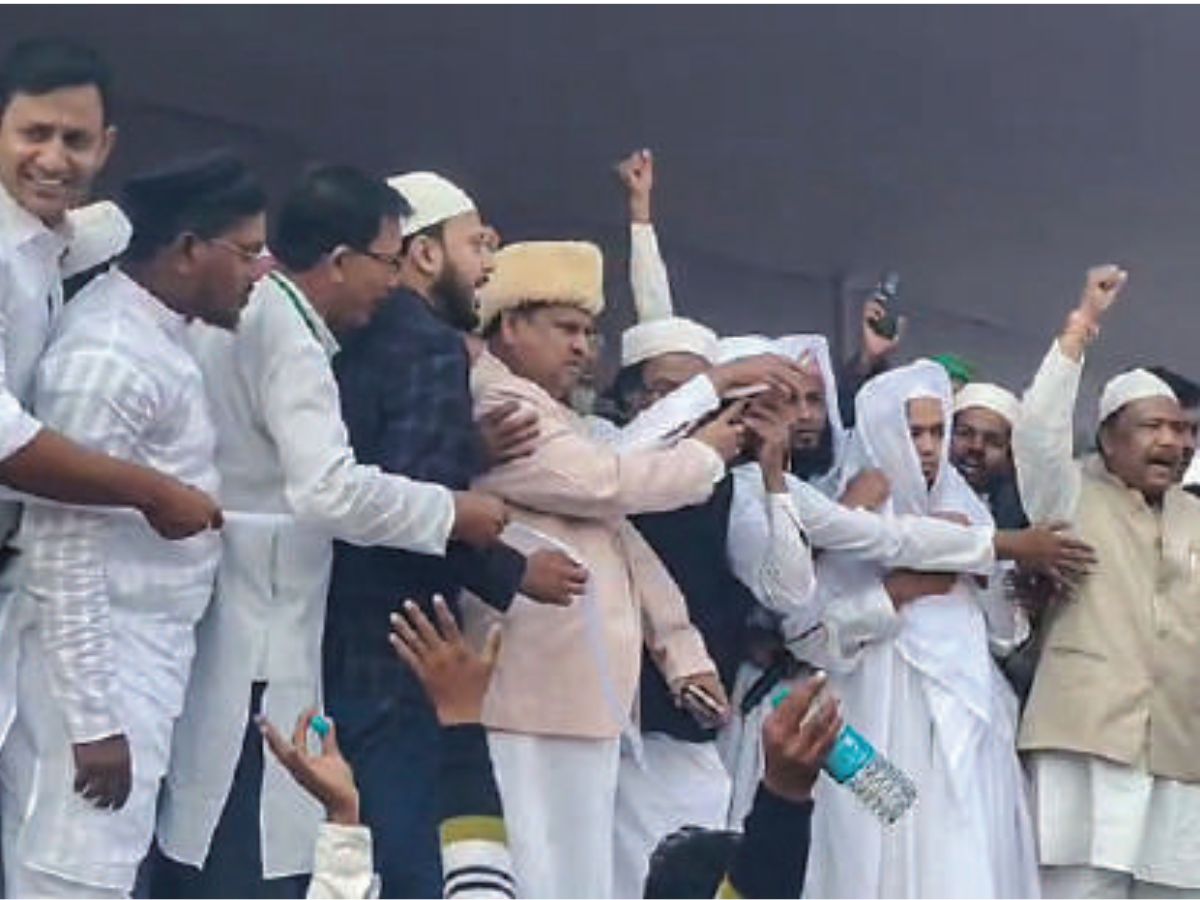
Kolkata: On the 32nd anniversary of the demolition of Ayodhya’s Babri Masjid, on Saturday, 6 December, in a highly charged political and communal atmosphere, suspended Trinamool Congress (TMC) MLA Humayun Kabir from Bharatpur led the foundation-laying (shilanyas) ceremony of a mosque styled after the Babri Masjid in Beldanga, Murshidabad district. The event was conducted amid unprecedented security preparations. Though hundreds of police personnel were brought in from three neighbouring districts to maintain law and order, sources said that no permission was sought for the gathering.
Kabir’s audacious move—following his suspension by the TMC for this very plan—triggered tremors through Bengal’s political landscape just over a year ahead of the state’s 2026 Assembly elections. He also threatened to float his own political party and maintained that his party would contest about 135 Muslim-majority seats in West Bengal. Murshidabad district has a 70% Muslim population. Observers said Humayun Kabir’s initiative threatens to fracture the unified Muslim vote bank that Mamata Banerjee’s party has long commanded, cementing the Trinamool Congress’ grip on power since 2011. “By threatening to form his own political party to contest 135 Muslim-majority seats, Kabir’s gambit will open the doors for the BJP to extract electoral advantage in the polls,” said political observer Biswajit Das.
The foundation event at Beldanga witnessed a massive turnout with thousands bringing bricks for the masjid gathering across a sprawling 25 bigha area. A 150-foot by 80-foot dais, capable of hosting approximately 400 dignitaries, was specially erected, while seven catering agencies were contracted to supply over 40,000 meal packets for guests and an additional 20,000 for local residents, pushing expenditure estimates to between Rs 60-70 lakh. Nearly 3,000 volunteers were deployed to coordinate crowd, traffic, and public order management. Visitors included prominent religious leaders from across states, including two qazis arriving from Saudi Arabia in a convoy organized from Kolkata airport. The event opened with Quranic recitation at 10 a.m., followed by the ceremonial foundation, with a promise to clear the venue by 4 p.m. as per police directives. Kabir appeared undeterred by political controversies or administrative vigilance.
Speaking to The Sunday Guardian hours before the ceremony, Kabir asserted that “there are conspiracies to disrupt the programme by instigating violence. Lakhs of people from across south Bengal districts will foil such attempts. It will be a peaceful ceremony.” Denouncing the TMC leadership’s characterization of the project as divisive, he accused his former party of “polarising the issue on religious lines that the BJP follows” and “hatching conspiracies” against the event. Emphasizing broader community benefits, he outlined plans not only for a mosque but also a hospital, educational institution, and guest house for visitors from all communities.
With the maverick MLA repeatedly making comments disparaging Mamata Banerjee and the Trinamool Congress, the party responded swiftly by suspending Kabir on Thursday, citing the construction of the Babri Masjid-style mosque as “gross indiscipline” and a threat to communal harmony at a delicate political juncture. Kolkata Mayor and Trinamool’s Muslim face, Firhad Hakim condemned the project as part of a divisive BJP agenda to polarize Bengal’s electorate ahead of the 2026 polls, highlighting that Kabir had been repeatedly warned against such provocations. Hakim questioned the timing and naming of the mosque, stating: “Why 6th December? Why did Humayun Kabir not choose another name? He can build a school or college in Murshidabad.” The party officially distanced itself from Kabir and vowed to observe “Samhati Diwas” (Unity Day) to promote communal harmony across Bengal districts instead.
Kabir, however, rejected the suspension and continued his pet project despite the fallout. He threatened to resign his MLA seat and announced plans to launch a new political party on December 22 that would contest 135 Muslim-majority Assembly seats statewide, a move that analysts warn could fracture the otherwise consolidated Muslim vote predominantly loyal to TMC. “The Chief Minister will be branded an ex-Chief Minister after 2026,” Kabir declared in a scathing attack against Mamata Banerjee, whom he accused of RSS-friendly politics and Muslim appeasement in name only. “Mamata builds temples with public funds but gives meagre allowances to clerics. She is doing RSS work,” he alleged, signalling an intent to position his new party as a genuine defender of Muslim interests.
Political experts regard the fallout from Kabir’s actions as potentially decisive in what promises to be a tightly fought battle. Murshidabad’s Muslim majority has given TMC a firm electoral footing for years, but internal dissent and Kabir’s breakaway threaten to siphon votes that could benefit the BJP, which has steadily expanded its footprint in Bengal. BJP leaders publicly criticised Kabir’s new political ambitions, framing them as part of a “pre-planned game” orchestrated with the TMC to split minority votes and divide the secular vote base. Union Minister Sukanta Majumdar called the TMC’s suspension of Kabir “dirty politics” to “please Hindu voters” and predicted Kabir would be “taken back into the party” after elections, further underscoring the perplexing alliances and tactical manoeuvres shaping Bengal’s political future.
The foundation ceremony itself was held under intense security, with police, Regional Armed Forces (RAF), and Central paramilitary contingents deployed throughout Rejinagar and Beldanga to prevent any law and order incidents. Authorities coordinated crowd management measures, including traffic diversions on National Highway 12—the main arterial road in Murshidabad—and prepared for any communal flare-ups given the district’s recent history of unrest. Despite the heavy presence, Kabir claimed full cooperation from administration and police, rejecting allegations of intending to provoke communal tension.
Humayun Kabir has long been known as a political gadfly. His political journey began in Congress before stints in BJP and TMC, and he carved a niche as a communal and political firebrand in Murshidabad. His critical role in orchestrating Yusuf Pathan’s victory over Congress stalwart Adhir Chowdhury in the 2024 general elections demonstrated his grassroots sway among Muslim voters and his capacity to influence pivotal outcomes. “Kabir’s history of inflammatory remarks and repeated clashes with TMC leadership have rendered him an unpredictable wildcard. His repeated provocations have earned him the tag of a ‘loose cannon’, and his suspension marks the latest chapter in a cycle of rebellion and reintegration with the party. Time will tell who gains from this—Mamata or BJP,” commented political observer Prasun Acharya.




