
New Delhi: India’s ambition to reduce its reliance on foreign weaponry has entered its most assertive phase in decades. The government points to unmistakable shifts: rising defence exports, new private-sector entrants, the restructuring of legacy ordnance factories, and procurement rules that place domestic industry at the centre. Official figures show defence production rising from around Rs 79,000 crore in 2019-20 to a record Rs 1.5 lakh crore in 2024-25, while exports have crossed Rs 21,000 crore and continue to climb.
Alongside this expansion, the share of the capital procurement budget earmarked for the domestic industry has been pushed to unprecedented levels. From 40% earmarked for local purchases in 2020-21, the Ministry of Defence has now allocated about three-quarters of its modernisation budget to Indian suppliers in successive years, a proportion senior officials describe as the highest on record.
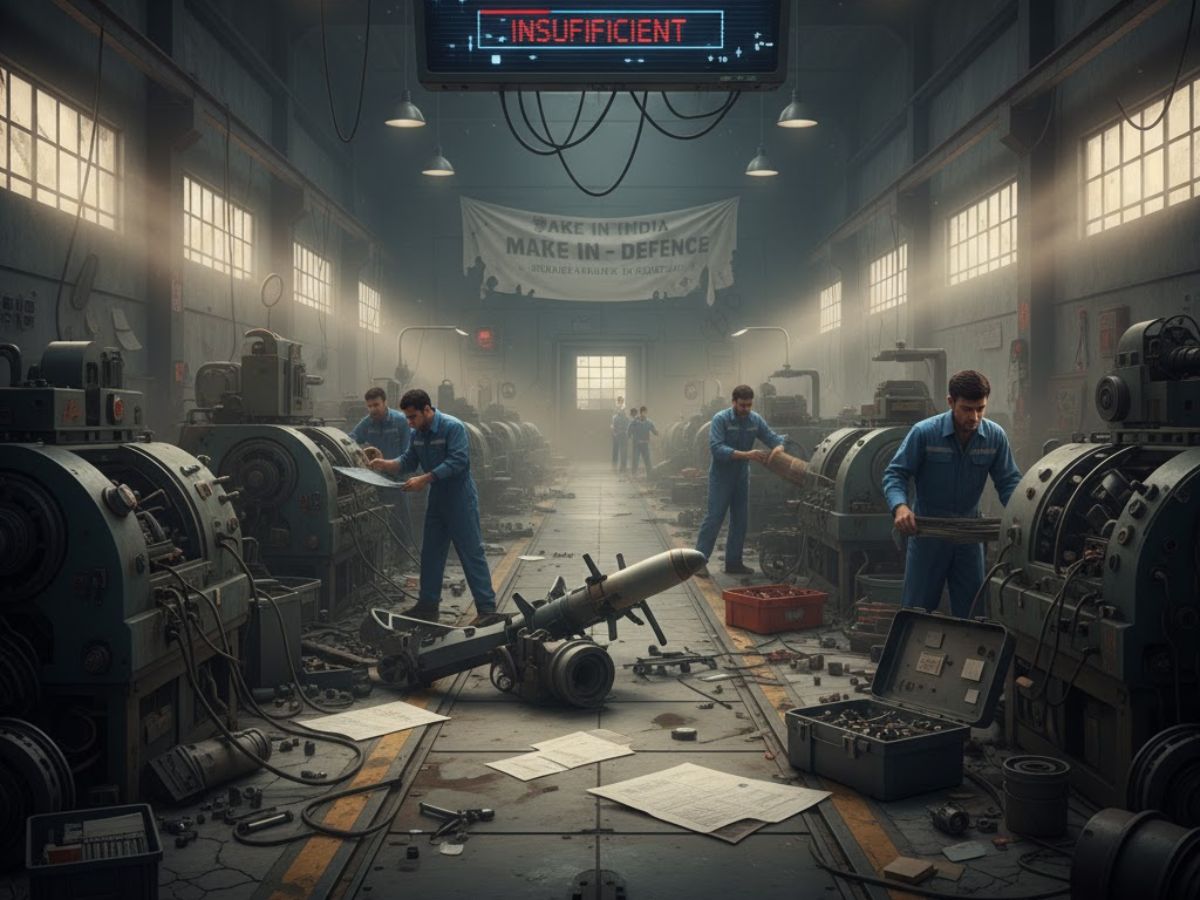
Yet beneath this visible progress lies a quieter, more stubborn problem—one that appears repeatedly in audit reports, parliamentary reviews, and service-level feedback. India is producing more equipment, but not always at the level of reliability the armed forces require. The country’s flagship drive for self-reliance risks being compromised not by a shortage of investment or political intent, but by what happens—or fails to happen—on the factory floor.
QUIET WARNINGS FROM INDIA’S AUDITORS
For decades, the Comptroller and Auditor General (CAG) has catalogued shortcomings in the quality of defence production. These findings are rarely headline material on their own, but read together, they expose a systemic pattern: defective ammunition batches, inconsistent machining tolerances, delayed defect investigations, missing trial documentation, and large volumes of stores rejected or withdrawn from service.
One audit, tabled in Parliament in 2022, recorded 584 accidents involving 10 ammunition items and one tank item between 2014-15 and 2018-19, reported from the users’ end. The CAG said the defects pointed mainly to component-quality problems, malfunctioning ammunition and weapon damage—issues linked directly to production and quality management rather than design.
Earlier CAG reviews and subsequent media coverage have described significant quantities of ammunition being rejected by the Army because of manufacturing defects, including cases where fuzes and other components were so unreliable that they risked premature explosions or barrel bursts. One high-profile report on ammunition management noted that defective stocks worth many thousands of crores of rupees were lying rejected in depots.
In parallel, an internal Army assessment—reported widely in 2020—flagged 403 accidents since 2014 in which ordnance factory ammunition was alleged to have been involved, a figure the OFB publicly contested but which nevertheless underlined the scale of user concern.
Parliamentary committees have echoed these themes. Their reviews frequently describe the same pattern: improvements on paper, reforms in procurement rules, corporatisation of factories—but a persistent gap in the quality assurance chain that reappears in acceptance trials by the services. The armed forces’ procurement wings have repeatedly had to reject defective batches, causing testing delays, replacement costs, and erosion of trust in local supply.
It is this consistent theme across audits—not isolated mishaps—that suggests a structural problem.
CORPORATISATION AS A TURNING POINT, BUT NOT A CURE
The dissolution of the Ordnance Factory Board (OFB) in 2021 was one of the most significant reforms in India’s defence-industrial landscape since the early 2000s liberalisation. Forty-one legacy factories—some with roots going back to the late 18th century—were reorganised into seven government-owned defence public sector undertakings (DPSUs).
The stated objective was that autonomy, clearer financial accountability and professionalised management would deliver the efficiency and discipline that a monolithic OFB had struggled to achieve. In the years since, several of the new entities—such as Munitions India Limited and Armoured Vehicles Nigam Limited—have reported stronger order books, export contracts and, in some cases, Miniratna status, suggesting a measurable improvement in financial performance compared with the OFB’s final phase.
At the same time, procurement pathways through the Defence Acquisition Procedure (DAP) 2020 and updated manuals have been rewritten to prioritise domestic content, tighten user trials and encourage Make-I/II and iDEX prototypes.
But reforms at the corporate level cannot by themselves transform the physical processes that shape quality. Corporatisation may improve governance, investment flow and contracting efficiency, yet the fundamental character of production still depends on everyday practices inside machine shops, assembly lines, casting units, explosive-handling bays and inspection cells.
It is here, not in board meetings or MoU ceremonies, that India’s self-reliance goals are most vulnerable.
WHAT THE FACTORY FLOOR REVEALS
CAG reports and quality-management reviews paint a more complicated picture than official production figures alone would suggest. Many ordnance units—now housed within the new DPSUs—continue to grapple with legacy production systems. Multilayer inspection frameworks exist on paper, with factory-level quality control backed by DGQA’s final inspection, but audits repeatedly find gaps in how these systems work in practice.
Inadequate inspection of input materials has been a recurring theme. Past CAG audits have documented cases where raw materials from trade were accepted without complete testing, contributing to defects later detected in ammunition performance.
Other reports have highlighted persistent problems with documentation and traceability—work-in-progress inventories stuck on the shop floor, incomplete records of batches and lots, and manual accounting systems that resist digitisation. In one period, unfinished items accounted for nearly a third of ordnance factory inventory, an indicator of process inefficiency as well as a quality-control risk.
Without rigorous incoming inspection, defective raw material can enter production cycles unnoticed. Without calibrated equipment, machining tolerances drift over time. Without digitised records, test failures are difficult to trace back to specific processes or vendor batches. And without skilled QA personnel embedded through each stage, inconsistencies accumulate until final acceptance trials expose them—often at significant cost in time, money and confidence.
This is not to suggest that all DPSUs or former ordnance units operate with outdated systems. Some factories have invested in modern tooling and process-control disciplines; others have partnered with private vendors and academic institutions to introduce more advanced manufacturing practices. But the unevenness across units—particularly those involved in ammunition, explosives and small-arms production—remains a serious concern for the services that depend on precision, reliability and safety.
QUALITY MATTERS MORE THAN PRODUCTION VOLUME
The temptation in political and public discourse is to treat rising domestic production as inherently synonymous with capability. But militaries do not fight with production figures; they fight with equipment that works, reliably and repeatedly, under extreme conditions. A batch of ammunition that fails specifications, or a fuze that does not trigger at the right moment, can nullify any headline figure on indigenisation.
This is why officers often stress, albeit privately, that the only metric that truly matters is performance during trials and in operational service. A “Made in India” label holds strategic value only if it translates into confidence at the front line.
When quality falls short, the ripple effect is immediate: units hesitate to place follow-on orders, trials are delayed, and procurement planners pivot back to imports—a reversal of the very objective national policy aims to achieve.
India’s strategic challenge is therefore not merely to indigenise components or raise domestic output but to indigenise reliability.
CORRECTIVE STEPS AND THE JOURNEY AHEAD
There have been unmistakable signs of course correction. The Directorate General of Quality Assurance (DGQA) has long been responsible for second-party quality assurance of defence stores from ordnance factories, DPSUs and private vendors. Recent reform announcements by the Ministry of Defence emphasise reorganising DGQA, automating and digitising standardised QA processes, and selectively outsourcing certain inspection functions to accredited third-party agencies—steps explicitly linked to supporting Aatmanirbhar Bharat while maintaining product reliability.
Private suppliers—particularly in metallurgy, electronics and precision machining—have entered the supply chain in greater numbers, often bringing with them modern quality systems and accreditation from bodies such as the National Accreditation Board for Testing and Calibration Laboratories (NABL). DPSUs now routinely reference testing partnerships with NABL-accredited labs and DRDO facilities for chemical, ballistic and environmental validation.
Vendor development under the Make and iDEX frameworks has encouraged new entrants and prototypes, while the corporatisation of the ordnance ecosystem has pushed units to compete on price, performance and delivery timelines—something the old OFB structure could not easily enforce. The Ministry of Defence has highlighted that more than 90% of new contracts in recent years, by number, have gone to domestic players, and that 75% of the modernisation outlay is now reserved for domestic procurement.
Yet the remaining gaps are clear. Independent QA capacity is still limited relative to the volume and complexity of upcoming procurements. Documentation of acceptance trials remains inconsistent across units. Corrective actions flagged by audits are sometimes delayed or incompletely implemented. And workforce skilling—especially in ammunition and explosives—remains uneven across the seven new DPSUs, even as two of them have earned Miniratna status on the back of strong order books and export prospects.
These gaps matter because the next phase of India’s defence-industrial evolution will demand far higher precision. As India moves deeper into complex systems—electronic fuzes, missile subsystems, seeker technologies, propellant chemistry and next-generation armament—the tolerance for manufacturing inconsistency will shrink dramatically.
A REALISTIC PATH FORWARD
The success of Aatmanirbhar Bharat in defence will depend less on slogans and more on mundane, unglamorous reforms: calibrated tools, digitised inspection logs, accredited laboratories, documented non-conformance tracking and continuous workforce reskilling.
These are not cosmetic changes. They require capital expenditure, steady management oversight, and a willingness to integrate private and foreign best practices without defensiveness. They also require the services to remain demanding customers—insisting on strict adherence to trials rather than accommodating production delays or quality deviations in the interest of domestic sourcing.
India is already producing more defence equipment, in value terms, than at any time in its post-Independence history. The challenge now is to ensure that this rise in production translates into operational confidence. The credibility of self-reliance depends on it.
The transformation the government seeks—a genuine shift from import dependence to domestic capability—will be realised not through announcements or policy documents, but on the factory floor, in the quiet spaces where machining meets metallurgy and quality systems decide whether an indigenised product becomes an asset or a liability.
In that sense, India’s journey toward defence self-reliance will ultimately be judged not by how much the country produces, but by how reliably it produces it.
-
Ashish Singh is an awardwinning senior journalist with 20 years of experience in defence and strategic affairs.




