
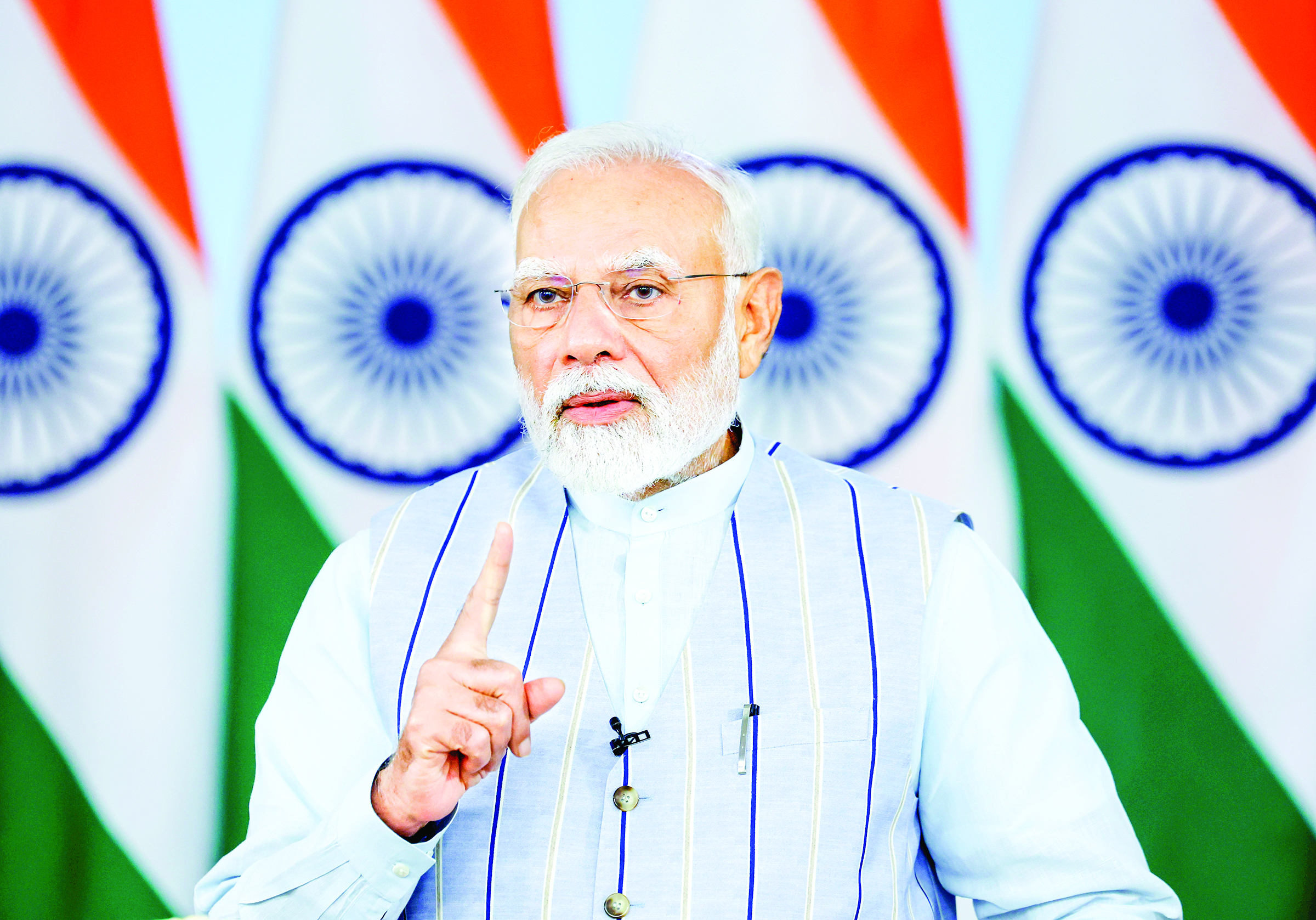
NEW DELHI: Work has already begun on further unlocking the potential of the immensity of talent in India in diverse fields. The economic crisis that came to a head during the period when V.P. Singh was Prime Minister of India in 1989-90 was the catalyst behind the Narasimha Rao reforms of 1991 and 1992. In the same way, although on a much larger scale, Prime Minister Narendra Modi is looking at the tariff tirade of President Trump directed at India as not a threat as much as it is an opportunity for disseminating Atma-Nirbharta (self-reliance) throughout different sectors of economic activity in what is already the third largest economy in the world in Purchasing Power Parity terms.
The US is more than the White House, and the clouds over the trade relationship caused by the Trump storm are not affecting the welcome given to investment from the US, especially in highly technical fields. Apple is producing more in India not because of the tourist attractions of the country, which admittedly are many, but because of lower costs and an abundance of numbers and talent within the workforce.
President Trump, with characteristic self-confidence, has been seeking to bend the laws of the economics of manufacturing to his will. How long such a quest will last is unknown, but given the harm it could cause to the US economy, it is unlikely to last long. From now onwards, the emphasis will be on the intermeshing of technology and increasing production in India where advanced systems presently imported are concerned. From the start of his term in office as Prime Minister in 2014, Prime Minister Modi has given great importance to the building up of a strong relationship with the US, while simultaneously understanding that the world is now multipolar, and hence the attention paid by him to institutions such as SCO and BRICS.
While a common BRICS currency is off limits where India is concerned, the present situation could see increased bilateral trade on the basis of countries using their own currencies to pay for imports from the other country. India changed dramatically during 1991-93 and is poised to change even more substantially during 2025- 27. The structures of governance, which still retain several trappings of the colonial era, are in line for a reset.
Resistance had built up within administrative structures that sought to avoid any diminution of the powers they have long had, but under the direction of the PMO, the eliminating of restrictions dampening the investment climate in India is accelerating. It will be noted that relations between India and countries in the Middle East, Africa and South America have substantially improved since Prime Minister Modi took over in 2014. Using India as a production base would be a valuable entry point to such markets, located as they are in continents poised for fast growth. The tariff storm has given importance to the need for diversification, and the countries of the Global South already are, or soon will be, valued trade partners of India and not just in meeting expanding energy requirements through fossil fuel and nuclear power.
As far as chipmaking is concerned, the rare earths required, specifically lithium in importance, are present in some of the countries that PM Modi has visited during the past few months, often for the first time in several decades, if ever, by an Indian Prime Minister. Whether it be laptops or aircraft, both civilian and military, or other fields of manufacture, unless the US companies migrate some of their services and production to India, they will soon become uncompetitive in the face of increasing competition from China.
President Trump may believe that he can change such realities by the sheer force of determination that he exhibited during the 2024 Presidential campaign, but events have proven him to be wrong. Prices of several consumer items have gone up as a result of the tariffs unleashed by him, while job growth has been slowing down. A few more months of such results and GOP legislators will find themselves losing either to primary challengers or to their Democrat opponents. President Trump has heeded the call of necessity and majorly softened the tariff blow he had initially sought to inflict on Japan, one of the staunchest allies of the US in the Indo-Pacific. He needs to do the same with India.
The tariff storm that he has unleashed on the most populous democracy in the world is seeking to cripple a country essential to security in the IndoPacific. That too, a country which has in Prime Minister Modi a leader who from the start of his stint as PM has focused on the US as the primary security partner of India. The good news is that President Trump is delegating a number of duties to Vice-President J.D. Vance, including matters as sensitive as preparing an official response to the growing demand that the Epstein files be revealed in full.
Should President Trump have to demit office early on health grounds, and this could happen to anyone, the Vice-President of the United States is proving himself to be up to the task of taking on the baton from a President who is rewriting history in several ways. Where India is concerned, PM Modi has kept a cool head despite all the tariffs being thrown in his direction by the US administration and has resisted the temptation of adopting a tit-for-tat approach.
In the meantime, the Prime Minister is strengthening self-reliance, as are his key ministers and officials. The tariff storm may enter the history books as having caused necessary and beneficial resets in several fields of policy, thereby heralding a period of double-digit growth.




