
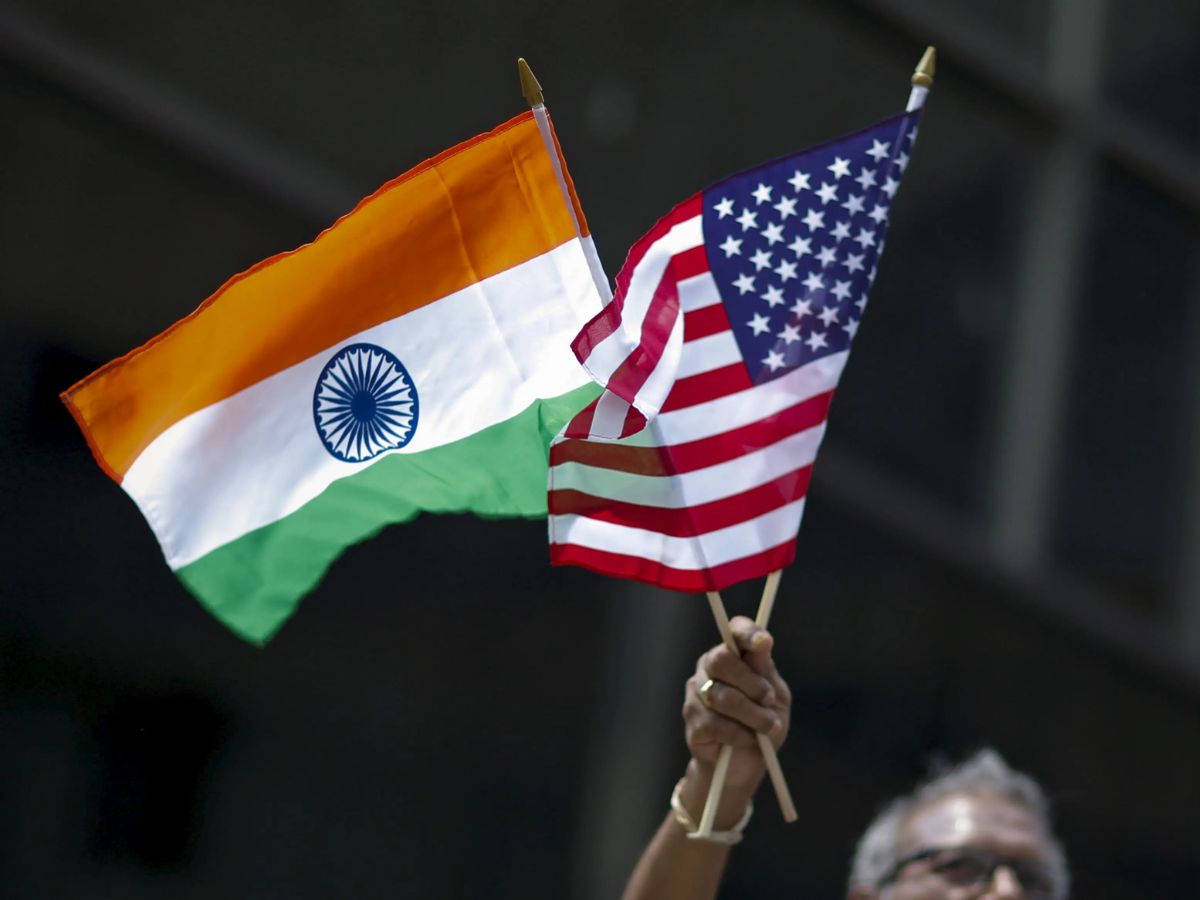
With the US Supreme Court striking down the tariffs imposed by the Trump administration on different nations under the International Emergency Economic Powers Act (IEEPA)—a 1977 law intended for national emergencies—trade experts say that India should renegotiate the terms of the trade deal with President Donald Trump’s power to impose tariffs having been blunted by the top court.
With the US Supreme Court ruling that Trump exceeded his authority by imposing tariffs under the IEEPA, stating that it did not authorize unilateral tariff action and that the administration cited no statute permitting such use, the ruling has technically invalidated country-specific “reciprocal tariffs” and fentanyl-linked duties imposed on imports from major trading partners.
A detailed report prepared by the Global Trade Research Initiative (GTRI)—a research group focused on climate change, technology and trade—mentions that the decision has effectively rendered recent trade deals initiated or concluded by the US with the UK, Japan, the EU, Malaysia, Indonesia, Vietnam and India “one-sided and useless.”
“Partner countries may now find reasons to dump these deals. Trump could attempt to reimpose similar tariffs under Section 301 or Section 232, but those statutes require new investigations and public justification, delaying action and inviting further legal challenges,” the report states, adding that “such measures cannot serve as a universal enforcement tool.”
Soon after the Supreme Court struck down the tariffs, Trump invoked Section 301 of the Trade Act of 1974 (unfair practices law) and Section 232 of the Trade Expansion Act of 1962 (national security law) to impose a global tariff of 10% (which he increased to 15% on Saturday) on all countries—a move which is on expected lines.
Imposing a 10% global tariff on all countries, President Donald Trump on Friday wrote on Truth Social: “It is my great honour to have just signed, from the Oval Office, a Global 10 per cent tariff on all countries, which will be effective almost immediately. Thank you for your attention to this matter!”
Trump’s Treasury Secretary, Scott Bessent has remarked that the new 10% duties and possible higher tariffs under Section 301 of the Trade Act of 1974 and Section 232 of the Trade Expansion Act of 1962 “will result in virtually unchanged tariff revenue in 2026.”
However, the GTRI report states that “the ruling against Trump would reassert Congress’s primacy in trade policy, sharply curbing presidential latitude to weaponize tariffs and reshaping how future administrations wield emergency economic powers.”
‘INDIA SHOULD SEEK FRESH TERMS’
Mentioning the impact of the US Supreme Court order on India-US trade equations, the GTRI report says that removal of the reciprocal tariffs will free about 55% of India’s exports to the US from the 18% duty, leaving them subject only to standard Most Favoured Nation (MFN) tariffs.
“On the remaining exports, Section 232 tariffs will continue—50 per cent on steel and aluminium and 25 per cent on certain auto components—while products accounting for roughly 40 per cent of export value, including smartphones, petroleum products and medicines, will remain exempt from US tariffs,” the report states.
Stating that the ruling should prompt India to re-examine its trade deal with the US, the report said that “India should use this clause to either opt out of or delay negotiations or seek fresh terms so the trade deal looks equitable.”
“After offering concessions—including reducing MFN tariffs, aligning economic policies with US interests, easing regulations affecting US goods, and signalling large purchases of US products—India was to receive an 18 per cent reciprocal tariff rate. Now, even without a trade deal, India, like other countries, faces a 10 per cent tariff on most goods, rendering the agreement being negotiated useless,” the report noted.
“The US-India joint statement dated February 6, 2026 mentions, ‘In the event of any changes to the agreed upon tariffs of either country, the US and India agree that the other country may modify its commitments’. Now US tariffs have changed, India should use this clause to either opt out of the or delay negotiations or seek fresh terms so the trade deal looks equitable,” the report said.
Some trade experts suggested that India should continue to engage with the US given that the country would now be in a position to re-examine the provisions of the deal.
“First of all, the India-US trade deal pertains to several sections that will not be impacted by the Supreme Court order which include services, investment and others. India needs to continue to engage the US over the tariffs imposed by the US as it has a chance to bring down the tariffs to zero. Given that the President’s power to impose tariffs has been blunted, the US would be in a position to re-negotiate the terms of the deal,” Director General and CEO of the Federation of Indian Export Organisations (FIEO) Ajay Sahai told The Sunday Guardian.
WHAT DOES ORDER MEAN FOR WORLD?
The GTRI report further notes that the ruling and the temporary tariff response inject significant uncertainty into global trade relations and ongoing negotiations.
“Countries that made concessions to avoid higher US tariffs may now reassess the value of those agreements, while the legal fragility and short duration of the 10 per cent tariff complicate business planning and diplomatic strategy.
“For India, the decision narrows the expected benefits of its pending trade arrangement and underscores the need to recalibrate negotiating positions. More broadly, the episode signals that future US tariff actions will face tighter legal scrutiny, making US trade policy less predictable but more anchored in congressional oversight,” it said.
The report notes that more broadly, the order reasserts US Congress’ authority over trade policy and sharply limits a President’s ability to use emergency powers to impose sweeping tariffs and weakens the rationale behind several recent US trade deals with partners such as the UK, Japan, the EU, Malaysia, Indonesia, Vietnam and India, which were negotiated to avoid higher tariffs.
“With a temporary 10 per cent tariff now in place—and even that facing legal uncertainty—partner countries may question the value of those agreements, few may dump them being useless and one sided. Still, some may hesitate to abandon them, given concerns about provoking the Trump administration, the temporary nature of the 10 per cent duty, and the risk of future tariffs or sanctions if relations deteriorate,” it said.
On April 2, 2025, Trump declared US’ chronic trade deficit a “national emergency” and imposed 10% tariffs on nearly all imports, which were later raised to as high as 50% on select countries. The US administration argued that decades of trade deficits had weakened the US industrial base and posed an economic threat even as critics called the justification unprecedented, noting that the US had run trade deficits since 1975 without such action.
The IEEPA was originally crafted to let Presidents restrict financial or property transactions with hostile foreign powers—not to impose general tariffs. Still, the administration relied on it to impose tariffs and collect an estimated USD 100 billion in new customs revenue, the GTRI report says.
Three lower courts have already ruled against the Trump administration on the issue. Strategic analyst K.P. Nayar told this newspaper that it seems that Trump was ill-advised on the tariff issue as all the lower courts that heard the case had outlawed the tariffs but the administration continued to impose tariffs instead of course correction.




