
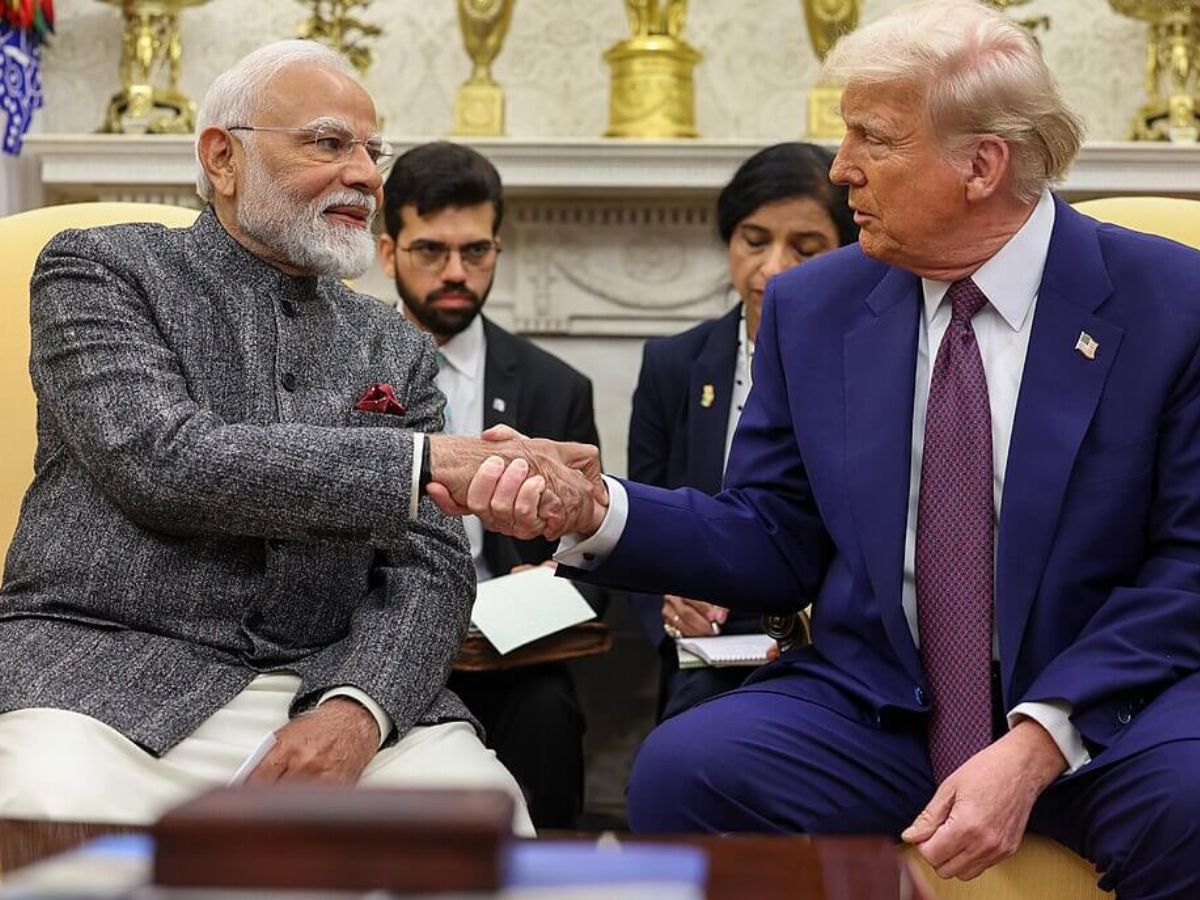
New Delhi: Recent developments across defence, trade, diplomacy and people-to-people engagement suggest that India and the United States are entering a phase of structured stabilisation, as both sides recalibrate their partnership towards long-term strategic convergence and away from episodic political or legal strains. The trajectory points to a deliberate effort by Washington and New Delhi to restore functional normalcy through institutional continuity, even as discrete areas of friction continue to surface.
The clearest signal of this stabilisation comes from the United States’ approval of a $93 million sale of Javelin anti-tank missiles and Excalibur precision artillery ammunition to India. Notified by the Defense Security Cooperation Agency (DSCA) on 20 November, the clearance underscores that the security establishment in both capitals is proceeding with operational cooperation unabated, despite ongoing trade negotiations and residual diplomatic sensitivities.
The sale includes 100 Javelin FGM-148 missiles and 216 M982A1 Excalibur precision-guided artillery rounds, systems designed to enhance India’s high-altitude warfare capabilities.
This development sits within a wider architecture of deepening defence institutionalisation. During the ADMM-Plus gathering in Kuala Lumpur, Defence Minister Rajnath Singh and US Defense Secretary Pete Hegseth signed a renewed 10-year “Major Defence Partnership” framework.
In parallel, the “Security of Supply Arrangement” (SOSA) has been operationalised, and General Electric has commenced the training of its shop-floor workforce in Pune for the co-production of F-414 jet engines. Simultaneously, the acquisition of 31 MQ-9B Sky Guardian drones has entered its implementation phase, with a Maintenance, Repair and Overhaul (MRO) facility now confirmed on Indian soil.
Further strengthening operational coordination, India has finalised the posting of liaison officers to key US military commands, including the Special Operations Command (SOCOM) in Florida and the Indo-Pacific Command (INDOPACOM) in Hawaii.
Beyond defence, the evolving diplomatic tone and people-to-people measures indicate a broader reset. Recent State Department moves point to a streamlining of B1/B2 interview waivers for repeat Indian travellers and accelerated H1B processing timelines for skilled professionals—efficiency measures designed to ease business mobility even within a stricter immigration environment.
At the same time, Indian officials have quietly sought to manage political messaging emanating from the US electoral space, particularly President Donald Trump’s repeated claims that he “stopped the war”. Senior officials have advised sections of the media against giving importance to these statements, stressing that they do not reflect the institutional position of the US government or the current direction of engagement between the two countries.
This calibrated approach is intended to prevent campaign rhetoric from distorting the broader diplomatic narrative and underscores Delhi’s intent to keep the relationship anchored in policy continuity rather than reactive headline cycles.
“Strategic decoupling”, as one official described it, has led to a situation where security imperatives are effectively insulated from bilateral irritants. This sentiment is mirrored in the economic domain, where a “Phase One” trade deal is reportedly nearing completion.
Following months of friction over the Trump administration’s threat of 50% tariffs on Indian goods, negotiators are closing in on a compromise that would see India lower duties on over 80% of US imports. The proposed deal aims to replace the punitive tariff spikes with a reciprocal structure, likely around 15%, allowing the US administration to claim a victory for its “America First” trade policy, while ensuring Indian exporters retain access to the US market.
To grease the wheels of this trade reconciliation, India has moved to offer a substantial economic sweetener in the energy sector. On 17 November, the Ministry of Petroleum and Natural Gas announced a “historic” agreement to import 2.2 million tonnes per annum (MTPA) of Liquefied Petroleum Gas (LPG) from the US Gulf Coast.
The deal, which accounts for nearly 10% of India’s annual LPG imports, is being viewed by analysts as a politically priced decision designed to mollify US energy lobbyists and offset the friction caused by India’s continued purchase of Russian crude oil. By putting hard cash on the table for American energy exporters, New Delhi has provided Washington with a tangible economic win that helps lower the temperature on the tariff front.
Importantly, this decision was announced just days before Russian President Vladimir Putin is expected to visit India, suggesting that Russia was likely taken into confidence by Delhi to ensure the timing did not send the wrong diplomatic signal.
Crucially, legal controversies regarding the Pannun case have been effectively compartmentalised, with US officials expressing satisfaction with India’s cooperation and the trial of Nikhil Gupta postponed to 2026.
However, Indian officials continue to navigate a complex challenge in the form of Pakistan Army Chief General Asim Munir’s evolving equation with the Trump administration. As of now, Munir enjoys unprecedented access to President Trump and his inner circle, a proximity largely driven by a series of high-stakes business promises rather than traditional geopolitical alignment.
Sources indicate that the Pakistan Army Chief has successfully pitched a portfolio of transactional sweeteners that appeal directly to the current White House’s interests, specifically in the domains of cryptocurrency, rare earth minerals, and energy.
This “tactical closeness” is underpinned by specific deliverables. Pakistan has reportedly offered exclusive access to unverified but potentially vast rare earth deposits in Balochistan—critical for the US supply chain war against China—and has engaged in talks regarding a state-backed cryptocurrency venture that aligns with the business interests of the Trump family’s “World Liberty Financial” project.
In exchange for these economic pledges, Munir has secured political cover and support for his domestic consolidation. Yet, diplomats in New Delhi assess this axis as fragile. The consensus is that Trump’s support for Munir is entirely conditional on performance; if the promised “crypto-returns” do not materialise or if the rare earth supply lines prove logistically unviable, the access Munir currently enjoys is likely to fall away swiftly.
Despite this external variable, the broader structural logic of the India-US partnership remains anchored in the Indo-Pacific. The August 2+2 inter-sessional dialogue reaffirmed cooperation under the Initiative on Critical and Emerging Technology (iCET), reinforcing a model of cooperation that is increasingly institutional.
Taken together, these developments indicate that India and the United States are moving toward a new equilibrium: a relationship that may remain rhetorically noisy and periodically tested by third-party transactionalism, but is ultimately underpinned by strategic continuity and institutional trust, irrespective of who the President is.




