New Delhi: India is in no hurry to respond to the latest flurry of mixed signals coming out of Washington, with policymakers in New Delhi acutely aware of US President Donald Trump’s temperamental swings and his tendency to combine praise with pressure.
Officials here believe Prime Minister Narendra Modi’s Saturday’s courteous acknowledgement of Trump’s recent remarks, and External Affairs Minister S. Jaishankar’s subsequent comments, should be read as protocol politeness rather than a substantive shift.
It is also understood in Delhi that Trump has come to view India’s reluctance to accept a one-sided trade deal not merely as a policy disagreement but as a personal affront that is being attributed to multiple reasons.
That perception has complicated matters further, because the path to resolution now rests less on routine negotiation and more on the US President’s own willingness to recalibrate.
For India, this means the wait-and-watch approach is likely to continue, with courtesy extended in public but no hasty concessions, while much of the effort to mend the rift will ultimately have to come from Trump himself.
Amidst the threats and rhetoric, India has quietly consolidated its ground with both China and Russia even as Trump has turned the screws with tariffs and public admonitions, and the government appears determined not to walk into a one-sided bargain of the kind Washington recently extracted from Japan.
While a prominent section of Delhi’s bureaucracy, political class, the media and business lobbies are pressing for a rapprochement with the US—many driven by commercial and personal stakes—the prevailing mood is to wait and watch, letting the noise settle before any serious engagement.
The current cycle began on 5 September, when US Commerce Secretary Howard Lutnick dismissed India’s defiance of Trump’s tariffs as “all bravado,” arguing that Indian businesses would eventually push the government back to the table. He said Delhi would be negotiating with Trump “in a month or two,” even suggesting India would be “saying sorry.”
In the same breath, Trump used his Truth Social account to warn that the US had “lost India and Russia to deepest, darkest, China,” posting a picture of PM Modi with Presidents Vladimir Putin and Xi Jinping. Lutnick justified Trump’s punitive 50% tariff by pointing to India’s soaring Russian oil imports—up from less than 2% before the Ukraine war to around 40% now—arguing that India was opportunistically buying cheap sanctioned crude to “make a ton of money.” His message was blunt: India must decide which side it is on, because in the end “the customer is always right” and America, with its $30 trillion economy, is the world’s consumer.
The following day, Trump struck a more ambivalent tone. Speaking at the Oval Office, he insisted he would “always be friends with Modi,” describing the Indian Prime Minister as “a great leader” and stressing that India and the US share a “very special relationship.”
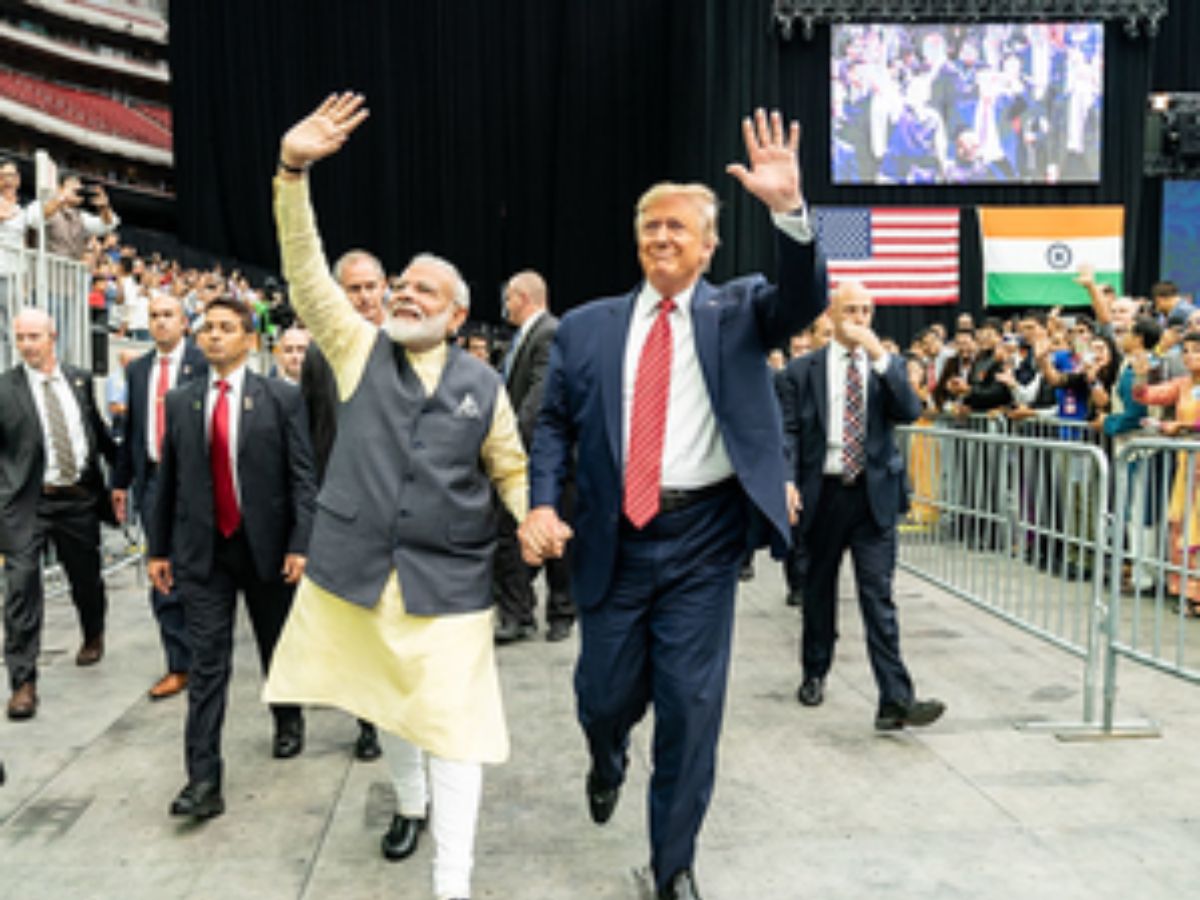
But he doubled down on his complaints about Delhi’s Russian oil purchases and made clear that the punitive tariff regime—25% reciprocal and an additional 25% penalty—was here to stay. He recalled Modi’s visit to Washington “a couple of months ago” when the two addressed the press together in the Rose Garden, saying he had no doubt about their personal chemistry but was dissatisfied “with what he is doing at this particular moment.”
Later that day, PM Modi responded with a carefully worded post on X, saying he “deeply appreciate[s] and fully reciprocate[s] President Trump’s sentiments and positive assessment of our ties” while describing India and the US as “comprehensive and global strategic partners” with a “forward-looking” agenda.
Soon after, EAM Jaishankar told reporters that PM Modi “attaches enormous importance to our partnership with the US” and “has always had a very good personal equation with President Trump,” though he declined to elaborate beyond noting that the two sides remain engaged.
The language was deliberate: enough to keep the friendship narrative alive, but stripped of any new commitment.
By 6 September afternoon, certain voices, identified with their closeness to a certain section of bureaucracy in Delhi, moved to reframe the optics and the Modi-Trump exchange was described as the first steps towards patching up, while insisting that India has never drifted into China’s camp and that engagement with Russia and normalization with Beijing were separate tracks.
All this plays out against the backdrop of the upcoming UN General Assembly in New York, where India has a slot to speak on 26 September. While the Prime Minister’s name was provisionally inscribed, the Ministry of External Affairs has yet to confirm his attendance, and the current assessment is that the PM will skip the session unless there is an eleventh-hour breakthrough in trade talks paving the way for a bilateral with President Trump.
In the past too, the External Affairs Minister has filled in for the Prime Minister at UNGA, and barring a dramatic change, Jaishankar is expected to lead the delegation again this year. For now, Delhi’s calculation is straightforward, officials told The Sunday Guardian on Saturday.
The US President’s mix of flattery and pressure is not new, nor is the transactional expectation that India bends quickly.
The government is content to ride out the turbulence and is treating the challenge as an opportunity to bring in significant changes, as GST reforms exhibited.
Having gained leverage with both Moscow and Beijing, and watching how Trump has dictated terms to allies like Japan, India is wary of walking into an asymmetrical deal.
While domestic lobbies may clamour for mending fences to protect business and financial interests, the official line remains one of patience.
India will engage the US on its own terms, not at the mercy of Trump’s moods.
