Ahead of the Indian Navy’s annual Indo-Pacific Regional Dialogue, Vice Chief of the Naval Staff, Vice Admiral Sanjay Vatsayan speaks to The Sunday Guardian on fostering a stable and prosperous Indo-Pacific.
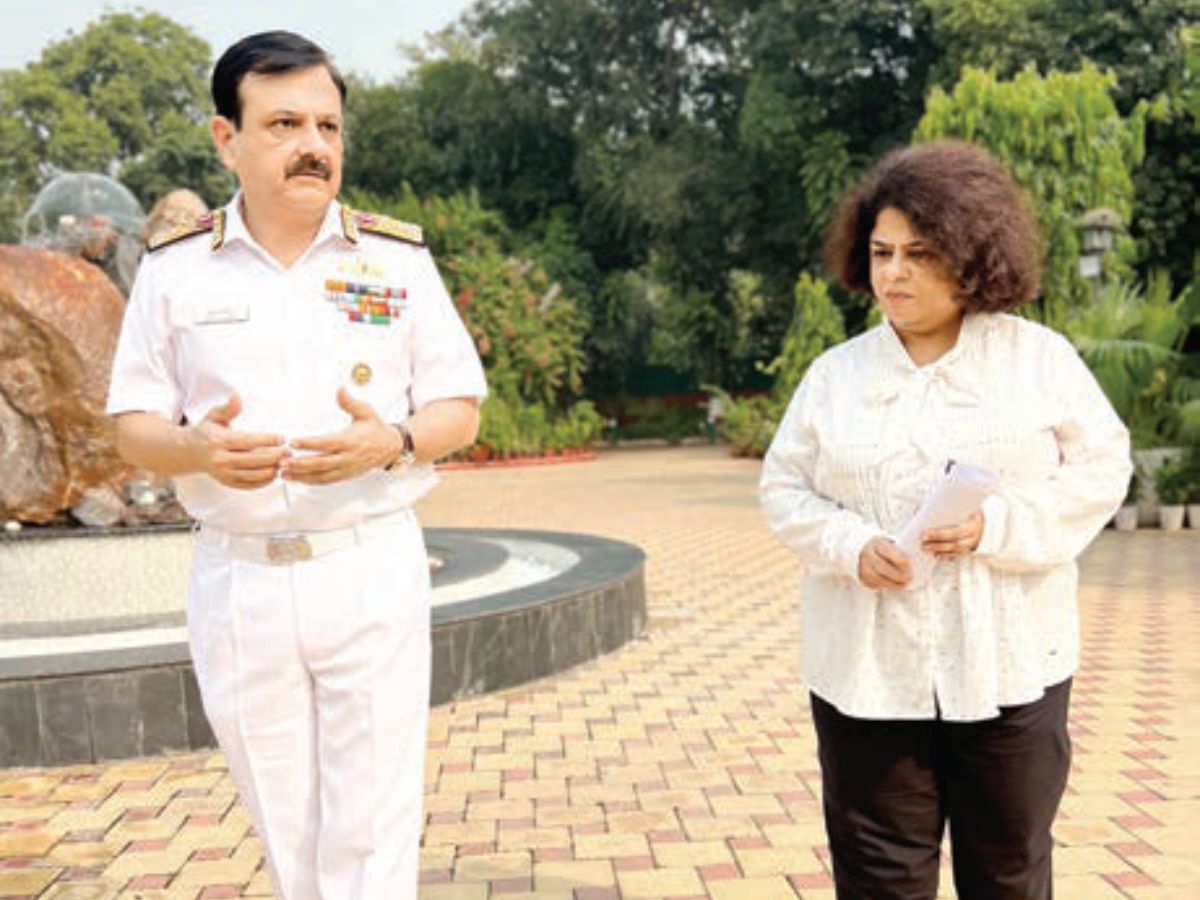
VCNS, Vice Admiral Sanjay Vatsayan speaks to Joyeeta Basu, Editor, The Sunday Guardian.
New Delhi: Vice Admiral Sanjay Vatsayan, AVSM, NM, who assumed charge as the 47th Vice Chief of the Naval Staff (VCNS), the second highest post of the Indian Navy, in August this year, spoke to The Sunday Guardian exclusively on the constructive role that the Indian Navy is playing in the Indo-Pacific, especially in terms of enabling partner navies to perform their maritime responsibilities successfully. The VCNS’ interview comes ahead of the Indian Navy’s Indo-Pacific Regional Dialogue (IPRD) 2025 being held on 28-30 October in New Delhi. Started in 2018, IPRD is a part of Indian Navy’s international outreach framework, and sees participation from nations across the Indo-Pacific to discuss this geopolitically crucial region. Prior to taking over as the VCNS, Vice Admiral Vatsayan served as Deputy Chief of the Integrated Defence Staff (DCIDS)—Operations, and thereafter as DCIDS (Policy, Plans and Force Development) at HQ IDS.
A: The phrase “capacity building meets capability enhancement” in the context of IPRD 2025 reflects the Indian Navy’s comprehensive approach under the Prime Minister’s MAHASAGAR vision to empower regional partners through both material and operational means. Capacity building focuses on the physical and institutional enablers of maritime security—provisioning of patrol vessels, interceptor craft, and aircraft; creation of shore, repair and training infrastructure; and development of maritime domain awareness networks, radar chains, and communication systems. These initiatives strengthen the basic maritime architecture of partner nations. Capability enhancement complements this by advancing the human and operational dimensions of cooperation. It includes professional training and exchanges, operational sea training, joint exercises, deployment of mobile training teams, hydrographic cooperation, and Joint EEZ Surveillance. Together, these efforts ensure that the capacities created are effectively employed and sustained. This synthesis of hardware, human skill and shared knowledge under the overarching SAGAR (Security and Growth for All in the Region) and MAHASAGAR frameworks encapsulates India’s maritime engagement philosophy—building enduring partnerships that combine growth with security for a stable and prosperous Indo-Pacific.
A: The Indian Navy remains deeply committed to actualizing the theme of “capacity building meets capability enhancement” through sustained, outcome-oriented partnerships with friendly foreign navies. Our approach is comprehensive from providing assets and infrastructure support to delivering extensive training and skill development programmes, and ensuring “womb-to-tomb” assistance that keeps these platforms at peak operational readiness. Regular Staff Talks with partner nations help us identify specific needs and tailor cooperative programmes accordingly Initiatives such as Indian Ocean Ship SAGAR and deployment of Mobile Training Teams have become vital enablers of regional maritime capability enhancement. Training continues to be the bedrock of these engagements. Officers and sailors from across the region undergo specialised courses at the Indian Naval Academy and other professional schools, while our training teams travel abroad to deliver bespoke modules on seamanship, damage control, navigation, and advanced operational procedures. Over the past year, we’ve seen tangible results. A major milestone was the Indian Ocean Ship (IOS) SAGAR deployment earlier this year, wherein INS Sunayna operated with a combined crew from nine friendly foreign countries i.e. Comoros, Kenya, Madagascar, Maldives, Mauritius, Mozambique, Seychelles, Sri Lanka, and South Africa. The monthlong deployment covered joint EEZ surveillance with Tanzania, Mozambique, Mauritius, and Seychelles, along with port calls, operational drills, and onboard training that built handson skills in navigation, seamanship, and watchkeeping. This was complemented by the maiden Africa-India Key Maritime Engagement (AIKEYME) exercise at Dar-es-Salaam, co-hosted with Tanzania and joined by 10 African nations. The exercise featured realistic anti-piracy, SAR, and VBSS operations, enhancing interoperability and regional readiness. Our Headquarters Sea Training (FOST) also plays a pivotal role by extending operational sea training support to partner navies, both in India and overseas. Together, these engagements have underscored the Navy’s commitment to nurturing collective capability and maritime security in the Indian Ocean Region, transforming intent into action, and partnerships into enduring capability outcomes.
A: The development of naval capacity and capability across the Indian Ocean Region is a collaborative and mutually enriching process. The Indian Navy’s training and knowledge-sharing initiatives are designed to empower regional navies with diverse resource levels through structured, need-based programmes. Leveraging India’s robust training infrastructure and professional expertise, these initiatives address a wide spectrum of competencies from seamanship, firefighting, and navigation to advanced simulator training and crisis management techniques. In addition, specialized Mobile Training Teams (MTTs) are regularly deployed abroad to deliver customised modules that respond to specific operational and environmental needs of partner navies. India’s approach ensures that capacity- building remains locally owned, sustainable, and responsive to regional needs. This inclusive model continues to strengthen maritime partnerships and promote security and growth for all in the Indo-Pacific.
A: Human resource development across education, simulation, and training stands as a top priority within the Navy’s cooperation agenda, supported by our vision for a “futureproof” and people-centric force. Recognizing that personnel are central to combat readiness and operational excellence; our approach emphasizes both institutional learning and collaborative growth. Education is delivered through the Indian Naval Academy, INS Chilka, and a network of specialized professional schools, which not only shape the next generation of Indian Navy leaders but routinely host officers and sailors from partner navies for advanced maritime courses. These programs also integrate emerging subjects such as Artificial Intelligence, Big Data Analytics, and cyber warfare, thereby cultivating subject matter experts in evolving domains and ensuring all personnel remain abreast of global best practices. Simulation is incorporated into all phases of training, leveraging sophisticated digital platforms and war-gaming scenarios to build competence in decision- making and crisis response. Realistic training, including onboard exercises and digital naval libraries, ensures that both Indian and foreign trainees are exposed to cutting-edge operational environments, making them prepared for contemporary maritime challenges. Ultimately, continuous human resource development is embedded in every aspect of our cooperative engagement, driving professionalism and enhancing mission outcomes for the Indian Navy and our partners alike.
A: The Indian Navy accords high priority to advancing maritime skills and innovation through a two-pronged approach—international training cooperation and academic–research collaboration. The first aspect focuses on training outreach through initiatives such as MAITRI—a modular, containerised training solution designed to deliver specialised professional courses to friendly foreign countries at their own locations. It allows deployment of self-contained mobile classrooms, simulators, and equipment, enabling customised instruction in areas like seamanship, damage control, marine engineering, and communication systems. This initiative represents a new dimension of India’s commitment to capacity building and capability enhancement by providing high-quality training without the need for partner personnel to travel abroad. The second aspect centres on academic and research partnerships with leading national institutions. The Navy has signed MoUs with IIT Madras, IIT Delhi, and IIT Kanpur to promote joint research in ocean engineering, naval architecture, warship design, and emerging technologies. Centres of Excellence such as the Marine Engineering Centre at INS Shivaji collaborate with academia and industry on propulsion systems, energy efficiency, and artificial intelligence. Further, partnerships with universities like Amrita Vishwa Vidyapeetham and Shiv Nadar University enable naval personnel to pursue advanced degrees in defence technology, cybersecurity, and anti-submarine warfare. Together, these initiatives strengthen India’s vision of an Aatmanirbhar, technologically empowered, and knowledge-driven maritime force
A: Maritime security today encompasses a complex array of interconnected challenges. It includes traditional interstate conflicts extending into the maritime domain and increasingly sophisticated non-state actors equipped with intelligence networks, unmanned systems, and advanced weaponry. Terrorism, transnational crime—including arms smuggling, drug trafficking, illegal fishing, human trafficking—and environmental threats such as marine pollution and climate change form an interwoven security tapestry. Viewing these issues in isolation overlooks their mutual impacts. For instance, environmental degradation and illegal fishing off the Horn of Africa was one of the contributing factors to Somali piracy’s rise. Natural disasters can trigger illegal migration, which in turn feeds into wider criminal networks. Hence, holistic maritime security means addressing these interconnected risks collectively to enable freedom from sea-borne threats. Within the Indo-Pacific, “holistic” takes on deeper meaning owing to the vastness and diversity of stakeholders. While Small Island Developing States prioritise climate resilience and ocean health, larger economies like India focus on securing critical sea lanes vital for trade and energy security. Tourism, fisheries, and regional stability complete the mosaic of interests that cannot be solved piecemeal. Therefore, initiatives like the Indo-Pacific Oceans Initiative, advocating a whole-of-region, multi-dimensional cooperative approach, embody the Navy’s commitment to comprehensive, collaborative maritime security across this strategic expanse.
A: That is indeed an important question. We are often asked about the tangible outcomes or deliverables from the Indo-Pacific Regional Dialogue (IPRD). The IPRD is designed to harness the strength of dialogue or ‘Samvaad’ among our partner nations to collectively address the challenges that impact our ability to utilise the seas for economic growth and development. Its primary aim is to galvanise cooperative and collaborative action across the Indo- Pacific, recognising that no single country can tackle all maritime challenges independently. The IPRD, now in its seventh edition, represents the Indian Navy’s premier international strategic outreach initiative. It complements other significant forums such as the Goa Maritime Conclave and the Goa Maritime Symposium, which focus on operational-level international engagement, and the MILAN series of exercises that bridge tactical and operational naval cooperation. It is important to emphasise that the objective of the IPRD is not to create a new framework. Existing frameworks like MAHASAGAR, India’s guiding policy, and the Indo-Pacific Oceans Initiative (IPOI) serve that purpose. Rather, the IPRD facilitates the development of actionable recommendations. For instance, last year’s dialogue yielded concrete ideas to strengthen cooperation with the Philippines, Indonesia, and Vietnam. In this manner, the IPRD is instrumental for us and our partners to derive practical and actionable inputs from the dialogue.
A: The Hon’ble Prime Minister’s vision of MAHASAGAR envisages an Indo-Pacific where security and growth are shared by all stakeholders. In maritime terms, this means that all boats must rise on a rising tide of growth. Growth is closely linked to security, and within the MAHASAGAR framework, security is “holistic,” encompassing trade, connectivity, maritime transport, marine ecology, resource management, capacity building, science and technology cooperation, disaster risk reduction, and maritime security. These constitute the seven pillars of the Indo-Pacific Oceans Initiative (IPOI). For India, the Blue Economy framework—a model which prioritises ocean health and sustainable harvesting of ocean resources—comprises seven priority areas: national accounting and governance; coastal marine spatial planning and tourism; fisheries, aquaculture and processing; manufacturing, emerging industries and skill development; logistics, infrastructure and shipping; coastal and deep-sea mining plus offshore energy; and security and strategic international engagement. These sectors reflect shared challenges and opportunities across the Indo-Pacific, although not every nation excels in all areas. This diversity underscores the essence of MAHASAGAR: mutual cooperation and complementing each other’s strengths. At IPRD 2025, sessions focused on climate change and the Blue Economy will deepen our collective understanding and strengthen regional collaboration.
A: Each edition of the Indo-Pacific Regional Dialogue (IPRD) dedicates itself to a key pillar of the Indo-Pacific Oceans Initiative (IPOI), reflecting the integrated character of the region’s maritime challenges. In 2023, IPRD’s focus was on the ‘Trade, Connectivity, and Maritime Transport’ pillar, where dialogue examined vulnerabilities in maritime supply chains, the operationalisation of transport corridors, and the broader impacts of geopolitical developments on trade and connectivity in the Indo-Pacific. These discussions brought muchneeded realism to the strategic imperatives for resilient, rules-based maritime connectivity. This year, while the focus has shifted to capacity-building and capability-enhancement, the essential interconnectedness of IPOI’s pillars ensures the continued relevance of prior deliberations. Notably, this year’s sessions will address the development of resilient maritime supply chains and regional cooperation on port and coastal resilience as part of ‘Building Maritime Resilience.’ Such continuity in thematic engagement ensures the steady evolution of actionable recommendations, leveraging insights gained previously while responding dynamically to emerging challenges in trade and connectivity across the Indo-Pacific. Ultimately, IPRD’s layered and iterative approach facilitates the translation of deliberation into practical, collaborative outcomes for regional stakeholders, sustaining momentum yearon- year
A: This year, the IPRD is structured in five “professional sessions”, under the central theme of Promoting Holistic Maritime Security and Growth: Regional Capacity Building and Capability Enhancement. Of these, four sessions directly link Blue Economy with capacity-building efforts across the Indo-Pacific. For instance, the session on The Blue Economy (Including Seabed Infrastructure) as an Instrument of Foreign Policy explores cooperative regional capability-enhancement for the protection of critical underwater infrastructure, as well as how to develop a sustainable ocean economy, or in other words, “blueing” the economy. Another session, which is dedicated to “Africa’s Integrated Maritime Strategy 2050” (AIMS- 2050) delves into capacitybuilding and capability-enhancement with an African perspective with elements of Blue Economy embedded within it. Similarly, we will also have a session on strengthening maritime resilience. In short, I think that IPRD 2025 will adequately address the linkages of Blue Economy initiatives with capacity building efforts in the region.
