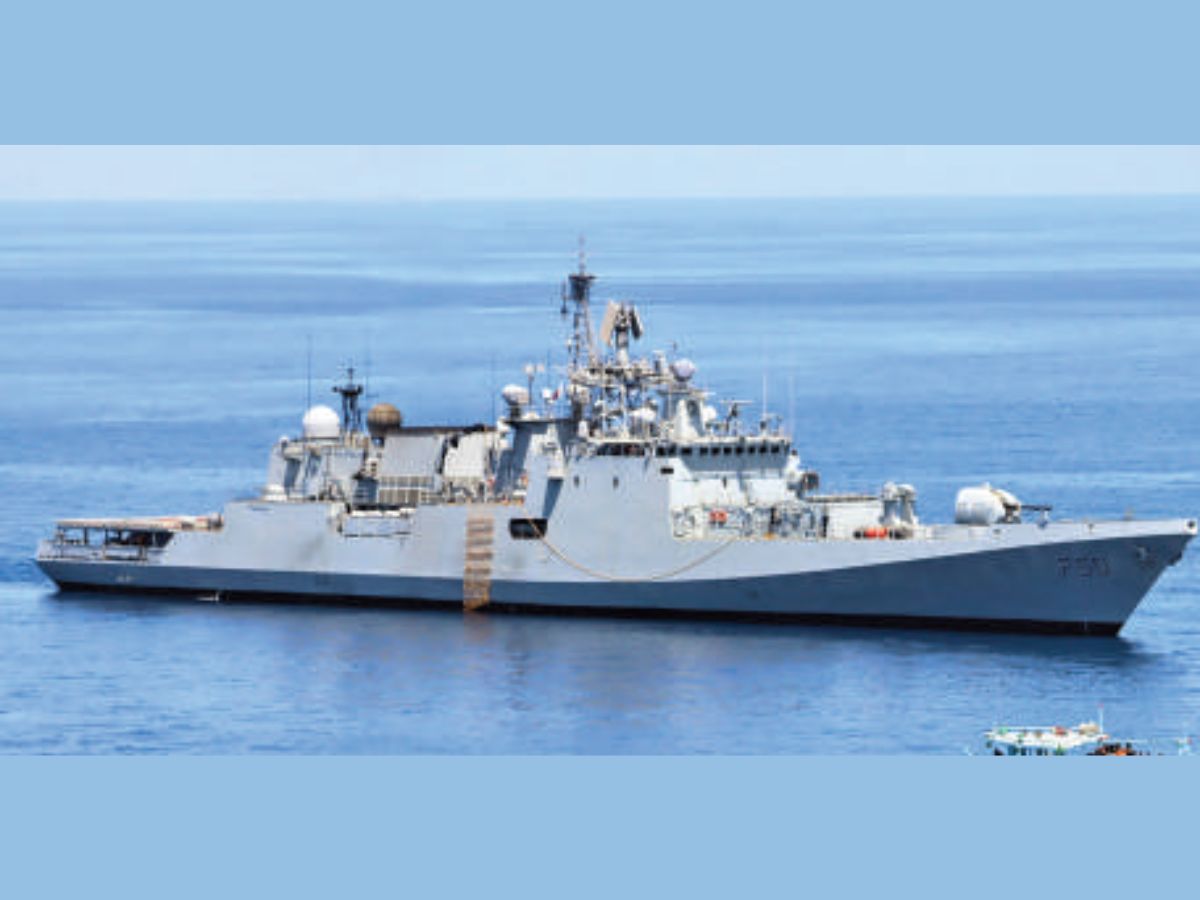
Indian Navy warship INS Tarkash. File photo
New Delhi: The Indian Navy is on track to induct ships at the rate of one every one-and-a-half months in the coming year, fuelling the economy as its maritime muscle is strengthened. This pace—roughly one warship every six weeks—is expected to continue through 2026. That schedule says a great deal about India’s maritime priorities. But before looking ahead, the past year deserves attention. It was a year of sustained operations, regular overseas deployments, humanitarian work, and steady progress in shipbuilding.
Operation Sindoor and the deployment of India’s carrier group drew most of the public focus. That attention was warranted. Yet those events were only part of a wider pattern. Over the past 12 months, the Navy remained continuously engaged at sea, in exercises, and in support roles while keeping new platforms entering service.
Maritime security remained a constant task. On 31 March 2025, INS Tarkash, working with a P-8I maritime patrol aircraft, intercepted a dhow in the Western Indian Ocean and seized around 2,500 kg of narcotics. It was one of several such operations carried out during the year. Under Operation Sankalp, naval ships escorted merchant vessels, conducted anti-piracy patrols, carried out boarding operations, and stayed on standby for emergencies. These missions do not attract much attention, but they are central to keeping trade routes open and limiting criminal activity at sea.
Humanitarian assistance and disaster relief remained a regular responsibility. One of the greatest efforts was Operation Brahma, launched after a 7.7-magnitude earthquake struck Myanmar in March 2025. The Navy deployed several ships, including INS Satpura, Savitri, Karmuk, LCU-52 and Gharial, delivering large quantities of relief material, medical supplies, and emergency stores. The HADR operation was carried out alongside Indian Air Force transport aircraft and Army medical teams. It demonstrated the Navy’s ability to respond quickly and operate far from home ports.
Search-and-rescue missions continued throughout the year. Naval helicopters evacuated crew from vessels such as MV Heilan Star. Firefighting teams were deployed to incidents aboard MT Yi Cheng 6 in the Gulf of Aden and to container ships including MSC Elsa 3 and MV Wan Hai 503 off the Kerala coast. These missions showed the Navy’s dual role of preparing for combat while also acting as a first responder across the Indian Ocean.
The year began with TROPEX-25, the Navy’s main operational exercise. Its timing later appeared significant, given the demands of Operation Sindoor. International exercises followed through the year. During KONKAN-25, INS Vikrant operated with the UK Carrier Strike Group led by HMS Prince of Wales, with participation from Norway and Japan. Samudra Shakti 2025 with Indonesia focused on anti-submarine warfare, air defence, and maritime surveillance. Under Mission Indian Ocean Ship (IOS) SAGAR, 44 naval personnel from nine friendly countries embarked an Indian naval vessel. The deployment included the first India-Africa multilateral exercise, AIKEYME, aimed at improving cooperation across the western Indian Ocean.
High-end exercises included Malabar with Quad partners off Guam and the French-led La Pérouse exercise involving nine navies. Bilateral drills were held with France (Varuna), Bangladesh (Bongo Sagar), and Japan (JIMEX), along with multilateral engagements such as SIMBEX and Sea Dragon. India also demonstrated its submarine rescue capability during Pacific Reach 2025 in Singapore through INS Nistar. Closer to home, Exercise Trishul integrated amphibious operations with cyber and intelligence elements, while Jal Prahar focused on beach-landing drills. Tiger Triumph with the United States continued to refine tri-service coordination for humanitarian and evacuation tasks.
Induction and shipbuilding remained a priority. INS Tamal, commissioned in Russia, marked the last foreign-built warship to enter Indian Navy service. Since then, the emphasis has shifted fully to domestic construction. In 2025, the Navy inducted INS Surat, a Visakhapatnam-class destroyer; INS Nilgiri, Himgiri, and Udaygiri, the first three Nilgiri-class frigates; INS Vagsheer, the final Kalvari-class submarine; and three anti-submarine warfare shallow-water craft—INS Arnala, Androth, and Mahe. The fleet also gained INS Nistar, an indigenously designed diving support vessel, along with survey ships INS Nirdeshak and INS Ikshak.
Naval construction continues to support a wide industrial base across India. It has driven the growth of specialised manufacturing and created skilled employment, with several technologies finding wider civilian use. The past year reflects a Navy engaged across its full range of responsibilities. Security operations protect trade. Exercises strengthen partnerships. Relief missions build trust and credibility. Indigenous shipbuilding supports long-term self-reliance. Much of this work received little public attention. Yet naval units remained deployed across critical sea lanes that carry most of India’s trade and energy supplies.
Looking ahead, the International Fleet Review and MILAN-26 in February 2026 will provide an opportunity to present these capabilities to a global audience, in line with India’s MAHASAGAR vision. With new ships entering service at a steady pace, the year ahead points to continued expansion in capability and presence. Through patrols, escorts, exercises, and crisis response, the Indian Navy remains central to stability across the Indian Ocean.
Maritime power is built gradually through platforms, personnel, doctrine and diplomacy. Over the past year, the Indian Navy has advanced on all four fronts, and the tempo suggests that effort will continue.
Ashish Singh is an award-winning senior journalist with over 18 years of experience in defence and strategic affairs.
