
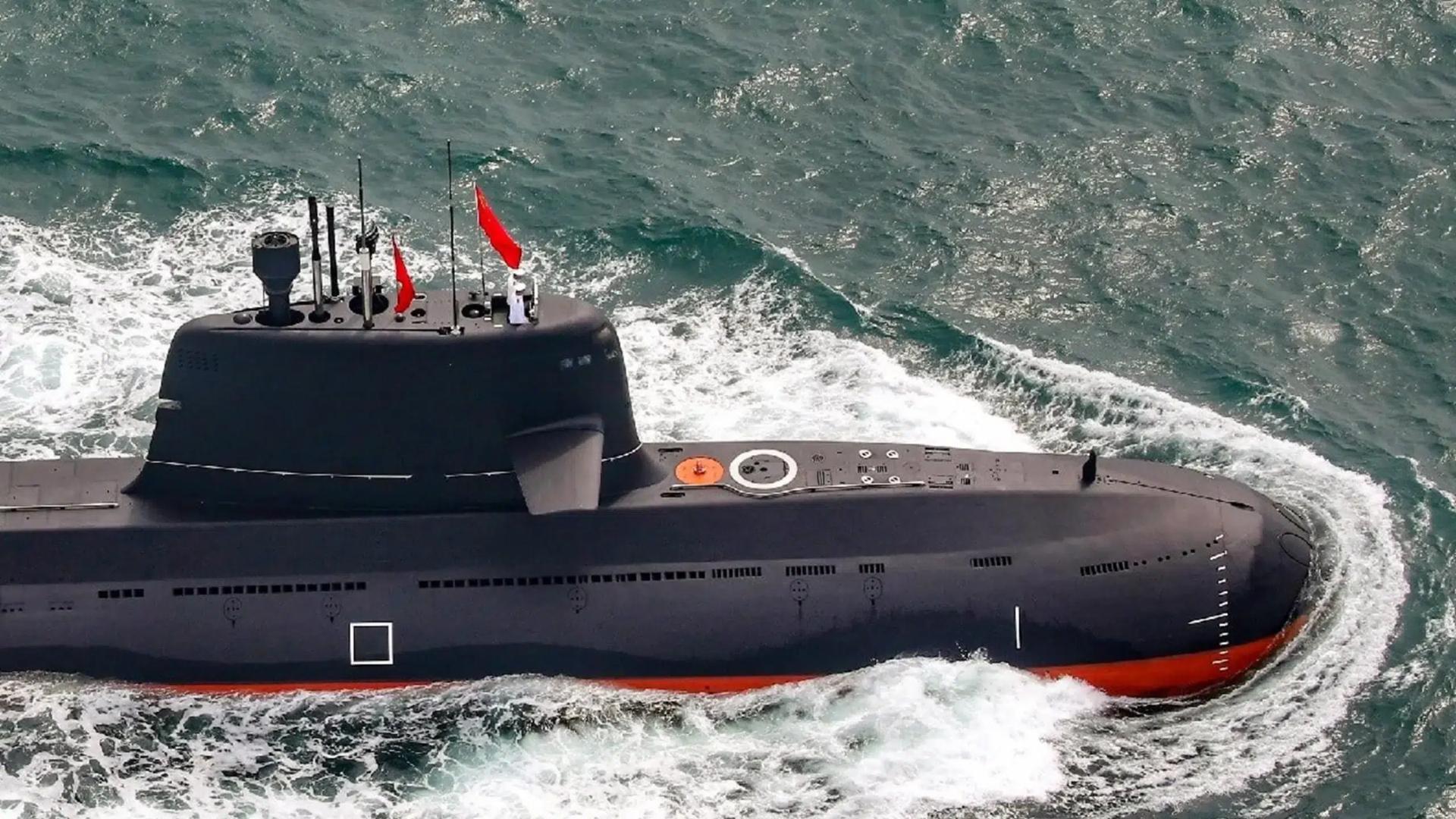
NEW DELHI: On August 15, 2025, while India marked Independence Day at home, a ceremony was staged in central China’s Wuhan. At the Wuchang Shipyard, the third Hangorclass submarine for Pakistan slid down the slipway into the water. State media called it a delivery. Commentators described it as a “big worry” for India. Officials in Islamabad spoke of a leap in deterrence. The vessel, according to celebratory reports, was equipped with air-independent propulsion (AIP), modern sensors, and cutting-edge stealth. Scratch beneath the surface, however, and the fanfare looks far less impressive.
A launch does not equal delivery. From now on, the submarine faces a long process of outfitting, trials and crew training before it can be considered combat-ready. Its propulsion system relies on Chinese engines that have never been proven in service abroad. Its export configuration will almost certainly be a downgraded version of what the People’s Liberation Army Navy (PLAN) keeps for itself. And, crucially, to reach the open waters of the Arabian Sea, the boat must leave Karachi or Ormara through shallow, noisy littorals that are already saturated with Indian anti-submarine patrols and sensors.
The Hangor is, therefore, less a story of Pakistan’s growing strength than of its deepening dependency on China. It is also a story of India’s quiet but sustained investment in capabilities designed precisely to ensure that these boats, even if they eventually become operational, will be hunted long before they pose a credible threat.
FROM CEREMONY TO COMBAT
Navies around the world hold launch ceremonies, but experienced planners know the distinction between a vessel entering the water and one joining the fleet. Sea acceptance trials, combat system integration, weapons qualification and crew work-ups can take 18 months or more. The third Hangor launched in Wuhan is still far from sailing a combat patrol under the Pakistani flag.
This is not the first time Islamabad has blurred the line. Earlier Chinese acquisitions— frigates, surveillance ships, even tanks—have been unveiled with great publicity, but their real-world readiness has taken far longer. The temptation to equate optics with operational effect is strong, but it is a temptation India’s navy does not indulge in.
PROPELLING DOUBT
Beneath the submarine’s hull lies its most serious vulnerability. The Hangor is an export derivative of China’s Yuan class, originally designed to use German MTU-396 diesels. Germany, however, blocked the sale of those engines to China and its clients. Beijing responded by offering its own CHD-620 engines. That substitution is untested in any foreign navy. Thailand’s experience illustrates the risks. Bangkok had ordered a single S26T Yuan-class derivative. When forced to accept the CHD-620, the Thai cabinet admitted a delay of more than 1,200 days to its schedule.
That extension spoke volumes about the integration challenges of using an unproven engine. Pakistan, with eight submarines on order and billions already committed, is locked into the same path. Propulsion is not a technical footnote. It is central to a submarine’s stealth. Every engine has an acoustic fingerprint. If the CHD-620 proves louder than its German counterpart, or less reliable under operational tempo, the Hangors will be easier to detect and more likely to spend time alongside waiting for repairs. In the underwater game of hide and seek, that is an unacceptable disadvantage.
THE AIP MIRAGE
Much of the media coverage surrounding the Hangor highlights its “air-independent propulsion” system. AIP does offer advantages. It allows a diesel-electric submarine to remain submerged for longer periods without surfacing to recharge batteries. In theory, that enhances survivability. But endurance should not be confused with invisibility. AIP cannot cancel the noise made by moving parts, pumps, or the hull as it cuts through water. Nor can it overcome the physics of operating in shallow seas where sonar conditions favour detection. Pakistan has not publicly detailed which AIP configuration its Hangors will carry. Reports suggest Stirling-type modules, but no specifications have been released. The result is a gap between promise and proof. For Indian planners, that gap translates into exploitable uncertainty.
GEOGRAPHY AS A CURSE
Even if the Hangors delivered everything their brochures promise, geography would still betray them. Every Pakistani submarine must exit Karachi or Ormara to reach deeper water. Those exits are constricted, noisy, and closely watched. India has prepared for precisely this challenge. On June 18, 2025, it commissioned INS Arnala, the lead ship of a new class of sixteen shallow-water ASW craft. Built with 80% indigenous content, Arnala is equipped with advanced sonars, torpedoes and ASW rockets. Its mission is simple: patrol choke points like those off Karachi and Ormara and make them lethal to hostile submarines.
A LAYERED INDIAN NET
The INS Arnala is only the newest addition to a layered net. India’s 12 Boeing P-8I Poseidon aircraft range across the Indian Ocean, deploying sonobuoys, detecting anomalies and striking with Harpoon missiles. The first squadron of MH-60R Seahawks, commissioned in March 2024, now operates with dipping sonar and torpedoes, ready to prosecute contacts quickly. Four Kamorta-class stealth corvettes, each armed with indigenous Varunastra heavyweight torpedoes and HUMSA sonars, patrol the Bay of Bengal and Arabian Sea.
Complementing these platforms are indigenous systems like the Mareech anti-torpedo decoy and the HUMSA-NG hull sonar, as well as a growing network of underwater domain awareness sensors at key gateways. This synergy gives India a detection-to-destruction chain: wide-area surveillance by P-8Is, rapid localisation by Seahawks, and final prosecution by corvettes or shallow-water craft. In such an environment, a Hangor leaving port would be under observation almost immediately.
LESSONS FROM DHAKA AND YANGON
Pakistan is not the first to receive Chinese submarines. Bangladesh did so in 2016, acquiring two refurbished Type-035G Ming-class boats for about 200 million dollars. The design dated back to the 1970s. To house them, Dhaka spent over a billion dollars on the new BNS Sheikh Hasina submarine base, inaugurated in 2023. The result has been a pair of subs used mostly for training, high in upkeep and low in operational value. Myanmar followed in 2021, receiving a Chinese Ming-class submarine to complement an ex-Indian Kilo. Again, symbolism outweighed substance. The Chinese boat was noisy, limited in endurance and used largely for coastal drills. Both examples underscore the pattern of China’s submarine exports: they deliver prestige and headlines, but fall short of combat credibility. DEPENDENCY BY DESIGN For Beijing, this outcome is not a flaw but a feature.
By locking smaller navies into Chinese spares, upgrades and technical assistance, China secures long-term influence. According to the Stockholm International Peace Research Institute, over 80% of Pakistan’s arms imports between 2020 and 2024 came from China. Submarines are just one more link in that chain. This dependence erodes strategic autonomy. If Beijing wishes to apply pressure, it can slow deliveries, withhold spares or delay upgrades. For Pakistan, that risk is particularly acute: its most expensive naval programme, the Hangor, is being built largely abroad, powered by Chinese engines, and reliant on Chinese support.
BALANCE BENEATH THE WAVES
When Pakistan’s third Hangor finally completes trials, receives its crew and embarks on its first patrol, it will enter an Arabian Sea that is no longer permissive. It will find Indian Poseidons already circling, Seahawks dipping their sonar, corvettes patrolling, and shallow-water craft guarding the exits. It will be hunted from the moment it leaves the harbour. The ceremony in Wuhan may have generated headlines. But beneath the waves, power is not measured in launches or speeches. It is measured in who can detect, track, and, if necessary, destroy. By that measure, India’s position is already secure.
Ashish Singh is an awardwinning senior journalist with over 18 years of experience in defence and strategic affairs




